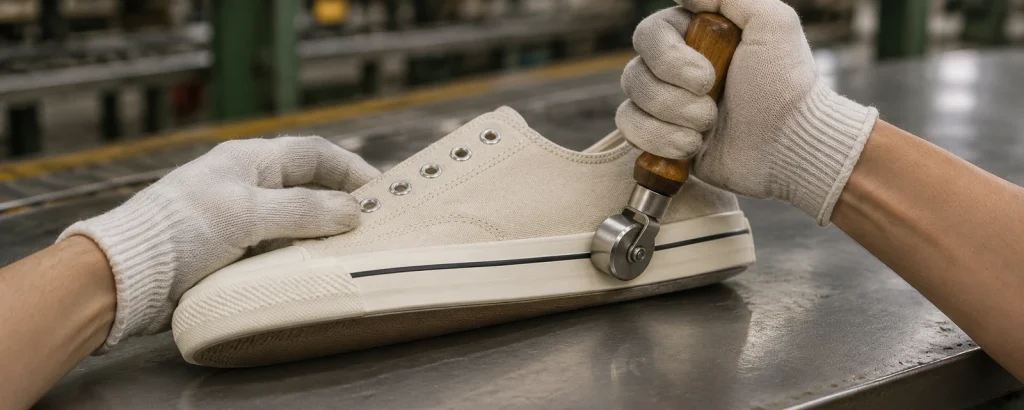
Vulcanized shoe construction is familiar from canvas sneakers and skate shoes, but its name tells you more about manufacturing than finished performance. In the traditional foxed construction covered here, rubber components are assembled with the upper before the assembled shoe undergoes its final curing stage. Understanding that sequence helps you evaluate material choices, compare other constructions, and identify what to check before approving a sample.
What Is Vulcanized Shoe Construction?
Vulcanization creates crosslinks within a rubber compound. It changes the rubber’s properties through curing; it is not simply melting rubber parts together or turning the entire shoe into one material.
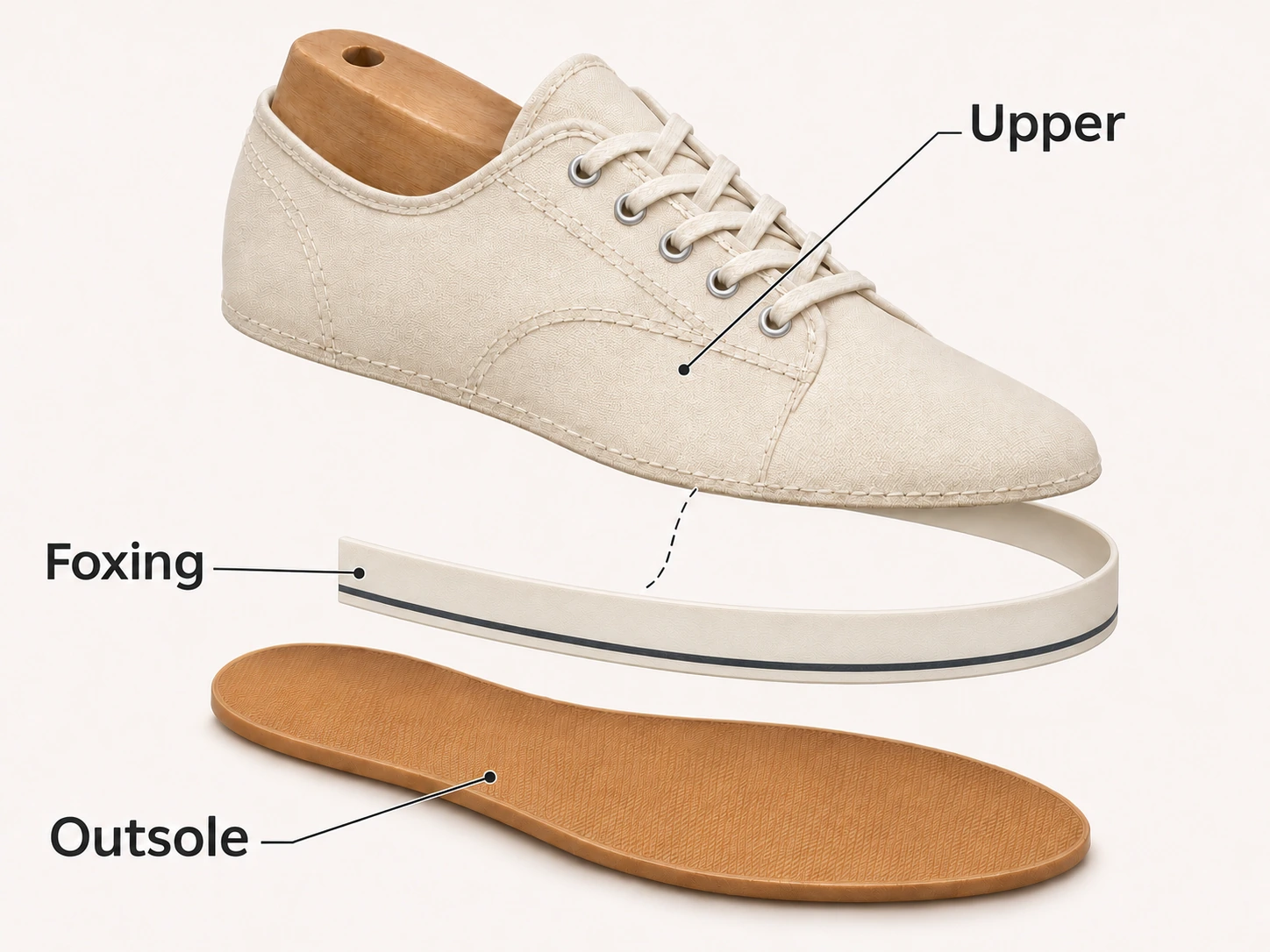
In a traditional vulcanized sneaker, the upper surrounds the foot, the outsole contacts the ground, and a rubber strip called foxing, or foxing tape, wraps around the lower edge. This strip overlaps the upper and the bottom assembly, helping connect them. The assembled shoe then passes through the curing process.
A rubber outsole alone does not establish how a shoe was built. Rubber can be cured separately and later attached to an upper by another method.
There are also different vulcanized manufacturing routes. In direct vulcanization, rubber is molded and cured against the upper in a mold. That differs from the foxed assembly described below. When discussing a design, clarify which route the manufacturer means.
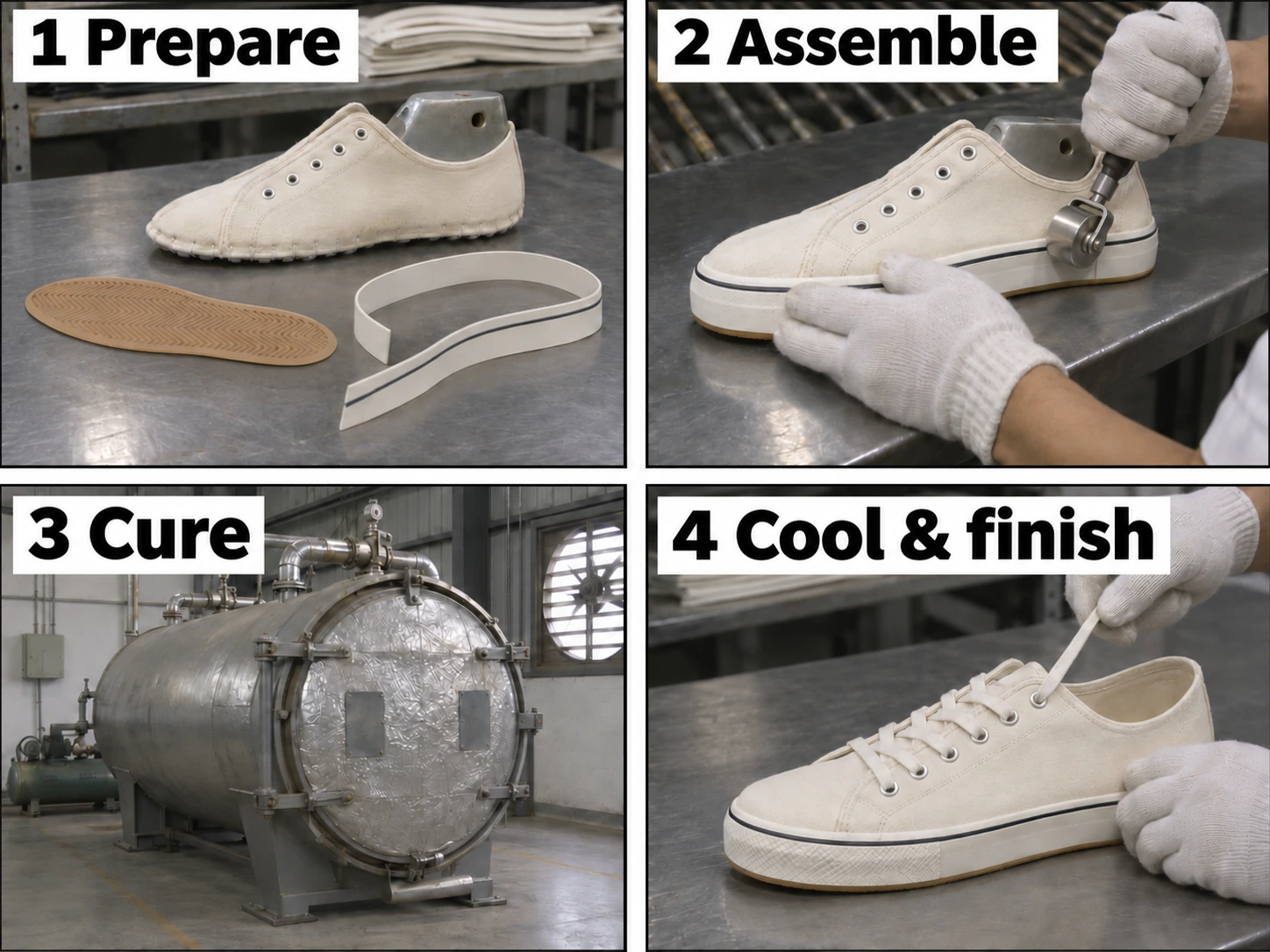
How the Vulcanized Construction Process Works
The following stages describe a typical traditional vulcanized sneaker. Individual operations depend on the design and materials.
Prepare the Upper and Rubber Components
The upper is assembled from its panels, lining, and other specified components, then shaped over a last—the form used to establish the shoe’s shape. Rubber parts for the bottom and foxing are prepared for assembly.
These parts must be compatible with the curing process. Confirm the bottom assembly and equipment planned for your design; the term “vulcanized” does not specify either.
Assemble the Sole and Apply the Foxing
The bottom components are positioned against the shaped upper. Primers and adhesives may be used to prepare and join the contacting surfaces. Vulcanized construction does not mean adhesive-free construction.
Foxing is applied around the lower edge, overlapping the upper and bottom components. Its position and joining seam need attention during assembly. Additional rubber details, such as a toe bumper, depend on the style. The assembly is checked and pressed as required before curing.
Cure the Assembled Shoe
The assembled shoe enters the curing equipment. Heat cures the rubber components after assembly. The required conditions depend on the rubber formulation, component arrangement, and production route, so a temperature or curing cycle used for one shoe may not suit another design.
Cool, Finish, and Inspect
After curing and cooling, the last is removed and finishing continues. This can include fitting the footbed and laces, cleaning, and inspection. A footbed installed at this stage has not necessarily experienced the earlier curing conditions—a useful distinction when discussing cushioning materials.
Where Vulcanized Construction Is Used
Traditional vulcanized construction appears in canvas-style casual sneakers and some skate shoes. These styles often pair a classic rubber-sided appearance with a relatively low sole profile. In skate footwear, a close-to-the-board feel can be part of the design brief.
A slim skate shoe and a more cushioned model can both use vulcanized construction. How each feels in use also depends on its underfoot materials, reinforcements, upper, and fit.
Start with the intended use. For a casual collection, appearance and everyday fit may guide development. For a skate shoe, the desired board feel and impact cushioning also need evaluation. A familiar construction does not establish suitability for every sport.
Vulcanized Construction vs. Cold Cement and Cupsoles
Cold cement and traditional vulcanized construction describe different assembly routes. This comparison focuses on how the bottom joins the upper and where heat enters the process.
| Comparison | Traditional vulcanized construction | Cold-cement construction |
|---|---|---|
| Joining route | Rubber components and foxing are assembled with the upper before the final curing stage. | A prepared sole unit is bonded to the upper assembly with adhesive. |
| Role of heat | Heat is used to cure the rubber after assembly. | Heat may be used for drying or adhesive activation; “cold” does not mean heat-free. |
| Material considerations | Components present during curing must suit those conditions, as well as the assembly process. | Surface preparation and adhesive must suit the materials being joined. |
A cupsole describes a bottom unit whose raised sides cup the lower part of the upper. It can be used in a cold-cemented shoe, so “cupsole” and “cold cement” are not competing descriptions. Its internal cushioning and supporting structure can vary.
Strobel describes another part of construction: stitching a bottom material to the lower edge of the upper. It does not, by itself, identify the later sole attachment method.
Some designs combine features associated with different constructions. Ask what the actual bottom assembly contains and how it is attached before assigning the shoe to a simple category.
Limitations and What Affects the Finished Shoe
Material Compatibility During Curing
Materials present during curing must withstand the actual treatment conditions. That assessment includes the upper assembly and its relevant layers and details, not just the visible outer fabric.
The question is broader than whether a material visibly melts. Heat can affect properties that matter in use; upper-material testing, for example, can assess changes in tensile strength.
Check which materials will be in the shoe during curing and which will be added later. A foam footbed fitted afterward needs a different compatibility assessment from foam included during curing. Neither “all synthetic materials are unsuitable” nor “any foam can be used” is a sound material-selection rule.
Cushioning, Bonding, and Flex Durability
The finished shoe’s cushioning depends on its underfoot configuration. Evaluate the actual sample rather than assuming that every vulcanized shoe feels equally firm or flexible.
Durability also involves several potential failure modes. A connection pulling apart calls for a different investigation from a crack developing within the rubber. Adhesion and flex testing address different aspects of performance.
Visible damage can help locate a problem, but it does not establish the cause. Nor can a construction name or one test result promise a fixed number of years of wear.
What to Confirm During Development
Use the sample review to connect the construction description with the shoe you intend to make:
- Intended use and route: Confirm the target activity and the manufacturing process proposed for the design.
- Materials and timing: Identify the material combinations and which components are fitted before or after curing.
- Bottom and foxing details: Review the sole configuration, foxing position, joining seam, and consistency between the two shoes.
- Fit and underfoot feel: Record specific feedback from trying the complete sample.
- Verification: Agree on appropriate checks, test methods where needed, and acceptance requirements for the intended use.
Appearance, fit feedback, and technical testing provide different information. A neatly aligned foxing strip is worth checking, but it cannot substitute for evaluating the relevant connection or the rubber’s resistance to cracking during repeated flexing.
FAQ
Can You Identify Vulcanized Construction by Appearance Alone?
Not reliably. A molded cupsole can imitate the appearance of traditional foxing; brands sometimes describe this as “faux-vulc.” Photos may show a similar profile without revealing the manufacturing route. Ask for the construction description and relevant sample details instead of treating the visible rubber sidewall as proof of vulcanization after assembly.
Are Vulcanized Shoes Always Cheaper to Make?
You cannot establish that from the construction name alone. Compare quotations for a defined design, material specification, development scope, and order quantity. A simple comparison between unrelated shoes can hide differences in components and requirements. Retail prices or tooling figures from another project are not reliable substitutes for a quotation for your own shoe.
Conclusion
Start with the appearance and underfoot feel you want, then review the assembly route, material compatibility, and complete sample. Bring your design or reference pair to the development discussion, with questions about the bottom, foxing, cushioning, and agreed test requirements. This gives you a concrete basis for deciding whether traditional vulcanized construction suits your shoe.