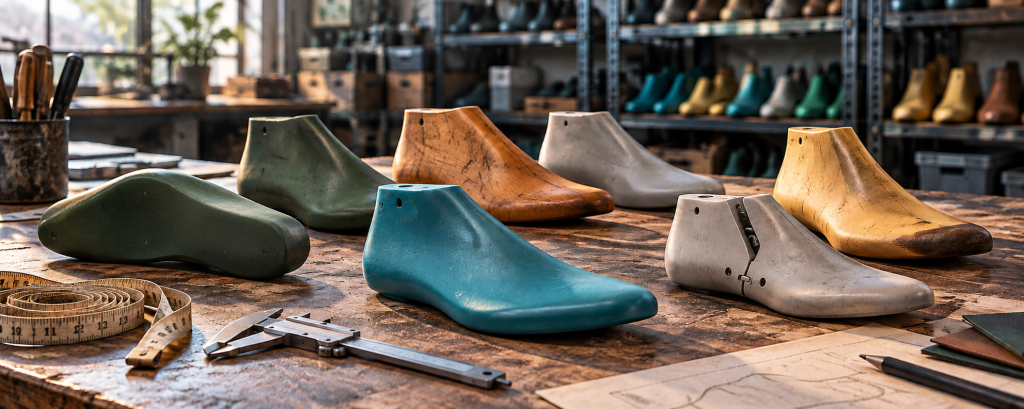
A shoe last is a three-dimensional form used to shape a shoe during manufacturing. It resembles a foot, but its contours are designed for the shoe being made. The last helps establish the shoe’s silhouette and the space around your toes, forefoot, instep, and heel.
Understanding that shape helps explain why two shoes in the same size can feel different. It also gives you a useful starting point when discussing a sneaker design or reviewing a sample.
What a Shoe Last Does
During lasting, the upper—the part of the shoe that surrounds the foot—is shaped around the last. The last supports the upper as the shoe takes form and helps maintain the intended shape during construction. It is removed as part of the manufacturing process; the exact sequence depends on how the shoe is made.
The distinction is simple: the last is the tool, and lasting is the process of shaping the upper around it.
A last is more than a copy of a bare foot. Its shape accommodates the intended shoe design, including the toe profile and the relationship with the sole. That makes it a reference for developing the upper pattern and coordinating the shoe’s components.
How a Last Influences Shape and Fit
Length, Width, and Volume
A size label cannot describe every contour inside a shoe. Length is one measurement; width describes the distance across a particular area. Girth is the circumference around that area. For example, ball girth is the circumference around the forefoot at the ball area. None of these measurements alone describes the full three-dimensional space.
This matters when you ask for a wider fit. More room across the forefoot does not automatically mean more room over the instep or a roomier heel. Specify where you want the space to change.
Toe Shape, Instep, and Heel
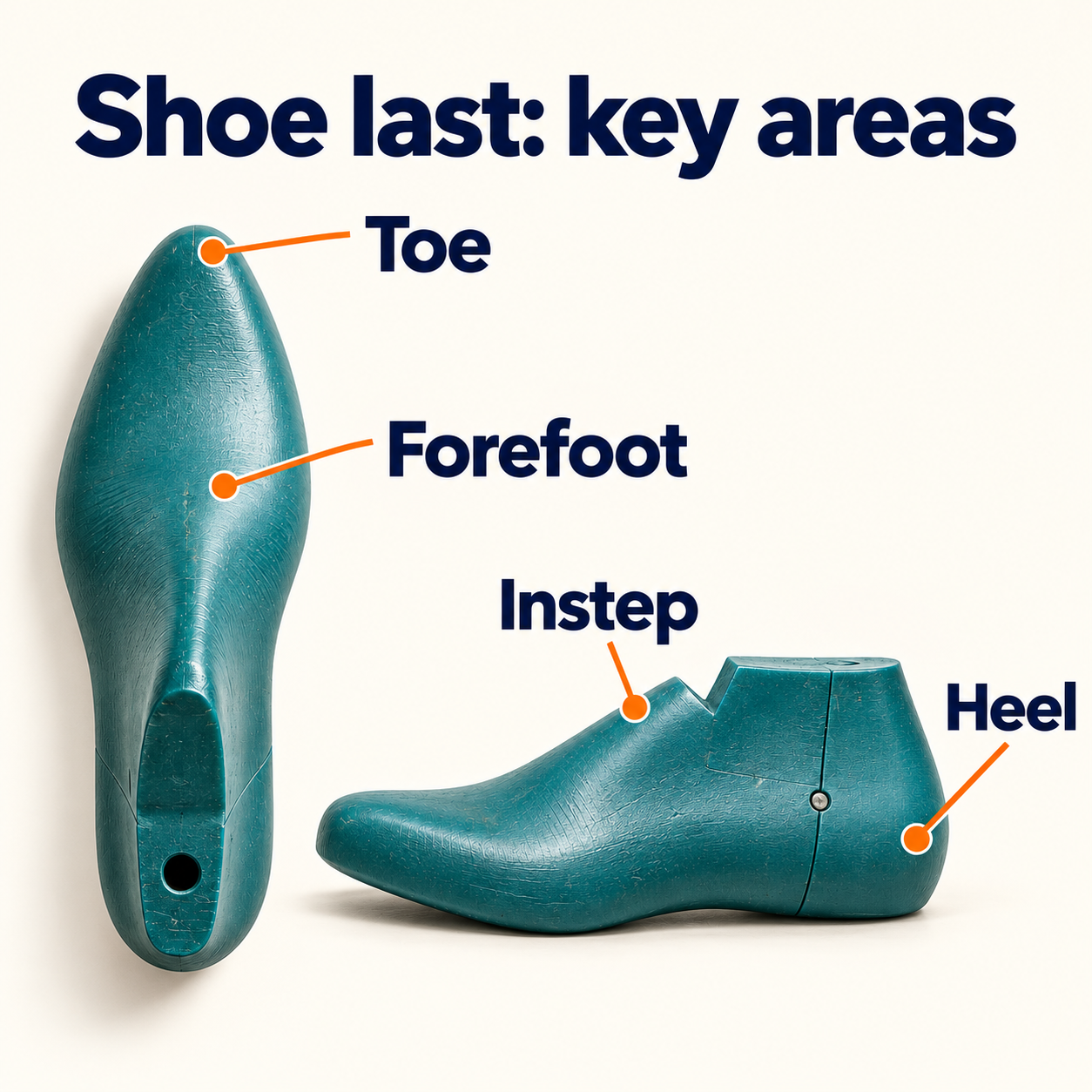
These areas give you a practical way to read a last’s shape:
| Area | What to look at |
|---|---|
| Toe | The front outline and height, which help shape the toe box. |
| Forefoot | Width and girth around the ball area. |
| Instep | The contour over the top of the foot. |
| Heel | The shape and width of the rear section. |
Appearance can be misleading. A longer-looking toe may include extra length for styling rather than useful space for your toes. Loake’s guide to its lasts, for example, distinguishes cosmetic toe length from fitting properties.
Treat these features as parts of a connected shape. A “wide toe box” description does not tell you how the entire shoe will fit, and the last’s dimensions still need to be considered alongside the finished shoe.
Shoe Last Materials and Types
Materials and Removal Features
Wood and plastic are familiar shoe last materials. Wooden lasts have a long history in shoemaking. Modern production also uses high-density plastics, with digital design and machining helping reproduce and adjust last shapes. Material alone does not tell you how accurately a last has been made.
Removal features are a separate consideration. Some lasts have a hinge to help with removal from the shoe. Others use a solid, one-piece construction. The appropriate arrangement depends on the footwear and the manufacturing process.
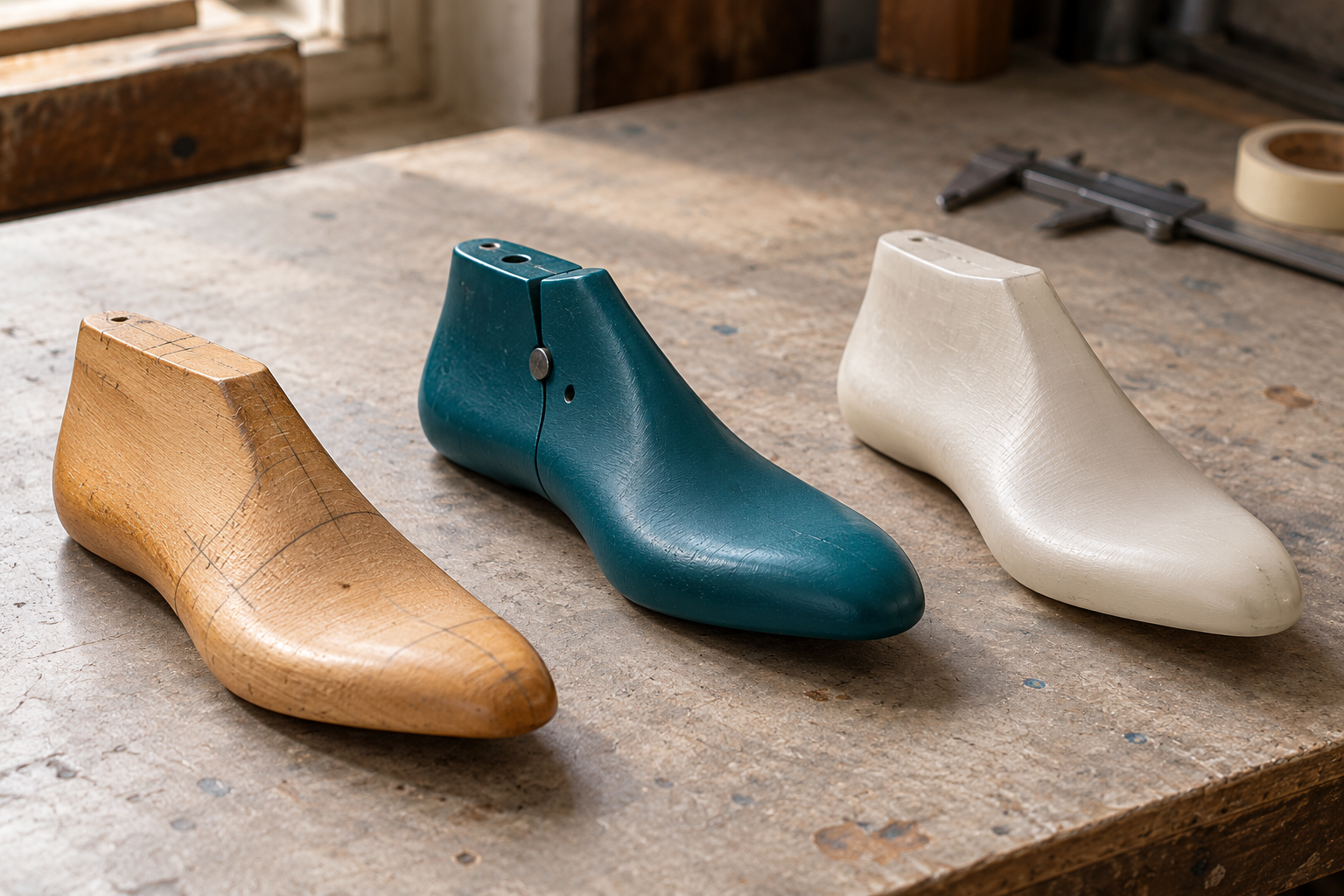
When comparing types of shoe lasts, keep the descriptions separate: material describes what the tool is made from, geometry describes its shape, and the removal mechanism describes how it comes out.
Straight, Curved, and Semi-Curved Shapes
These terms describe how straight or inward-curving the last’s shape is when viewed from underneath. They are different from toe spring, which describes the elevation of the front tip above the ground in side view.
Neither the curve of the last nor its toe spring can tell you, on its own, whether a finished shoe will suit a particular foot. Assess the complete sample as well.
The Last, Upper, and Sole Work Together
Shoes made on the same last can feel different when their materials or construction change. A flexible upper, a firmer reinforcement, a different lining, or a change in fastening can affect how the shoe accommodates and holds the foot. The sockliner—the insert under your foot—also takes up space, so changing its thickness can change the room available inside the shoe. SATRA’s guidance distinguishes assessment of the last from assessment of fit in the finished shoe.
The components also need to work together geometrically. The upper pattern must suit the last, while the last’s bottom shape needs to be considered with the sole design.
Suppose you want more room across the forefoot of a sneaker sample. That request should prompt a review of the last, upper pattern, materials, and available sole shape. An existing sole may or may not accommodate the proposed change; that needs to be checked for the project.
A useful sample review therefore asks two questions: does the shoe have the intended shape, and does the finished construction provide the intended fit? Last measurements help with that discussion, but they cannot replace evaluating the sample.
What to Discuss for a Sneaker Project
You do not need to arrive with a complete last specification to explain your goal. Start with information that makes the design and fit requirements clear:
- Reference and intended use: show the silhouette you want and explain which features of a reference shoe you want to retain or change.
- Size range: identify the sizes planned for the style and the size of any reference or sample.
- Construction: share the intended upper materials and sole option, if already selected.
- Sample feedback: identify the sample version, the exact area of concern, and the conditions in which you noticed it.
For example, “the sample in this size feels tight at the sides of my forefoot when I wear the intended socks” gives a clearer starting point than “make it bigger.” It identifies the concern without assuming which component needs changing.
Also discuss how the design will extend across the size range. Grading—the development of related sizes—requires coordinated changes to last dimensions and patterns. It is not simply a matter of adding length or enlarging every feature by the same percentage. A sample in one size cannot establish fit across the whole range.
FAQ
Is a shoe last the same as a shoe tree?
No. A shoe last is a manufacturing tool used to shape the shoe. A shoe tree is inserted into finished footwear to help maintain its shape between wears. They can look similar, but their jobs are different. A shoe tree is not a substitute for the last used to develop the shoe.
Do all shoes from one brand use the same last?
Not necessarily. A brand can use several last shapes, and one last can also be used for multiple styles. Loake’s published last guide shows both arrangements. Check the specific model’s information when it is available; the brand name alone does not identify the last behind a shoe.
Conclusion
A shoe last helps define a shoe’s shape and internal space. The upper, sole, and construction also affect how it fits. If you are developing a sneaker with HEVA, bring your reference shoe, planned size range, and specific fit feedback into the discussion so the team can review the project requirements with you.