
A factory quote gives you a starting point for a shoe order, but it does not settle the U.S. duty bill. Before you approve an import budget, confirm the shoes’ classification, origin, and customs value, along with the rules that apply at entry.
Footwear tariffs are easier to check when you separate those questions. This guide explains the parts of a duty estimate, where to verify them, and what to record so you can revisit the estimate when the product or shipment changes.
What Determines Your Footwear Duty Rate?
There is no single U.S. duty rate for all shoes. Start with the actual product: its upper and outsole materials, construction, and any other details required by the relevant tariff provision. A commercial description such as “running shoe” does not establish a complete classification.
The U.S. Harmonized Tariff Schedule (HTS) assigns ordinary duty rates at the eight-digit level. Two further digits complete the ten-digit statistical reporting number used for entry. A supplier’s export-country code may differ in its national digits, so confirm that the number you are reviewing belongs to the U.S. schedule.
Origin and the applicable date also matter. They help determine which treatment and additional measures need checking.
Keep the duty rate separate from the duty amount. A larger order can produce a larger bill without changing the percentage rate. Customs value and quantity determine the calculation; value ranges within a particular tariff provision may also affect which rate line applies. Check the relevant size or wearer distinctions rather than assuming one style name settles the whole order.
Understand the Parts of a Footwear Duty Estimate
The ordinary rate and any special treatment
Read the rate column that applies to your goods. Column 1–General contains the ordinary rates for goods eligible for normal trade relations treatment. Column 1–Special lists qualifying preferential rates, while Column 2 applies to goods from the countries specified in HTS General Note 3(b). Do not select a rate simply because it is the lowest number on the row.
A special rate depends on the applicable program’s conditions and the required claim. Seeing “Free” in that column does not establish eligibility, or show that no other duties or charges apply. Ask what qualifies the shipment for the treatment being used.
Additional duties and exclusions
The ordinary rate may be only part of the duty calculation. Check any additional measures that cover the product and its origin, including relevant Chapter 99 provisions.
An exclusion needs its own review. Match the product description and applicable tariff number, then verify the effective period. An announcement extending exclusions does not mean every shoe from that country is exempt.
For China-related Section 301 measures, for example, use the relevant U.S. Trade Representative (USTR) notices and U.S. Customs and Border Protection (CBP) implementation guidance alongside the HTS. Do not assume that relief from one measure removes another.
Customs value and the form of the rate
Customs value is not necessarily the total on a factory quote. Where transaction value applies, specified additions may be required if they are not already included in the price actually paid or payable. These can include qualifying packing costs, selling commissions, assists, and certain royalties.
An assist can include a mold you supply for production. Its treatment and allocation depend on the facts; avoid adding every tooling charge automatically or counting an amount twice. Freight also needs careful review. A charge labeled “shipping” is not enough information to decide its valuation treatment.
Next, read how the rate is expressed. Footwear provisions can use a percentage of value or a compound rate combining a percentage with an amount per pair. For a provision using that compound form:
Apply this calculation separately to each group of shoes subject to the same rate.
Ordinary duty = (V × r) + (Q × s)
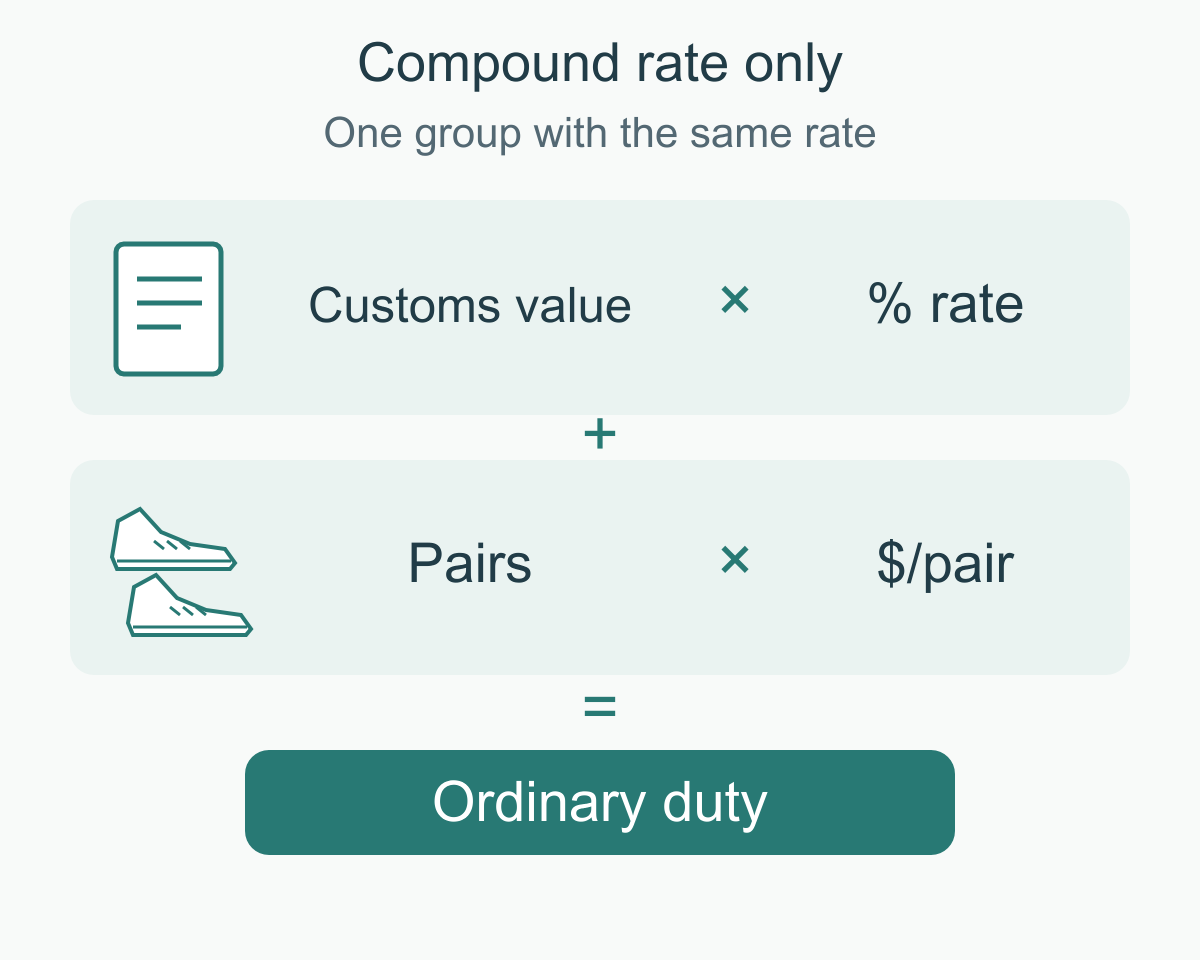
V = the customs value, in U.S. dollars, of the shoes covered by that rate.
r = the applicable percentage expressed as a decimal.
Q = the number of pairs covered by that rate.
s = the applicable dollar amount per pair.
Use this formula only when the applicable provision combines a percentage with an amount per pair, and enter the rates you have verified for your shoes. Calculate additional measures according to their own provisions rather than assuming they apply to the ordinary-duty amount.
Finally, separate duties from other budget items, such as applicable customs fees, brokerage, freight, and destination delivery. A duty estimate is one component of landed cost.
How to Check the Current Rates
Use a sequence that another person can follow. If you work with a customs broker, provide the underlying product and transaction facts rather than asking for a percentage based only on the country and shoe name.
The table below organizes the check. The record column is a practical working checklist, not a statement that every item must be filed in that format.
| Step | What to check | What to record |
|---|---|---|
| 1. Identify the shoes | Match the shipment to its specifications, materials, construction, relevant sizes, origin information, value, and quantity. | Style and specification version; supporting product facts; missing information. |
| 2. Verify the HTS provision | Use the current U.S. HTS. Read the complete description, parent provisions, and relevant notes. | Full reporting number; classification basis; HTS edition or revision. |
| 3. Confirm the ordinary treatment | Identify the applicable rate column and any conditions for special treatment. | Rate and its units; program and eligibility basis, if claimed. |
| 4. Check additional measures | Review relevant Chapter 99 provisions, product exclusions, and USTR or CBP guidance. | Additional provisions; product-description match; effective dates and exclusions. |
| 5. Review the estimate | Confirm the relevant entry timing, customs value, quantity, and calculation with the person handling the entry. | Assumptions; source links; date checked; unresolved questions. |
Start at the current schedule
Start with the U.S. International Trade Commission’s (USITC) HTS website. Check the edition or revision before relying on a saved page. A search result can lead you to a provision, but the result alone does not establish that it covers your shoes.
Read “Other” descriptions within their parent categories. Follow relevant notes and cross-references to the underlying provisions. A helpful footnote or reference table is a navigation aid, not a substitute for the legal text.
If a previous CBP ruling helps explain the classification, compare its product facts carefully with your own. Then check the applicable schedule and measures for the shipment you are planning. An old ruling’s duty statement is not a current quote.
Check the dates attached to each measure
Record when a measure starts or ends and which event determines its application. Under the general rule, the applicable duty rate is the rate in effect at the legally defined time of entry, with exceptions such as certain warehouse withdrawals and special provisions.
The day you place the order, the sailing date, and the arrival date are therefore not interchangeable. If a measure includes an in-transit exception, check its actual conditions rather than assuming that anything already shipped qualifies.
Save a short explanation of the result
Someone reviewing the estimate should be able to see why you used each rate. Keep the classification, origin basis, valuation assumptions, relevant provisions, and calculation together.
Where something remains unresolved, name it. “Awaiting confirmation of outsole material” is more useful than presenting an estimate as final while the classification input is incomplete. Retain the underlying information as well as the finished total so a later change can be traced.
The HTS is central to this work, but its search interface is not a complete list of every possible trade remedy. If the product or origin raises a question about other measures, have that issue checked separately. This does not mean such measures apply to footwear generally.
When to Recheck Your Estimate
Revisit the affected parts of the estimate when the facts change. A different upper construction may require a classification review. A change in manufacturing arrangements may require a fresh origin check. Revised prices or production inputs may affect the valuation analysis even when the ordinary rate stays the same.
Also review the estimate when the expected entry timing changes, a measure is amended, or an exclusion approaches its end date. A change calls for a check; it does not necessarily mean the duty rate will rise.
Keep a dated version of the estimate and identify the product version it covers. Before the shipment proceeds, resolve outstanding questions with the person preparing the entry. Before using an early development-stage estimate for the shipment, check that it still matches the finished shoes and the applicable rules.
FAQ
Do free shoe samples have a zero customs value?
No. Receiving a sample without paying a price does not automatically establish a zero customs value. If transaction value cannot be used, customs valuation follows the applicable alternative methods.
Provide accurate information about the sample and how it was supplied. Any special sample treatment has separate conditions to check. Calling the shoes “samples” on the paperwork does not, by itself, establish duty-free treatment or justify an arbitrary declared value.
Does shipping shoes through another country change their origin?
A different shipping route alone does not establish a different origin. You need to identify where the relevant production took place and whether any further processing meets the applicable origin rules.
Be clear about the purpose of the origin determination. Marking rules, preferential-treatment rules, and the requirements of a particular additional duty measure should not be treated as interchangeable. Give the person reviewing origin the manufacturing facts, not just the port from which the shoes depart.
Are low-value footwear shipments automatically duty-free?
No. As of November 18, 2026, you should not budget an ordinary commercial footwear shipment on the old assumption that a value of $800 or less automatically provides de minimis duty-free treatment. CBP has implemented suspension rules covering postal and non-postal shipments.
Entry procedures and duty exemptions are separate questions. Check the rules for the shipment’s route and circumstances, including any applicable exception. A small order or a simpler entry process does not, by itself, establish that no duty is due.
Conclusion
A useful footwear duty estimate connects the actual shoes with the applicable classification, origin, valuation, and timing. Read the ordinary rate correctly, check additional measures, and keep the assumptions and sources behind the result. Revisit the estimate when those inputs change.
For an athletic footwear development project with HEVA, bring your upper, outsole, and construction requirements into the discussion early. Clear specifications help you provide the product information needed for a separate customs review before the order is ready to ship.