Before your shoe order leaves the factory, confirm who will handle the U.S. import and what information they need. A finished sample and a freight quote do not settle the product’s classification, marking requirements, or customs value.
Importing shoes to the USA starts with those details. The steps below explain how to prepare a commercial footwear order, organize its documents, and coordinate the shipment through customs release. The exact requirements depend on the shoes, their origin, and how they travel.
Before You Ship: Confirm Who Handles the Import
Start by confirming the importer of record—the party responsible for the customs entry—and the people handling transportation and customs work. Agree on the arrangements before booking freight.
You generally do not need a general import license to bring goods into the United States. Check whether your shoes require any product-specific permit or certification.
Before your first formal entry, have your broker confirm the importer identification and CBP Form 5106 setup. A CBP-assigned number may be available if you have neither an EIN nor a Social Security number.
For a typical order, you can divide the preparation this way:
- Ask the factory for accurate shoe specifications, commercial details, and packing information.
- Have your freight forwarder or carrier confirm the route, transport documents, and shipping deadlines.
- Confirm who will make the customs entry. If you use a licensed customs broker, agree on the authorization, information, and payment arrangements.
Hiring a broker does not remove your responsibilities. For example, if you give a broker money to pay duties and the broker never pays CBP, you still owe those duties.
Keep a named contact for questions about materials, invoices, and shipment changes. If the order travels by ocean, flag the advance Importer Security Filing (ISF) requirements early; some information is due before loading overseas.
Gather the Shoe Details Needed for HTS Classification
Your shoe’s Harmonized Tariff Schedule (HTS) classification helps determine the applicable duty treatment. “Sneakers” describes a product commercially, but it does not provide enough information to establish its full classification.
Prepare a style-specific record rather than using one description for every shoe in the order. It should identify the manufacturer’s style, your corresponding stock or style number, the intended wearer and use, and the relevant value information.
Then confirm the construction details needed for that particular shoe, including:
- The materials forming the upper and their external surface areas, with the applicable treatment of accessories and reinforcements.
- The outer sole materials and relevant surface-area information.
- Whether the shoe covers the ankle and which construction or fastening features apply.
- Any features relevant to a special footwear category, rather than relying on a marketing claim.
Pay attention to how a material percentage was calculated. An upper’s external surface-area breakdown is different from the percentage of the whole shoe’s weight. A general material list does not answer that question by itself.
Likewise, everyday terms such as “sports shoes” do not automatically establish a particular tariff category. Give the person checking classification the actual construction facts.
Review this record when the approved design changes. Replacing upper panels or changing the outsole may require a fresh check of the classification information. A code used for a similar-looking style is a starting point for review, not confirmation that it fits your order.
Prepare Your Import Documents
Organize the documents by the information they provide. This makes it easier to see who needs to supply a missing detail and whether the paperwork describes the order that will actually ship.
| Document or information | What it supports | Who to coordinate with |
|---|---|---|
| Commercial invoice | The transaction, product description, quantities, prices, currency, origin, and relevant charges. | Obtain it from the seller and review the details with your broker. |
| Packing information / packing list, as applicable | How styles and quantities are distributed among packages. | Have the factory confirm the final carton breakdown. |
| Bill of lading or air waybill, as applicable | Identification of the shipment and its transport arrangements. | Check the carrier or forwarder’s details against the shipment. |
| Footwear information / IFI | The material and construction facts needed to check classification. | Have the factory confirm the facts; agree on the format with your broker. |
| Applicable entry and bond information | The filing procedure and customs bond arrangements. | Confirm requirements and authorization with the party handling entry. |
How an interim footwear invoice fits in
An interim footwear invoice (IFI) is commonly used to collect the detailed information needed for footwear classification. It supplements the commercial information about the transaction; it does not replace an accurate commercial invoice.
The footwear provisions in 19 CFR 141.89 allow the additional information to be supplied by the exporter, manufacturer, or shipper on CBP Form 5523 or in another appropriate format. Required information and a particular worksheet are therefore separate issues.
If your broker sends an IFI, have the factory confirm the construction answers against the actual style. Do not guess a material percentage or select a category simply because the wording resembles the product name. Agree on an acceptable format with the person preparing the entry.
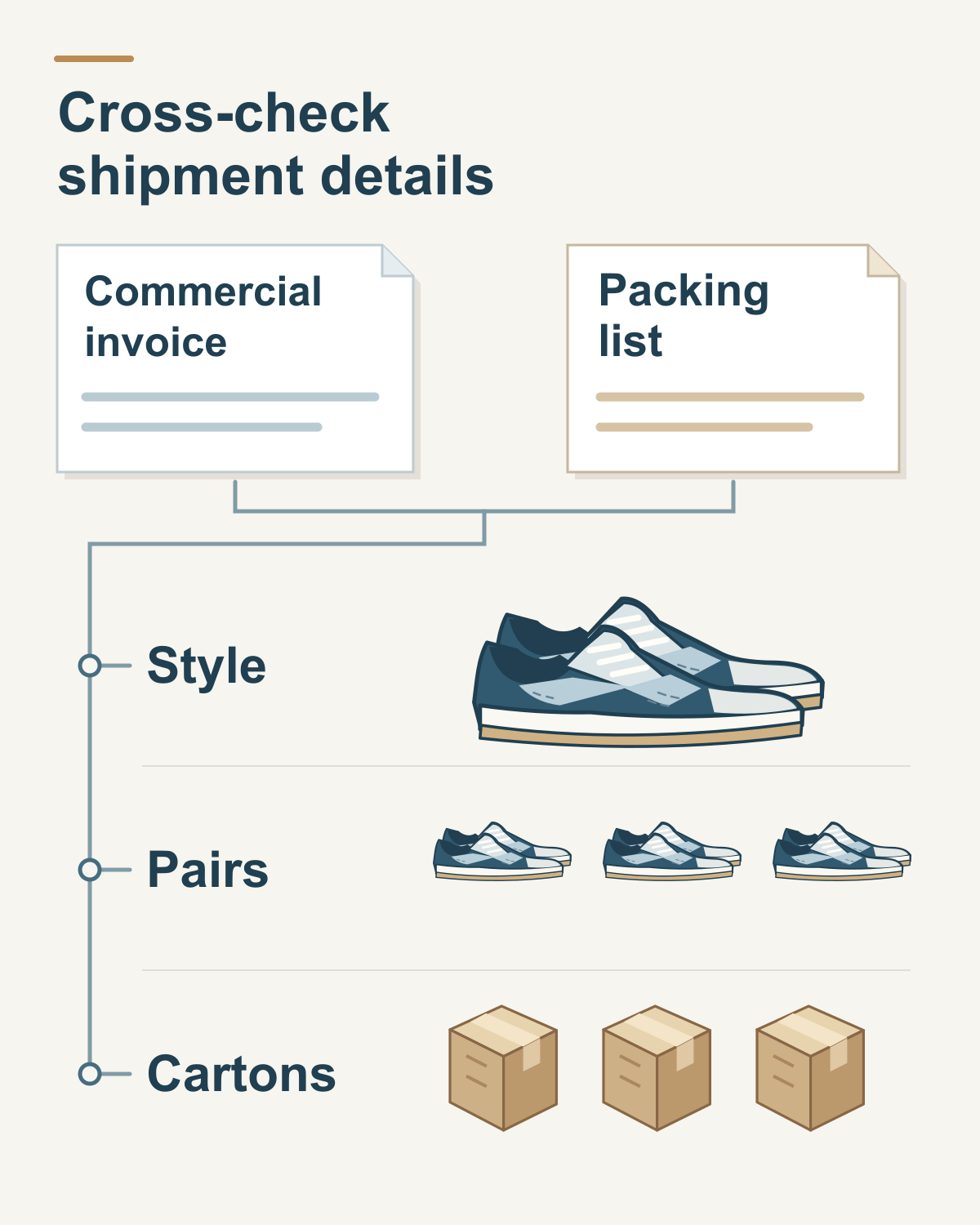
Before sending the documents, cross-check the style references, quantities in pairs, carton counts, values, currency, and origin information. The commercial invoice must be in English or accompanied by an accurate English translation. Different parties may legitimately appear as seller, manufacturer, consignee, or importer; check that each role is recorded correctly rather than forcing every name to match.
Entry documents may be electronic, and an entry summary can serve as the entry in the applicable circumstances. Avoid treating every customs form name as an additional paper document required for every shipment.
Check Marking and Product-Specific Requirements
Country-of-origin marking
Check the marking plan before printing packaging or finishing the order. Unless an exception applies, imported articles must identify their country of origin in English, with marking that meets the applicable visibility, legibility, and permanence requirements.
Confirm whether the proposed marking on the shoes and their packaging satisfies the rules for your shipment. A country name printed on a shoebox does not automatically establish that marking the box alone is sufficient. Nor is there one label location or attachment method that suits every shoe.
Keep origin marking separate from other labeling questions. For example, footwear is excluded from the definition of textile wearing apparel in the FTC Care Labeling Rule. That does not exempt shoes from every other federal or state requirement.
If your order includes children’s shoes
For shoes intended primarily for children age 12 or younger, identify the applicable children’s product safety rules. Then confirm what testing is required or the basis for any applicable exemption. Material and component differences matter; do not assume every style needs an identical test package.
Also plan the required tracking marks on your children’s shoes and packaging, to the extent practicable. They need to make the responsible company, production date and location, and batch or similar source information traceable.
Where a Children’s Product Certificate (CPC) is required for imported products, the importer is responsible for issuing it. Where third-party testing is required, base the CPC on results from a CPSC-accepted laboratory. A factory-supplied report is supporting evidence, not the CPC itself. Match the certificate and its supporting records to the products they cover.
CPSC implemented certificate-data eFiling for most regulated imports on July 8, 2026. Confirm the applicable submission arrangements before shipping. The change concerns how existing compliance information is transmitted; it does not create a new testing obligation for all shoes. Separate implementation timing applies to certain Foreign Trade Zone entries.
Estimate Duties and Total Landed Cost
There is no single import duty rate for shoes. To check the applicable treatment, use the full classification, country of origin, customs value, and relevant entry date. Account for any additional measures that apply.
Separate the customs valuation question from your overall budget. Under transaction-value rules, specified additions may be required. For example, molds you provide to the factory free of charge may constitute an assist whose value needs to be apportioned. International freight and insurance have their own valuation treatment; do not simply add or deduct every charge labeled “shipping.”
Ask for a cost breakdown that covers:
- The shoes and any separately charged production or packing items.
- International transportation and insurance.
- Applicable duties, taxes, and customs fees.
- Brokerage and the actual cost of any required customs bond.
- Destination handling, delivery, and other quoted services.
Check what each quote already includes so you do not count the same charge twice. A bond’s coverage amount is also different from the premium or service charge you pay for it.
Low value does not automatically mean duty-free. As of October 2026, you should not budget an ordinary commercial shipment on the old assumption that goods under $800 qualify automatically for de minimis duty-free treatment. The $2,500 threshold associated with certain informal entries is a separate procedural issue, with exceptions.
Before approving the shipping budget, ask which classification, origin, valuation assumptions, and entry date the duty estimate uses. Recheck it if those facts change.
From Shipment to Customs Release
Before loading
For ordinary commercial ocean shipments subject to ISF, arrange the filing before the shoes leave the foreign port. Generally, eight information elements are due at least 24 hours before loading onto the vessel bound for the United States.
The container stuffing location and consolidator information have different timing rules: submit them as early as possible, no later than 24 hours before arrival, or by loading for a voyage shorter than 24 hours. Agree on your filing agent’s earlier working deadlines and update changed information as required. These ocean ISF rules do not apply to air shipments.
At entry
Have the party handling entry confirm the appropriate entry procedure and bond arrangements. Some shipments valued at $2,500 or less may qualify for informal entry, subject to exceptions; CBP can still require formal entry. Bond requirements and any waiver depend on the applicable conditions.
Send the final shipment documents and keep someone available to answer questions about construction, value, or marking. If information changes after the initial handoff, send the correction to the person handling the filing. Complete paperwork helps resolve questions, but it does not guarantee a particular release date.
After release
Coordinate pickup and delivery, and confirm any outstanding filing or payment steps with your broker. An entry summary may be filed at entry; where the later-filing rule applies, it is generally due within 10 working days after the time of entry, not a universal period measured from release. Release also differs from liquidation, which is the final computation or determination of duties.
Keep your required customs records accessible; the general retention period is five years from entry or the activity that required the record, with exceptions for particular records.
FAQ
Can a non-U.S. company import shoes into the United States?
A nonresident corporation can enter merchandise for consumption if it meets the applicable conditions. These include a qualifying resident agent authorized to accept service of process and the required bond backed by a resident corporate surety. The agent’s location must meet the rules for the port or applicable remote filing arrangement.
Before shipping, have your broker confirm the company’s eligibility and setup. A U.S. warehouse or delivery address alone does not establish that those conditions are met. These provisions concern nonresident corporations; other entities need their own eligibility check.
Conclusion
Before you book the shipment, resolve the missing shoe specifications, import responsibilities, document details, and cost assumptions. That gives everyone involved a clearer basis for preparing the entry and handling questions.
For an OEM/ODM athletic shoe project, you can discuss materials, construction, specifications, and order requirements with HEVA. Bring the product details your customs professional needs into that conversation early, while there is still time to confirm the design and shipping information.