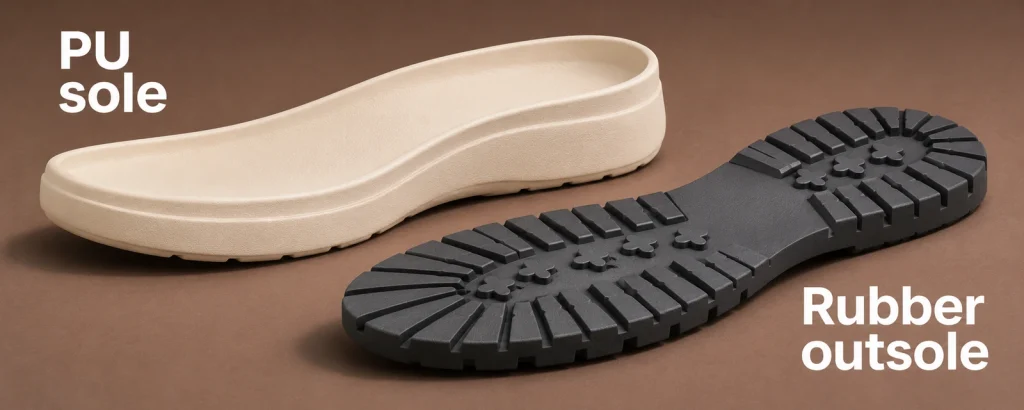
A foamed PU sole is worth considering when you want a light, cushioned shoe. A rubber outsole is worth comparing when ground contact, grip, and wear are priorities, provided its performance matches your intended surfaces. A PU midsole with a rubber outsole lets you address cushioning and ground contact separately.
The choice becomes clearer once you know which part of the shoe you are comparing. “PU sole” and “rubber sole” can describe different constructions, and neither label tells you everything about comfort or durability. For everyday walking and casual shoes, compare the actual sole design as well as the material.
What Are You Comparing: A Sole or an Outsole?
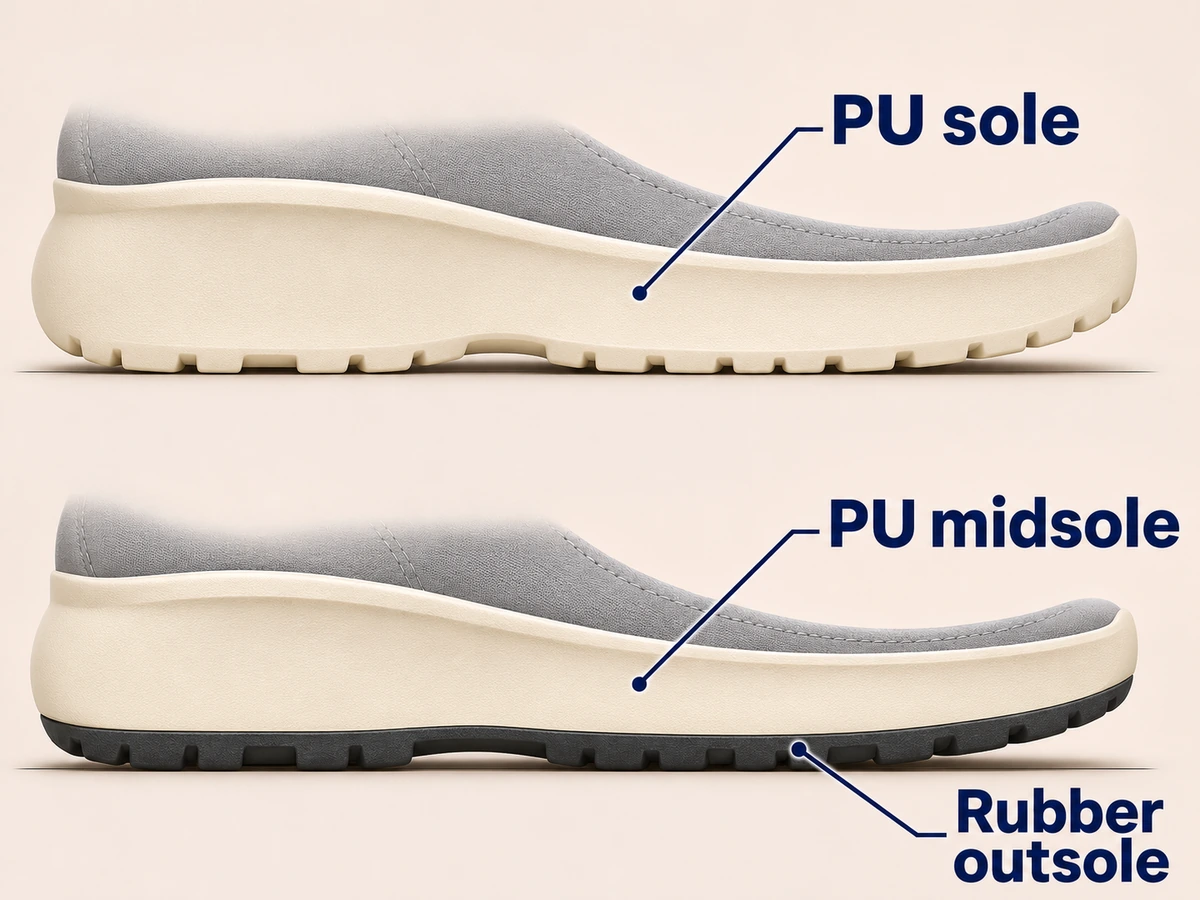
The sole is the bottom assembly of a shoe. Within that assembly, the outsole contacts the ground, while a midsole, when present, sits above it and can provide cushioning. A footbed sits under your foot inside the shoe; it is not the outsole.
PU, short for polyurethane, can be used in different parts of this assembly. One shoe may have a PU sole that contacts the ground. Another may have a PU midsole covered by a rubber outsole. Calling the second shoe a “rubber sole shoe” leaves out the material doing much of the cushioning.
PU also describes a family of materials. This comparison mainly concerns common reaction-molded PU sole systems, including foamed constructions. Thermoplastic polyurethane, or TPU, belongs to the broader polyurethane family but includes grades and forms with different properties and processing requirements. Do not assume that every PU component behaves like the same foam.
Before comparing two options, identify the material in each layer and find out whether you are comparing outsoles, complete sole units, or finished shoes.
PU vs. Rubber: The Differences That Matter
Use the table to organize your comparison. A PU sole unit and a rubber outsole attached to a separate midsole are different constructions, so these are design considerations rather than universal material rankings.
| Factor | PU sole option | Rubber outsole option | What to compare |
|---|---|---|---|
| Comfort and flexibility | Foam and sole geometry can contribute cushioning. | The outsole works with the cushioning layers above it. | Fit, thickness, bending feel, and comfort during wear. |
| Weight | Density and the amount of material affect weight. | Thickness and ground coverage affect its contribution. | Actual weights at the same reference size. |
| Grip | Check the specific ground-contact formulation and tread. | Check the specific compound and tread. | Performance on relevant surfaces in relevant conditions. |
| Wear and flexing | Assess abrasion and resistance to repeated bending. | Assess abrasion and resistance to repeated bending. | Results for the proposed material and construction. |
| Cost | Include the sole system, tooling, and production route. | Include the outsole, other layers, tooling, and assembly. | Quotes covering the same requirements and quantities. |
Comfort and Flexibility
A softer sole does not automatically make a more comfortable shoe. Thickness, bending behavior, and fit affect how the shoe feels underfoot. A soft, thin component can feel very different from a thicker one, even if both have similar hardness readings.
Try the complete shoe under its intended wearing conditions. Pressing the sole with your thumb cannot tell you how the whole construction will feel during a walk. If you compare hardness figures, check the test scale and conditions; numbers from different scales are not directly interchangeable.
Weight
Foamed PU offers a way to develop a lightweight sole, but a material name cannot establish which finished shoe is lighter. Weight depends on density and the volume used. A thick sole unit and a thin outsole are not equivalent objects.
Compare the same reference size and record thickness, coverage, and any other layers. If the samples have different constructions, the weight difference reflects more than the material choice.
Grip on Your Usual Surfaces
For grip, ask where and under what conditions the sole was evaluated. Compound, tread, surface texture, and water or other contaminants all matter. A result on a dry floor does not establish performance on wet tile.
Rubber alone is not a slip-resistance guarantee, and PU alone is not a reason to reject an outsole. Look for evidence relevant to the proposed compound and tread. Also distinguish oil resistance, which concerns the material’s response to oil, from grip on an oily surface.
Abrasion and Repeated Flexing
Abrasion is material loss caused by contact with surfaces. Flex resistance describes how well a sole withstands repeated bending without damage. Both matter, but neither alone establishes the life of a shoe.
For a layered construction, the connections between components need attention too. A sole may retain its tread while another part of the assembly develops a problem. Compare the performance that matters to your design instead of reducing durability to a single material label.
Cost Beyond the Material Name
A useful price comparison starts with what each quote includes. Is it an outsole, a complete bottom assembly, or a finished shoe? Are you using an existing sole design or requiring new tooling?
Compare material specifications, components, production steps, order quantities, and acceptance requirements together. Without that shared scope, “PU is cheaper” or “rubber costs more” may simply reflect different products or processes. A retail shoe price is not evidence of its sole manufacturing cost.
Sole Wear and PU Aging Are Different Questions
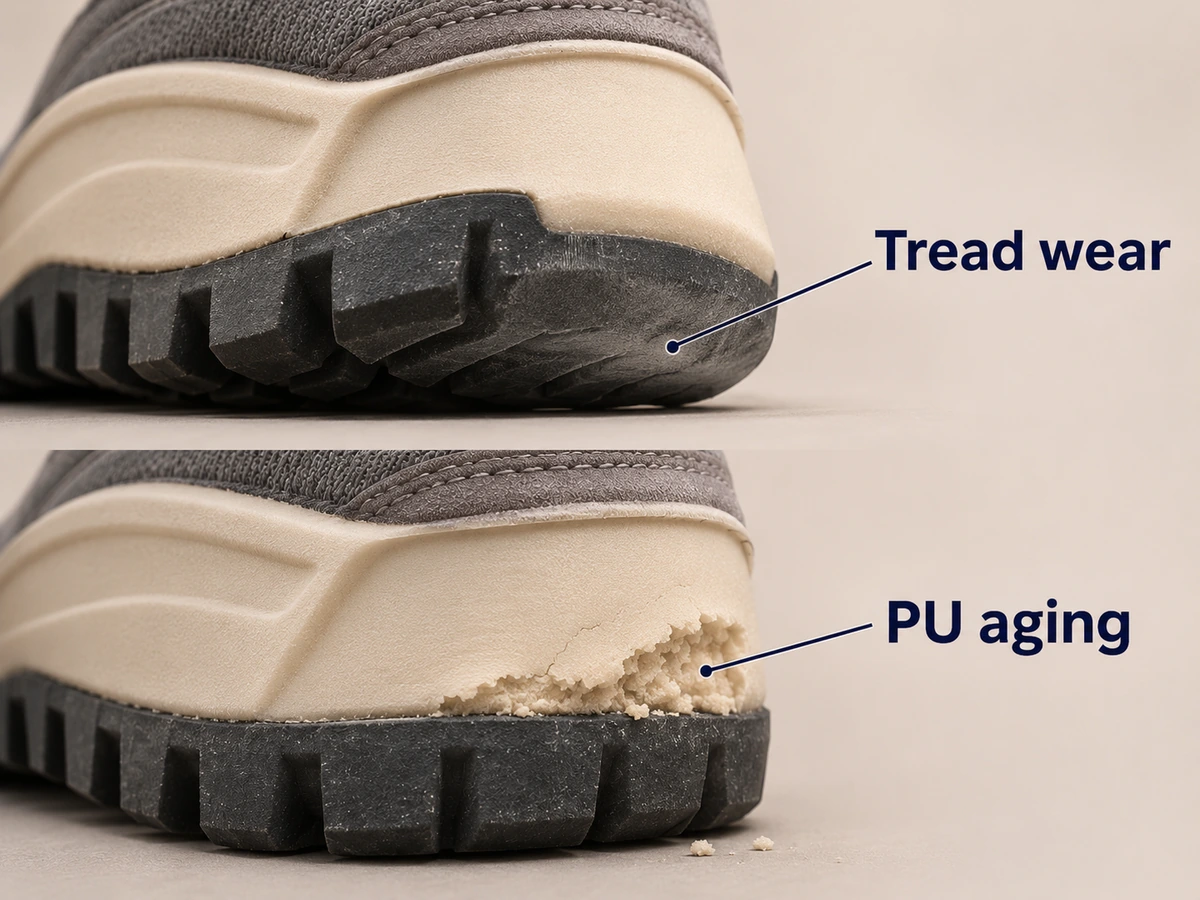
A PU sole can develop problems before its tread has worn smooth. Mechanical wear and material aging follow different paths, which is why visible tread depth cannot tell you the condition of the entire sole.
Hydrolysis is a chemical breakdown involving water. In susceptible PU systems, moisture and heat can affect the material’s properties over time. Polyether-based PU is an option to consider when hydrolysis resistance is a priority. Polyester-based systems can also be formulated for improved resistance, so compare the specific system and supporting test results rather than relying on the family name alone.
That makes “all polyester PU will crumble” too broad. It also makes “polyether PU never ages” an unreliable promise. For a proposed sole, ask which system is being used and what evidence supports its suitability for the expected environment.
Relevant aging evaluations can compare properties before and after controlled exposure. They do not, by themselves, tell you that every shoe will last a fixed number of years. Raw-material shelf life is a different measure again.
A rubber outsole does not remove the need to assess a PU midsole above it. Likewise, regularly wearing a shoe is not a guarantee against hydrolysis. When storage or humid conditions are a concern, include them in the material discussion instead of relying on a general lifespan claim.
Which Sole Construction Fits Your Shoes?
Start with the demands that matter most to your shoe, then compare constructions that address them.
For a light, cushioned casual shoe, a suitable foamed PU sole is one option to evaluate. Check the finished weight and walking feel, then consider how any exposed PU performs where it contacts the ground. You can also compare it with a cushioned construction that uses a separate rubber outsole.
When grip and tread wear are your priorities, compare the proposed rubber compound and tread with the PU option you are considering for the outsole. For wet surfaces, prioritize relevant grip evidence; for abrasive surfaces, examine relevant wear performance. Keep the cushioning layer in the comparison so that an outsole decision does not stand in for a whole-shoe comfort judgment.
When cushioning and ground contact have different requirements, a PU midsole with a rubber outsole gives each layer a distinct role. Decide where you need rubber coverage, then check the finished weight, flexibility, and how the layers hold together. Assess the PU layer’s aging resistance too.
These are starting points for sample comparison. Labels such as “walking shoe” or “running shoe” do not prove that a material meets the demands of that activity. The complete construction and its performance evidence remain the basis for your decision.
What to Check in a Sample Pair
Before choosing a sole, make sure the sample and its supporting information answer four practical questions:
- What is in each layer? Record the ground-contact material, midsole, and specific material system rather than just “PU” or “rubber.”
- What exactly are you comparing? Note the reference size, thickness, outsole coverage, and actual weight of the sole unit or shoe.
- Where will it be worn? Define relevant surfaces and expected dry, wet, or humid conditions.
- What needs to be checked? Agree on the relevant comfort, grip, abrasion, flexing, connection, or aging requirements and how they will be assessed.
Wear trials help you judge the complete shoe, while suitable tests address defined performance questions. Check that any report relates to the proposed material or construction and states its conditions. Choose the checks that address this shoe’s intended use.
FAQ
Can You Tell PU and Rubber Soles Apart by Looking at Them?
Appearance, color, and hand feel can provide clues, but they cannot reliably confirm the exact material or grade. Start with the component specification and material records. If identification remains important and uncertain, use appropriate professional analysis. A visual guess is not enough to establish the formulation behind a performance claim.
Does a PU or Rubber Sole Make a Shoe Waterproof?
No. The sole material alone does not establish whether the complete shoe is waterproof. The upper, connections, and overall construction also matter, along with appropriate whole-shoe evaluation. Keep waterproofing separate from hydrolysis resistance and wet-surface grip: each describes a different property, and evidence for one does not establish the others.
Are Rubber Soles Always Non-Marking?
No. Check the specific rubber compound and its performance on the intended floor. Color alone is not a reliable guide; some black rubber outsoles are specified as non-marking. If floor marks matter for your use, ask for relevant evidence. Non-marking also does not mean slip-resistant, so assess grip separately.
Conclusion
Choose between PU and rubber by identifying the layer, setting your priorities, and comparing complete sole constructions. A foamed PU option may suit a light, cushioned design; a rubber outsole may address ground-contact requirements; a combination can separate those roles. Confirm the relevant performance in the actual sample before deciding.
If you are developing a casual shoe, bring your reference shoe and sole requirements to HEVA to discuss suitable material and construction options for your project.