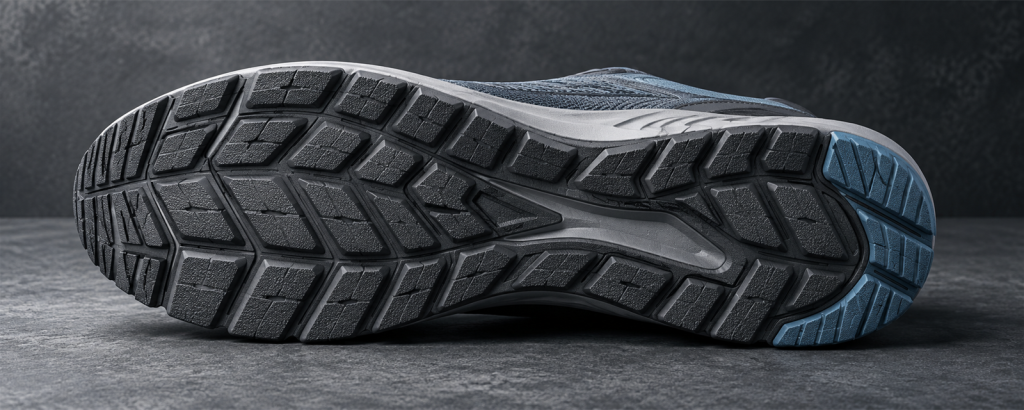
The outsole is the outer part of a shoe’s sole that makes contact with the ground. On many athletic shoes, you can identify it by turning the shoe over and looking at the rubber layer or patches underneath. Other designs use suitable foam in some ground-contact areas.
How an outsole performs depends on its material, tread, and construction. Knowing which part you’re looking at helps you understand a shoe’s specifications and discuss changes to a sample.
Outsole vs. Midsole, Insole, and Sole: What’s the Difference?
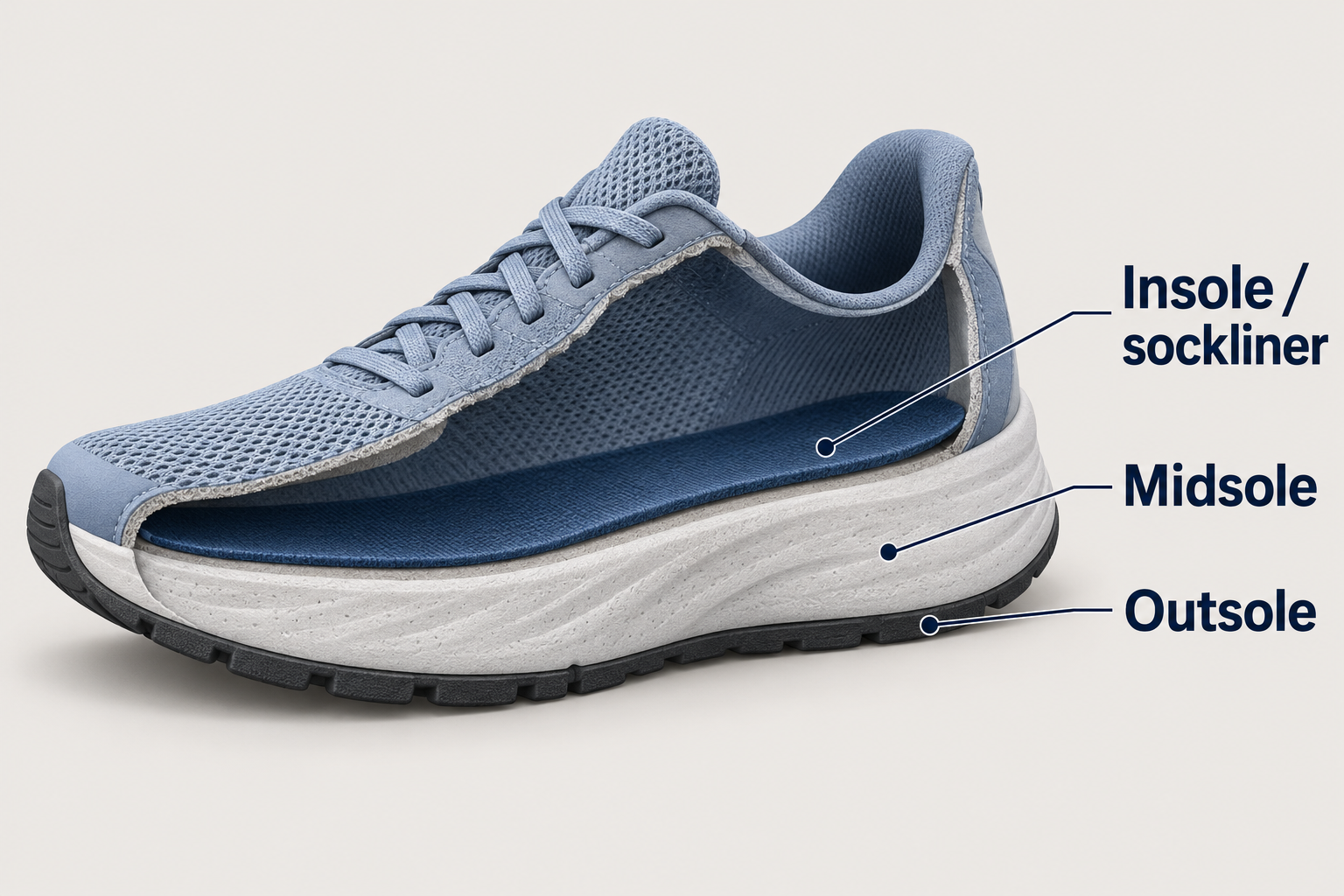
These terms describe different parts of the shoe’s bottom. For a typical athletic shoe, the distinction looks like this:
| Term | Where it is | Main role |
|---|---|---|
| Sole | The overall bottom structure beneath your foot | A broad term covering the shoe’s bottom components |
| Outsole | The outside bottom, where the shoe meets the ground | Ground contact, grip, and resistance to surface wear |
| Midsole | Usually between the outsole and the underfoot layers | Much of the shoe’s cushioning; its design also contributes to support |
| Insole / sockliner | Inside the shoe, directly beneath your foot in this article’s usage | An underfoot layer that contributes to comfort and fit |
Not every shoe has three clearly separated layers. In product descriptions, “insole” often means the sockliner. In manufacturing, it can also refer to a structural insole used in the shoe’s construction. When reviewing a specification, confirm which component the term refers to.
What Does the Outsole Do?
The outsole handles the shoe’s contact with the surface below it. Three functions are useful to separate:
- Grip: The material and tread contribute to traction. Their performance depends on the surface and conditions, including moisture or other substances underfoot.
- Resistance to wear: Ground-contact areas take repeated rubbing against walking or running surfaces. Abrasion resistance describes how well a material withstands that wear.
- Flexibility: Outsole material, thickness, and shape contribute to how the shoe bends. The midsole and other components also influence the finished shoe’s flexibility.
Cushioning needs its own assessment. A soft outsole does not tell you how the entire shoe absorbs impact. Likewise, a wear-resistant compound does not establish grip on a wet floor. The bonds between bottom components are another separate consideration.
What Are Shoe Outsoles Made Of?
Common outsole material labels include rubber, TPR, TPU, PU, and EVA. Each label gives you a starting point, but the specific formulation and component matter.
| Material label | What it tells you | What to confirm |
|---|---|---|
| Rubber | An outsole compound based on natural or synthetic rubber, with other ingredients | Which compound is used and how it performs for the intended surface. “Rubber” alone is not a grip or wear rating. |
| TPR | Thermoplastic rubber, a common material label in footwear | The specific material system and intended use. Products labeled TPR can have different properties. |
| TPU | Thermoplastic polyurethane, used in solid outsole parts and other footwear components | Whether the description refers to a solid outsole, a support component, or foamed material in another layer. |
| PU | Polyurethane; different systems can be used in outsoles, midsoles, and insoles | Which component and material form are being specified. A PU sole description needs that context. |
| EVA | Ethylene-vinyl acetate foam, which can also serve in ground-contact applications | Whether the particular foam is suitable for ground contact and how it is used in the bottom design. |
Some of these material categories overlap. TPU belongs to the polyurethane family and is also a type of thermoplastic elastomer, or TPE. In a sample discussion, identifying the actual component and compound is more useful than treating every label as a separate performance grade.
Leather is another outsole material, especially in dress shoes. For an athletic shoe project, keep the comparison focused on the materials and construction relevant to that shoe.
How Tread and Ground Contact Affect the Outsole
Tread is the pattern on the outsole’s ground-facing surface. Lugs are raised blocks, while grooves are channels between or across parts of that pattern. These features describe the design rather than the material.
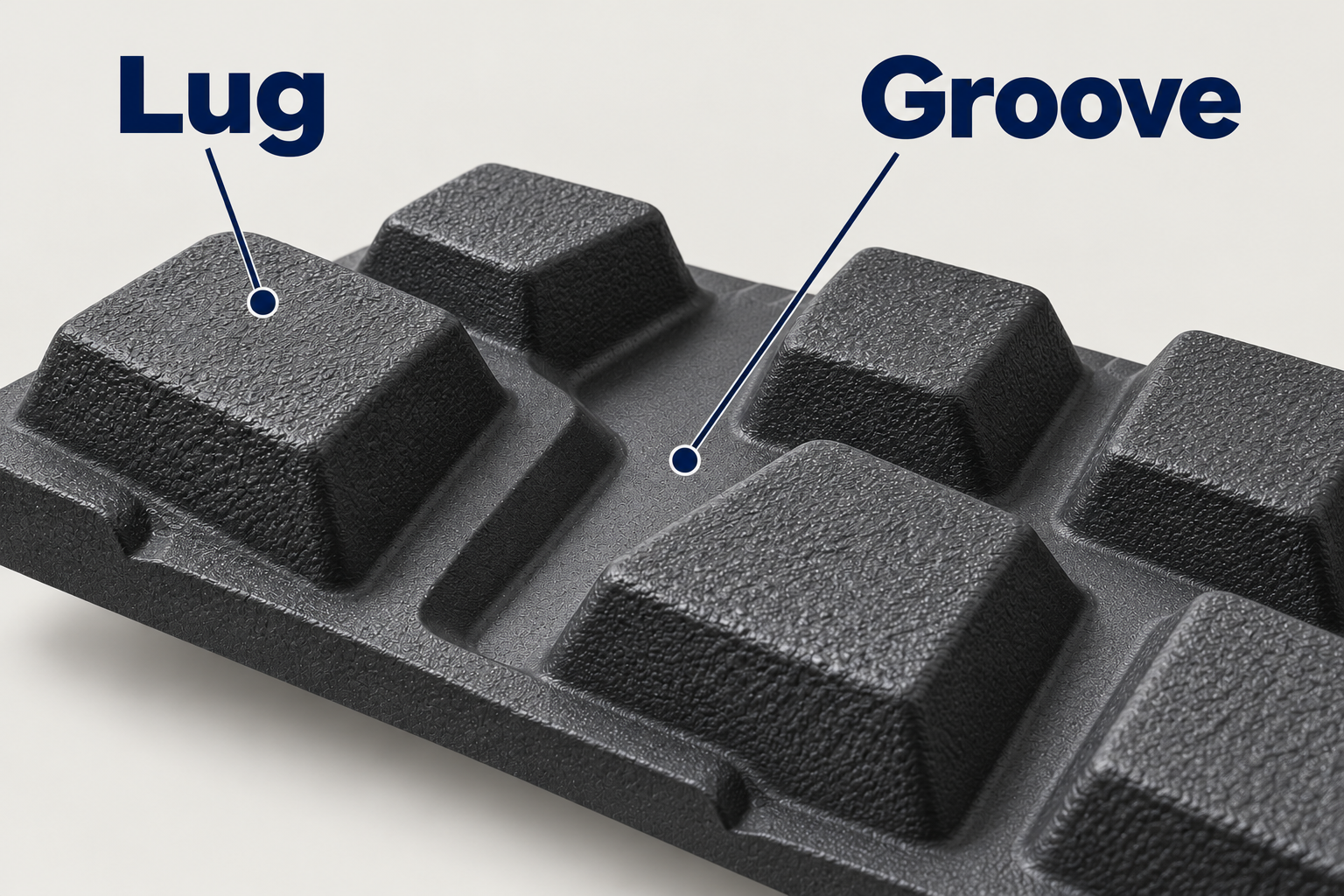
A deeper or more complex pattern does not automatically provide better grip everywhere. Consider the compound, the surface, and the conditions together. A design intended for loose outdoor ground faces different demands from one intended for an indoor court.
For example, imagine an athletic shoe with rubber patches under the heel and forefoot, exposed foam between them, and a recessed section through the middle. Check which areas actually touch the ground. Some exposed foam may contact the surface; a recessed area may sit above it.
That distinction helps you describe the bottom accurately. Color alone cannot tell you which material is present, and visible foam is not necessarily part of the ground-contact surface. Identify the material and position of each area before comparing two designs.
What to Check When Discussing an Outsole Sample
When you review a sample, make the discussion specific. Start with four questions:
- Which areas contact the ground?
- What material or compound is used in those areas?
- What surfaces is the shoe intended for?
- Which requirements need to be checked on the sample?
For the last question, separate grip, surface wear, flexibility, and bonding where relevant. Agree on what needs evaluation instead of relying on a general request for a “better sole.” This gives the development team a clearer basis for discussing the sample and any changes. A visual review can identify questions; performance requirements still need appropriate assessment.
FAQ
Does a Non-Marking Outsole Mean It Is Slip-Resistant?
No. Non-marking concerns whether an outsole leaves marks on a floor. Slip resistance concerns friction between the shoe and the walking surface. These are separate requirements. You cannot establish both from the sole’s color or a rubber label. If the shoe needs both properties, confirm each requirement for its intended use.
Can Outsole Length Tell You Whether a Shoe Will Fit?
Outsole length measures an external dimension. It does not tell you the usable space inside the shoe or how its shape fits your foot. Check the sizing guidance for that particular style and assess the fit through a sample or try-on. There is no single amount you can subtract from outsole length to determine the correct size.
Can a Shoe’s Outsole Be Replaced?
Some can, depending on the shoe’s construction and condition. Replacement also depends on suitable parts and a repairer’s ability to work with that design. Ask the manufacturer or a qualified repairer to assess the specific shoe, including the damage and remaining structure. An intact upper alone does not establish that replacing the outsole is practical.
Conclusion
To understand an outsole, start with the part that meets the ground. Then look at its material, tread, and contact layout in relation to the intended surface. That gives you a clearer way to read specifications and discuss samples. For a footwear development project with HEVA, bring the shoe concept, intended surfaces, and outsole requirements into the conversation.