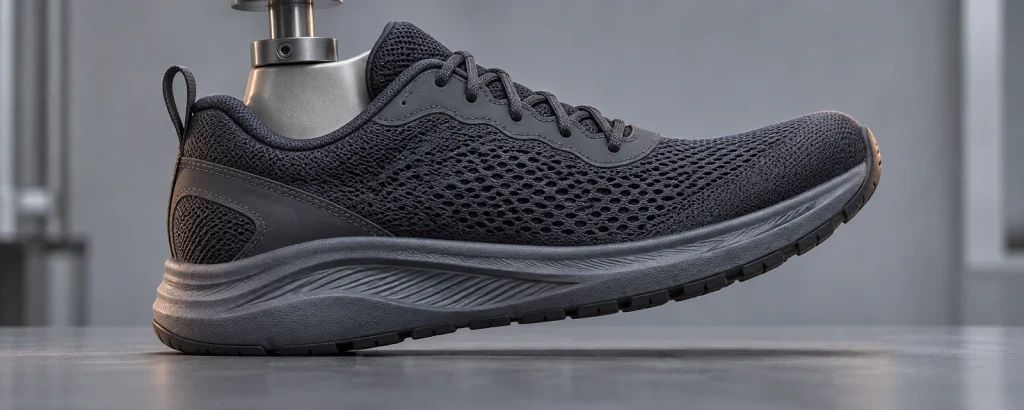
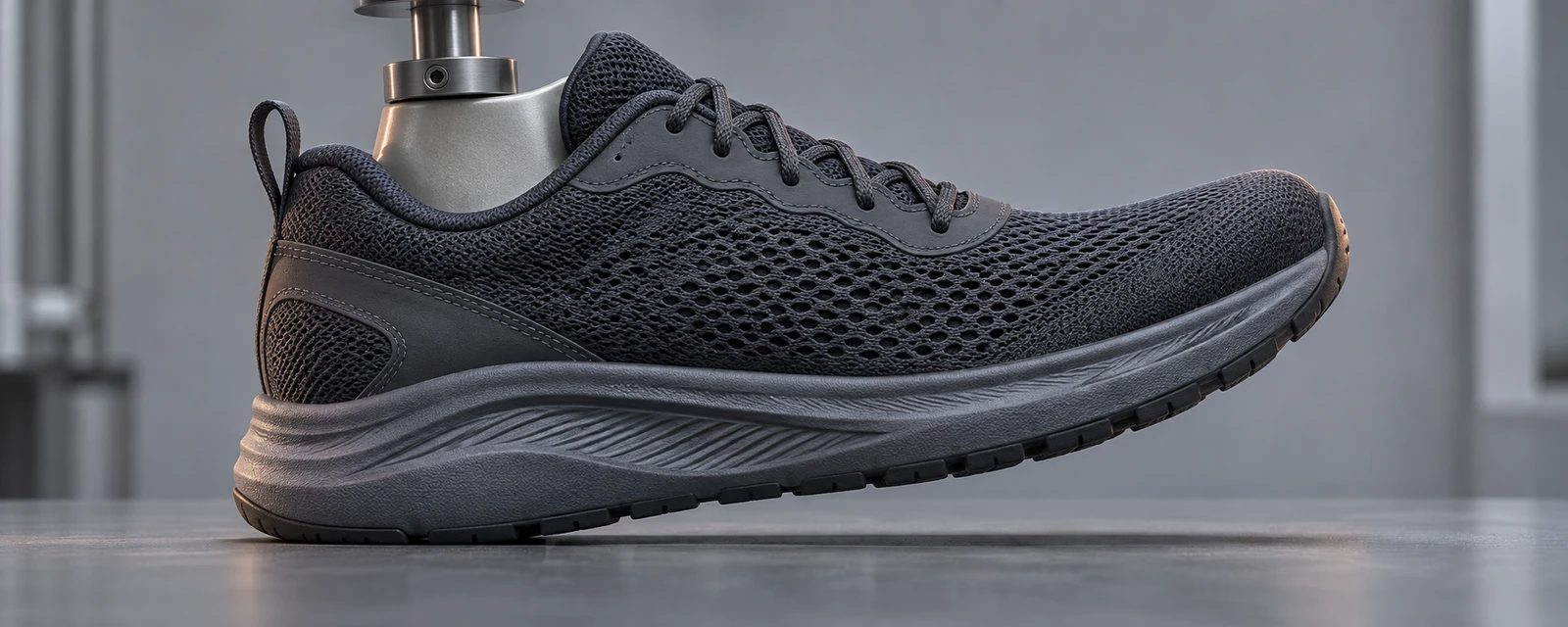
A footwear specification that calls for ISO 13287 tells you which slip resistance test method is being requested. To understand what the result means for your shoe, you also need to know the test conditions and the requirements it will be judged against. Those details matter when you commission a test, compare samples, or review a supplier’s report. Here is how to read the standard reference and use the information in a footwear development project.
What Is ISO 13287, and Which Footwear Does It Cover?
ISO 13287 specifies a laboratory method for testing the slip resistance of personal protective equipment (PPE) footwear. Its scope excludes special-purpose footwear with spikes, metal studs, or similar features.
For a sports shoe project, start with the intended use and the performance claim. A shoe’s athletic appearance does not establish whether this method is appropriate. You may encounter the reference in a customer specification or when discussing footwear intended to provide protection against slipping.
Ask the laboratory whether the method is appropriate for your intended use and claim. Be clear about whether you need a development comparison or evidence to support a specific product claim. The standard’s scope alone does not settle every market’s regulatory requirements.
Which Version of ISO 13287 Applies?
As of November 12, 2026, ISO lists ISO 13287:2019 as the published third edition. The 2019 edition replaced ISO 13287:2012, which ISO now lists as withdrawn. A draft amendment, ISO 13287:2019/DAmd 1, remains under development. A draft amendment is not a published replacement for the standard.
Check the complete reference on your test request and report, including the year. A review date or the year shown in a website footer is not a new edition. If you receive an older report, ask whether its method and scope meet your current project requirements; the date alone does not answer that question.
How Does the ISO 13287 Slip Resistance Test Work?
The test measures friction while footwear and a test surface slide relative to each other under controlled conditions. The equipment measures the frictional force resisting movement and the normal force pressing the shoe against the surface. Their ratio gives the dynamic coefficient of friction, or CoF.
A CoF value describes the friction measured under the test conditions. It is not a percentage chance of avoiding a slip. To interpret it, check the surface, contaminant, and contact mode used.
| Test mode | Contact and relative movement |
|---|---|
| Forward heel slip | Angled heel contact, with the shoe moving forward relative to the surface. |
| Backward forepart slip | Angled forepart contact, with the shoe moving backward relative to the surface. |
| Forward flat slip | Flat contact, with the shoe moving forward relative to the surface. |
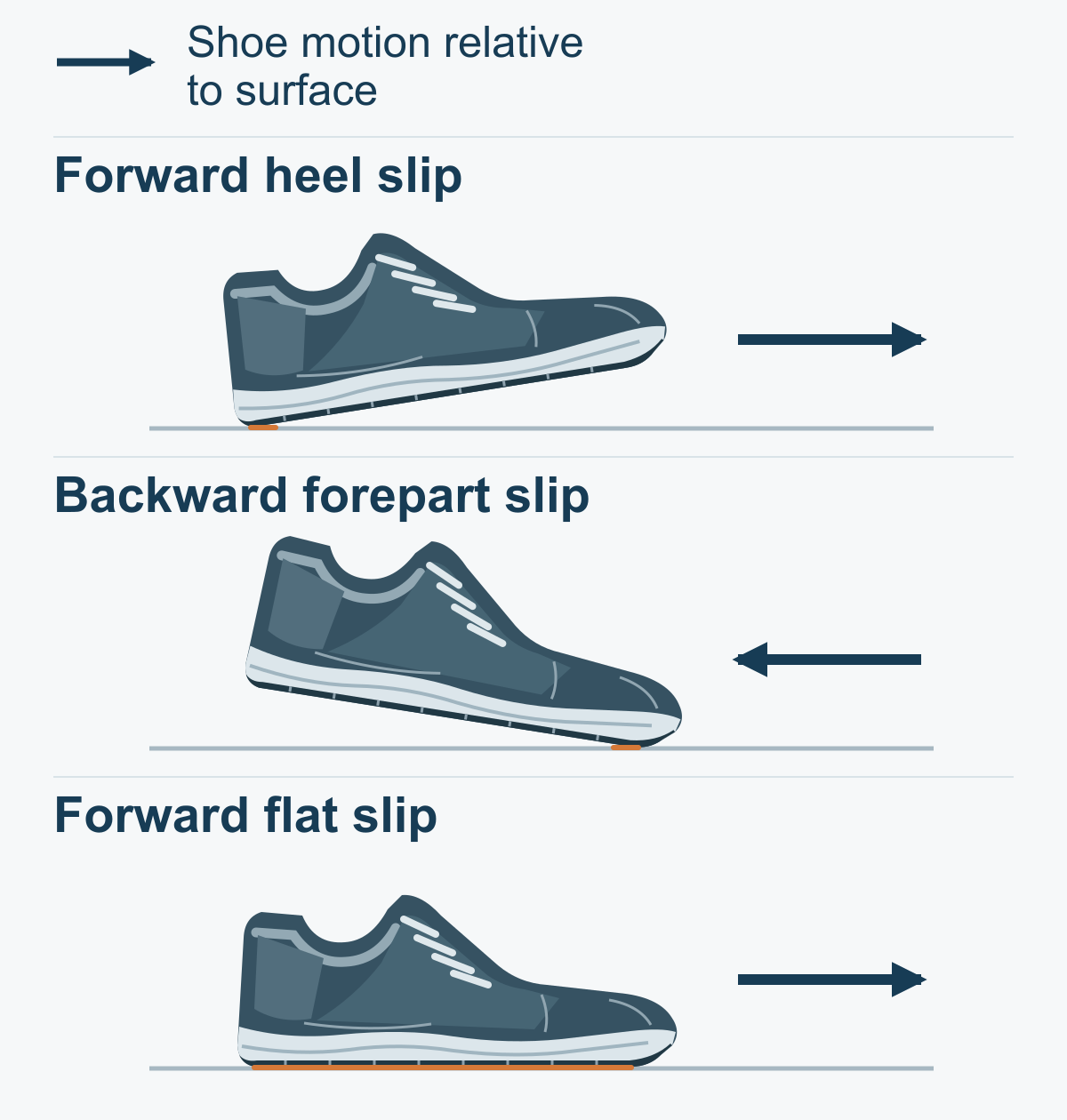
The method provides these modes, but you should check which ones the applicable requirements call for and which the report actually includes. A result for one contact mode should not be presented as though it represents every mode.
For a useful comparison, ask whether both samples were evaluated under matching conditions. If one result comes from a different surface or contaminant, the numbers do not provide a straightforward ranking of the shoes. Include the test conditions whenever you share or discuss a sample’s result.
Does Testing to ISO 13287 Mean a Shoe Has Passed or Is Certified?
The phrase “tested to ISO 13287” identifies a method. On its own, it does not tell you which performance requirement was met or establish certification.
A product standard, such as ISO 20345 for safety footwear, has a different role: it specifies requirements for the product. To understand a pass statement, identify the relevant requirement, its edition, and the conditions under which the result was assessed. Do not take a value from one product category and apply it to every shoe.
Certification also needs its own supporting evidence. ISO develops standards; external bodies perform certification. If a supplier makes a certification claim, ask which body issued the certificate and what product, requirements, and scope it covers.
ASTM F2913 is a whole-shoe slip resistance test method, while ASTM F3445 sets slip resistance performance requirements using that method. Ask which reference governs each requested assessment rather than treating an ISO result as automatic evidence that a different specification has been satisfied.
How to Read an ISO 13287 Test Report
Start by checking that the report describes the sample and assessment you requested. The following questions are a practical reading aid, not a reproduction of the standard’s complete reporting requirements.
| Check | Why it matters |
|---|---|
| Sample identity | Confirm the model, size, and whether the specimen is a finished shoe or a component. |
| Method and edition | Identify the method used and its full version reference. |
| Surface and contaminant | Understand the conditions represented by the result. |
| Contact mode and result | Match each CoF value to the mode actually tested. |
| Assessment basis and notes | Identify the requirement used for any pass statement, plus deviations or qualifications. |
Read each result with its row labels and any explanatory notes. For any pass statement, check which requirement the result was assessed against. If the report gives results without a pass/fail assessment, ask how those results should be evaluated for your project.
Missing context is a reason to ask the issuing laboratory for clarification. It is not a reason to assume that an unlisted condition was tested. Likewise, if you are comparing reports from different sources, establish that the samples and test conditions support the comparison before using their CoF values to choose a design.
What Should You Confirm for Your Footwear Project?
Give the laboratory and your development supplier a clear description of the intended use, expected flooring and contaminants, target market, and any customer requirements. Then agree on the samples and testing needed to answer the project’s questions.
Discuss whether the laboratory conditions adequately address the intended environment or whether additional evaluation would be useful. Performance on a wet surface does not establish performance on an oily one. An oil-resistant sole also does not, by that description alone, demonstrate slip resistance on oil.
Think beyond the new sample. Wear, debris, and cleaning can affect how footwear performs in use. If the product or intended conditions change, ask whether the existing evidence still applies. A report can inform a development decision without supporting every future variation of the shoe.
FAQ
Where Can You Get the ISO 13287 Standard?
Check ISO’s official catalog or the relevant national standards body for the edition you need. Public previews can help you identify the document and understand its scope, but they do not necessarily contain the complete procedures, reporting requirements, or annexes. Confirm what is included before relying on a downloaded PDF as your working standard.
Can Outsoles or Other Sole Components Be Tested?
Yes. ISO 13287 allows sole units, outsoles, and certain other soling components to be tested for product development. Be clear about what the specimen represents. Component data can help you investigate a design, but you should confirm what further evidence is needed for the finished shoe and its intended claim.
What Do EN ISO and BS EN ISO Mean?
EN ISO identifies a European adoption of an ISO standard; BS EN ISO identifies its British adoption. These prefixes describe the standard’s adoption, not a higher slip resistance rating. BSI lists BS EN ISO 13287:2019 as identical to EN ISO 13287:2019 and ISO 13287:2019. Use the full reference requested for your project.
Conclusion
ISO 13287 becomes useful when you connect the method reference to a defined sample, test conditions, and assessment requirements. That context helps you understand a report, compare evidence more carefully, and ask better questions before committing to a design.
When discussing your footwear development project with HEVA, share the intended use and any existing test specifications or reports. They provide a clearer starting point for discussing the shoe’s design and the requirements the project needs to address.