
A footwear specification says “tested to EN ISO 20344.” A report lists the same number beside a result. What does that tell you about the shoe? EN ISO 20344 describes test methods for footwear designed as personal protective equipment (PPE). To interpret the evidence, you also need to know the applicable product requirements, the version used, and what was tested. This guide explains how those pieces fit together, so you can ask useful questions before relying on a specification or report.
What Is EN ISO 20344, and Which Footwear Does It Cover?
EN ISO 20344 provides methods for testing PPE footwear. Its scope starts with footwear designed to protect the wearer, rather than every shoe that happens to be worn at work.
Begin with the intended use and the protection being claimed. A shoe’s athletic appearance does not tell you which protective requirements apply. Likewise, seeing a familiar test method in a specification does not settle the product’s classification.
For a sports shoe project, clarify the use, claims, and target requirements before selecting tests. You may need evidence about particular properties, but that alone does not tell you whether EN ISO 20344 is the right basis for your project’s test specification.
Keep that distinction in your discussions with the laboratory: are you evaluating a particular property, or gathering evidence against the requirements for a defined type of PPE footwear? The answer affects what you ask the report to demonstrate. It also prevents a broad phrase such as “safety tested” from standing in for an agreed scope.
How EN ISO 20344 Relates to EN ISO 20345, 20346, and 20347
The neighboring standard numbers have different roles. EN ISO 20344 addresses testing methods; the other three set requirements for their respective footwear categories.
| Standard | Main role | What to check |
|---|---|---|
| EN ISO 20344 | Test methods for PPE footwear | Which method and edition were used? |
| EN ISO 20345 | Requirements for safety footwear | Which applicable requirements and claims are being assessed? |
| EN ISO 20346 | Requirements for protective footwear | Does this specific category match the intended product? |
| EN ISO 20347 | Requirements for occupational footwear | Which basic and additional requirements apply? |
Here, “protective footwear” is the specific category associated with EN ISO 20346. “PPE footwear” is the broader term used throughout this article. The numbers are not a scale you can use to rank shoes from least to most protective.
This division matters when you read a result. The method reference helps identify how a property was assessed. The relevant requirement supplies the basis for judging whether that result is acceptable.
The product standards also distinguish general applications from special risks that may need complementary standards. Start with the intended protection; then confirm the relevant requirements and methods together.
Which Edition and National Adoption Are You Looking At?
An EN ISO designation identifies the European adoption of an ISO standard. Record the complete reference, including its prefix, year, and amendment. ISO 20344:2021 is the base edition, with Amendment 1 published in 2024. A consolidated European adoption may therefore appear as EN ISO 20344:2021+A1:2024.
National publication dates can make the numbering look less consistent than it is. For example, DIN EN ISO 20344:2022-04 adopted the ISO and EN 2021 texts. Its replacement, DIN EN ISO 20344:2024-06, incorporates the 2024 amendment. The “2022” in the earlier German reference does not identify a separate ISO 20344:2022 base edition.
Prefixes such as BS and DIN identify national adoptions. Read the complete designation and the publisher’s description rather than comparing year numbers alone.
Amendments matter because they can affect testing details. The 2024 amendment includes a change to the conditioning provisions, among other revisions. Do not silently update a report’s reference to a newer version: it should identify what the laboratory actually used.
If you receive a report citing 2011 or another older edition, confirm whether it meets the project’s applicable requirements. A publication’s replacement status alone does not decide whether a particular report will be accepted.
What Types of Footwear Tests Does It Describe?
The standard covers several parts of the shoe. Grouping the methods by what they examine makes a report easier to navigate than treating the standard number as a single test.
| Test grouping | Examples | Question to ask about the evidence |
|---|---|---|
| Whole footwear | Bond strength; slip resistance | Which finished shoe configuration was assessed? |
| Upper, lining, and tongue | Tear strength; selected chemical properties | Which part and material does the result describe? |
| Insole, insock, and footbed | Water absorption and desorption | Which component was tested? |
| Outsole | Abrasion, flexing, and hydrolysis resistance | Which property and method are covered? |
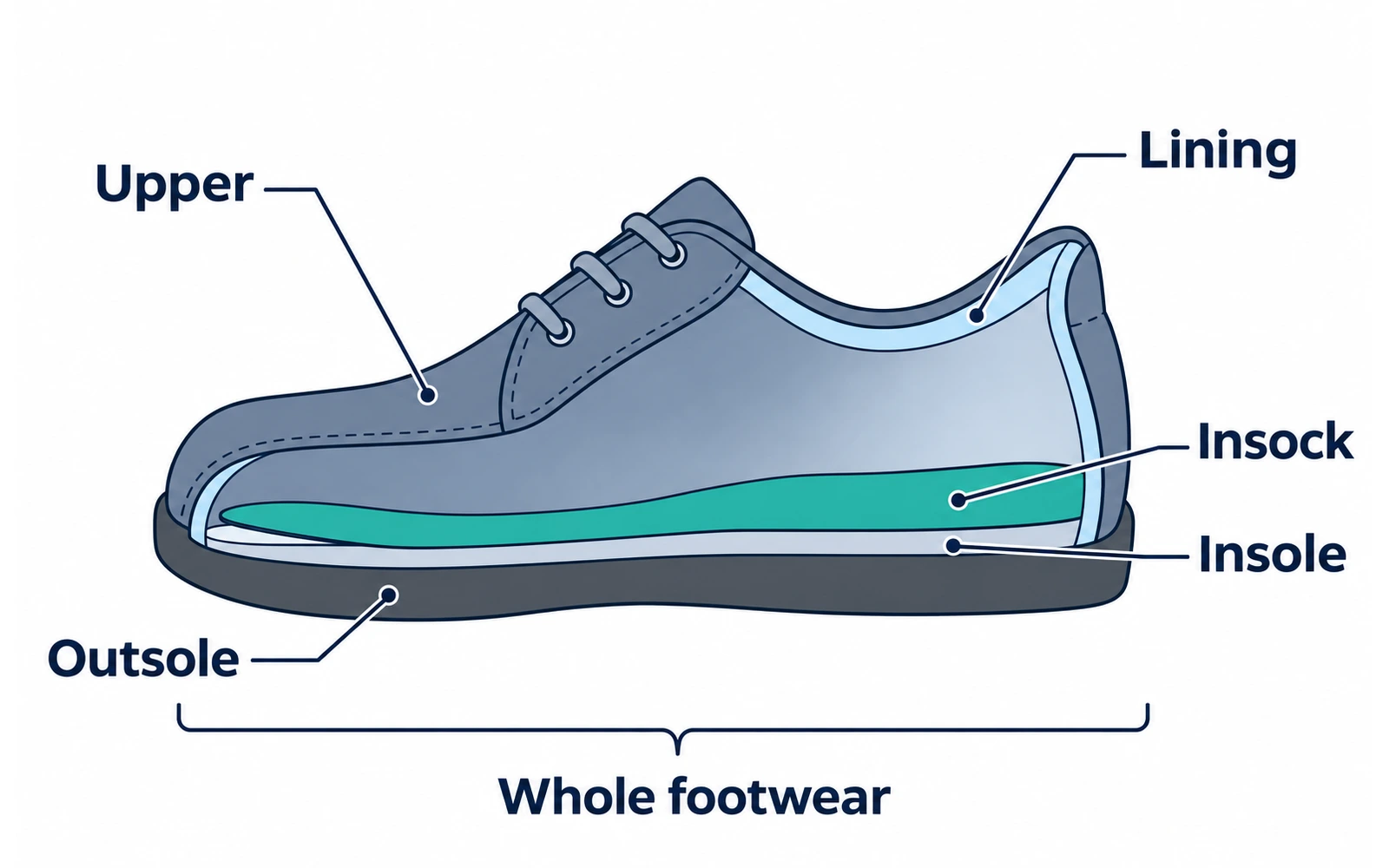
These are examples, not a universal test package. The applicable product requirements and claims determine what needs assessment. The questions in the last column are practical reading prompts, not a replacement for the methods’ instructions.
EN ISO 20344 is not exclusively a physical testing standard: its contents also include pH and chromium VI testing. That does not make a report under this standard a complete chemical compliance assessment for every market.
Keep individual properties separate, too. Evidence about abrasion resistance does not answer a question about slip resistance. A hydrolysis test should not be translated into a promised number of years of service without a separate basis for that prediction.
When reviewing a proposed test package, compare its scope with the questions your specification needs answered. Ask the laboratory to explain any gaps or limits before testing begins.
How to Read the Scope of an EN ISO 20344 Test Report
Check the report details
Start with the information that connects the results to the work performed. Clause 4.4 of the 2021 base text calls for laboratory details, the report date, the standard and clause used, sample identification, the specified results, and any method deviations. Clause 4.4 also calls for measurement uncertainty to be reported when requested by the customer. That reporting condition does not mean uncertainty matters only when requested.
Then check whether the report matches your project. Can you match the sample identification to the model, materials, and construction you are reviewing? Are the relevant test conditions and units clear? If the product has changed since testing, ask whether the evidence still represents it. These are practical review questions, not a claim that every item is a separate mandatory field in clause 4.4.
Match the results to your requirements
A “Pass” statement needs context. Check which results it covers, which requirements were met, and how the conformity decision was made. ILAC’s guidance on laboratory conformity statements explains the role of a decision rule: how measurement uncertainty is considered when deciding whether a result meets a specified requirement. A rule may already be inherent in the relevant specification or standard.
You do not need to recreate the laboratory’s calculations to ask for a clear explanation. If the document provides only results, confirm which requirements apply before treating those results as a pass against your specification. Keep untested requirements visible rather than assuming the report covers them.
Hypothetical example: A supplier sends a page headed “EN ISO 20344 tested,” showing a result for one listed method. Before relying on it, request the complete method reference and edition, the sample details, and the requirements covered by any pass statement. This example illustrates a missing-information check; it does not establish that the shoe passes or fails its intended requirements.
Keep testing and certification distinct
Testing determines particular characteristics. Product certification involves an independent body issuing a certificate confirming that specified requirements are met. ISO develops standards; it does not itself issue product certificates.
If certification is claimed, check the certificate and its scope as well as the supporting test evidence. Neither a method number nor an isolated result establishes every claim made about the product. The useful question is specific: what does this document demonstrate about this shoe?
FAQ
Where can you get the full EN ISO 20344 standard?
Check ISO or the relevant national standards body for the edition and text you need. Confirm whether the document is the international standard, a national adoption, an amendment, or a consolidated version. Public previews can help identify the contents, but they are not the complete working text. Do not assume that a PDF appearing in search results is complete, current, or authorized for redistribution.
Can a component test report demonstrate compliance of the finished footwear?
It can support the properties it actually assesses, but it cannot by itself establish that the finished shoe meets every applicable requirement. Check the specimen and the method’s sampling provisions. Clause 4.1 allows material used to make the component to substitute when the shoe cannot provide a sufficiently large test piece; the report must note this. Have the laboratory explain how that evidence relates to the finished construction and what remains to be assessed.
Conclusion
EN ISO 20344 becomes useful when you connect the method reference to a defined product and a clear requirement. Start with the intended use, confirm the applicable standards and editions, and read the report for what it actually covers. Bring the specification, sample details, and existing evidence to the laboratory or compliance lead when something is unclear. A precise question about a missing requirement will take the review further than a general request for an “ISO-tested” shoe.