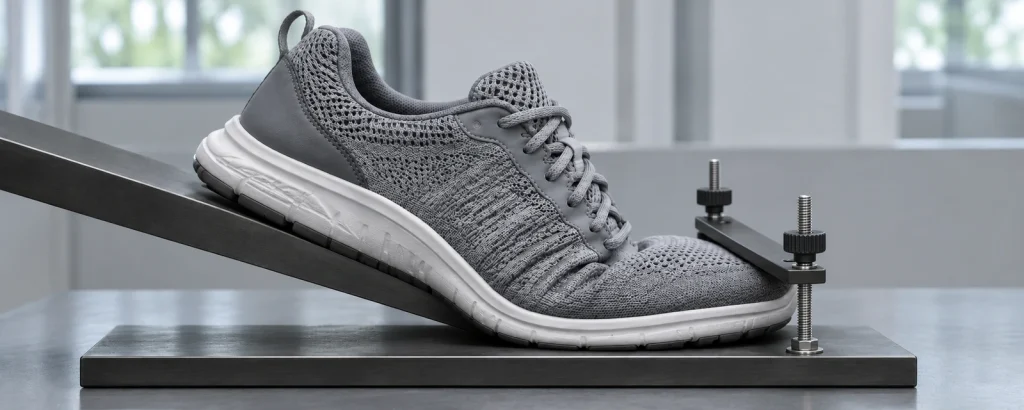
A test report can name a recognized standard and still leave your main question unanswered: does this evidence support the decision you need to make about your shoe?
Footwear testing standards define methods, requirements, or both within a stated scope. Choosing one means checking the product, the property being measured, the sample, and the purpose of the result. A material test may help you compare compounds without showing how a finished shoe performs.
If you are developing athletic footwear for the U.S. market, this guide explains how to read standard references, narrow your options, and turn a selected method into clear requirements for your development team and laboratory.
What Footwear Testing Standards Tell You
A test method describes how to measure or assess a property under specified conditions. A performance specification sets requirements against which a product can be evaluated. Some documents contain elements of both, so check the actual content instead of relying on the word “standard.”
Your project also needs a reason for using that document. A customer specification may identify a method and an acceptance limit. A product standard may refer to a separate test method. A regulation may reference particular standards or impose obligations that extend beyond physical performance testing.
These distinctions affect what you can conclude from a report. A measured result answers a particular test question. A pass/fail statement also needs an applicable requirement and a basis for the decision. Neither automatically establishes that the shoe meets every requirement for its intended market.
Laboratory accreditation and product certification are separate, too. Accreditation concerns a laboratory’s competence within a defined scope; it does not turn every product it tests into a certified product. Product certification depends on the requirements of the relevant certification scheme.
For footwear development, keep the physical test plan in its proper context. Applicable chemical restrictions and labeling requirements need their own assessment. Passing an abrasion or flexing test does not resolve them.
Start With the Shoe and Its Intended Use
Before selecting standard numbers, write down what you are developing and what you need to learn. A useful starting brief includes:
- Use: the intended activity, environment, and relevant hazards.
- User group: who will wear the shoe, including whether it is classified as children’s footwear.
- Market and customer: where it will be sold and which requirements the customer has specified.
- Construction: the materials, sole assembly, attachment methods, and other features relevant to the property.
- Proposed claims: what you intend to say about the shoe’s performance.
Use that brief to check scope. ISO 20344:2021 describes test methods for footwear designed as personal protective equipment. It is not a universal checklist for every athletic shoe. Whether those methods are relevant to your shoe depends on its intended protective function and the applicable requirements.
Age classification can matter even for a familiar performance test. ASTM F1976-24, which addresses impact attenuation in athletic shoe cushioning systems and materials, excludes shoes classified by the manufacturer as children’s shoes.
This brief is a practical selection tool. It helps you identify scope conflicts before arranging a test; it does not replace the requirements of the selected standard.
Read ASTM, ISO, EN, and SATRA References Correctly
The names on a test request tell you where to look, but they do not rank a method’s suitability for your shoe.
- ASTM International publishes documents that include test methods and performance specifications. Read the document type and scope as well as the designation.
- ISO publishes international standards. A footwear reference may concern a material, a component, a whole shoe, or a particular product category.
- EN identifies a European Standard. It is not the name of a testing laboratory. An EN ISO reference indicates European adoption of an ISO standard; check the complete reference rather than assuming similar numbers identify interchangeable documents.
- SATRA TM identifies a SATRA test method. The method number and revision matter: “SATRA tested” alone does not tell you which property or sample was evaluated.
Record the designation, year, and any applicable amendment. For example, ISO 20344:2021 has Amendment 1:2024. A later review confirming an ISO standard does not, by itself, change its publication year.
Also distinguish the published edition from the edition your project actually references. A newer publication does not automatically rewrite a customer specification or a regulation. OSHA’s foot-protection rule illustrates this distinction by naming particular editions in its requirements for affected workplaces.
If references differ, clarify which requirement applies and why. Neither “always use the newest edition” nor “an older report is always invalid” is a reliable selection rule on its own.
Match the Standard to the Property and the Sample
A property name is only the beginning. “Flex resistance” might describe damage to an outsole or deterioration of a complete shoe. The sample and the failure being assessed determine whether the method answers your question.
The examples below are a starting point for checking scope, not a mandatory test package. Confirm the complete method before commissioning work.
| Property | Example reference | Sample or assembly | Scope check |
|---|---|---|---|
| Outsole abrasion | ISO 20871:2018 | Outsole | Measures abrasion resistance; it is not a water-resistance test. |
| Outsole flex resistance | ISO 17707:2005 | Outsole | Assesses cut growth and has a longitudinal rigidity limit. It does not establish whole-shoe life. |
| Whole-shoe flexing | ISO 24266:2020; SATRA TM92, November 2016 | Completed shoe | Check each method separately. ISO 24266 has geometry and flexing restrictions. TM92 does not assess flex cracking of upper or soling materials. |
| Upper-to-sole adhesion | ISO 17708:2018 | Applicable upper/sole or adjacent sole-layer assembly | Check the attachment construction, the bond being evaluated, and the failure location. |
| Impact attenuation | ASTM F1976-24 | Athletic shoe cushioning system, component, or material specimen | Check specimen dimensions, input conditions, and prior conditioning before comparing results. |
| Slip performance | ASTM F2913-24 | Footwear or applicable soling specimens | Identify the sample, surface, and contaminants. Results concern the tested conditions. |
Even methods within one standard may not be interchangeable. ISO 24266 describes two whole-shoe flexing methods and states that their results might not be comparable. Listing it alongside SATRA TM92 identifies two references worth investigating, not equivalent alternatives you can swap without review.
Construction needs attention in adhesion testing. ISO 17708 describes relevant cemented, vulcanized, and injection-molded assemblies with a continuously closed upper. Its note says the test need not be performed when the bond is made by nails, screws, or stitching. That does not justify excluding every shoe that contains a stitch: a mixed construction requires a closer look at the connection you want to assess.
For a stiff or thick sole, check a flexing method’s applicability before treating its familiar title as sufficient. Geometry and flexibility restrictions define whether the method applies; they are not general quality limits for the shoe.
Keep the result tied to its sample. Evidence about a material specimen can inform material selection, but it should not be presented as proof that the finished assembly has passed a whole-shoe test.
Turn Your Selection Into a Clear Test Specification
Once you have a suitable reference, make the request specific enough that the laboratory and your team understand the same task. The following checklist is a practical discussion aid; individual methods may require additional information.
- Product and purpose: identify the intended use, the performance question, and any claim the evidence needs to support.
- Sample identity: record the style or design revision, material or assembly, and test location where relevant.
- Method: give the full reference, edition, applicable amendments, and any options that need agreement.
- Conditions: confirm the relevant conditioning, test environment, surface, or input conditions with the laboratory.
- Acceptance basis: if you need pass/fail, identify the requirement, its source, and how the decision will be made.
- Report needs: agree on the results, units, observations, and sample identification needed to interpret the work.
- Responsibility: identify who will resolve conflicting instructions and approve the requirements.
Confirm specimen preparation, sample quantities, and operating settings with the laboratory using the complete applicable method. A public scope summary is useful for screening options, but it cannot supply the full procedure.
ASTM F2913 and F3445 show why method and acceptance basis should be recorded separately. F2913-24 measures the dynamic coefficient of friction under reproducible laboratory conditions. F3445-24 specifies minimum slip-resistance requirements for completed footwear using F2913. If your project calls for F3445, a report naming F2913 alone is not enough to demonstrate that all relevant F3445 requirements have been met.
That pairing is an example, not a requirement for every shoe. F3445 also cautions that controlled laboratory testing does not establish performance in every situation a wearer may encounter.
If no acceptance limit has been identified, clarify the purpose before testing. Development work may need comparative measurements rather than a pass/fail verdict. If a customer needs a conformity decision, resolve the applicable requirement first instead of choosing a convenient threshold after seeing the results.
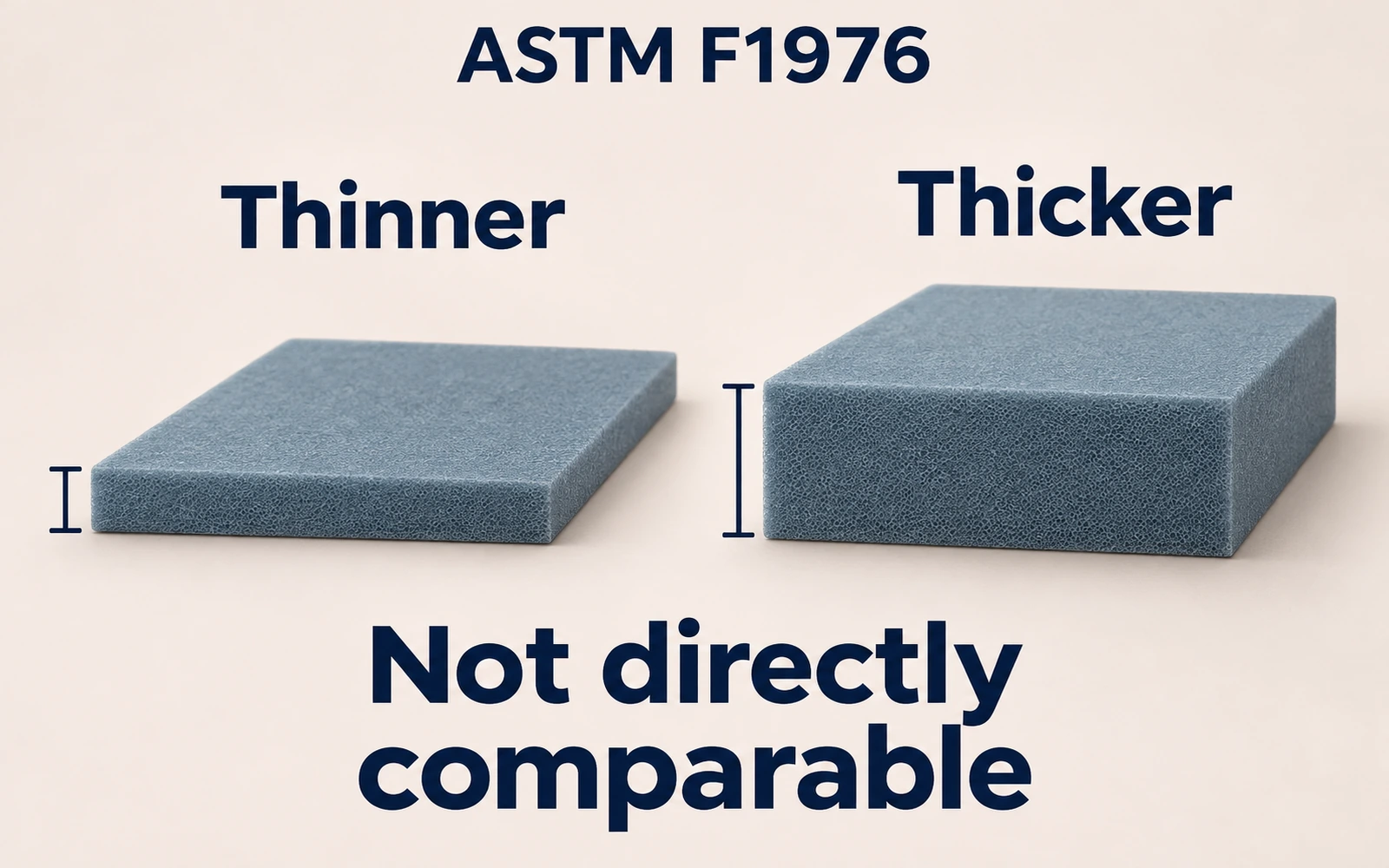
Before comparing reports, check their conditions. Under F1976, results obtained with different input energies or impact masses are not directly comparable. The same applies to material specimens of different thicknesses; nominal specimen size and prior conditioning must also match for comparison. A cushioning result is not, by itself, an injury-prevention promise.
Finally, if accredited testing is required, check that the requested method falls within the laboratory’s accreditation scope. The laboratory’s logo or a general statement about accreditation does not answer that specific question.
FAQ
What if a customer specifies a method that does not fit the shoe?
Document the specific mismatch, such as an excluded construction or an unsuitable sample type, and discuss it with the customer and laboratory. Explain what the requested method would assess, why its scope creates a problem, and what an alternative could establish. Obtain agreement before substituting a method. If the change affects a contractual requirement or a proposed product claim, involve whoever is responsible for that requirement. An alternative method may be technically useful without being acceptable to the customer for the original purpose.
Can you use an existing test report after changing materials or construction?
Review what changed against the sample and conditions identified in the report. A new cushioning material, thickness, outsole, or attachment construction may affect the evidence relevant to that property. Discuss the affected requirements with the laboratory and the person responsible for the specification, then determine what additional evidence is needed. Do not assume the old report covers the revised design, but do not treat every change as an automatic reason to repeat every test. Keep the design revision and the report’s scope clearly connected.
Conclusion
Choosing footwear testing standards starts with a defined product and a clear question. Check the method’s scope, match it to the actual sample, and identify how the result will be interpreted. Complete references and agreed conditions make the evidence more useful when you compare options or review a design.
For your next athletic footwear project, bring together the intended use, target market, construction or bill of materials, and any existing test requirements. You can use that brief to discuss OEM/ODM development with HEVA and identify the questions that need to be resolved as the design progresses.