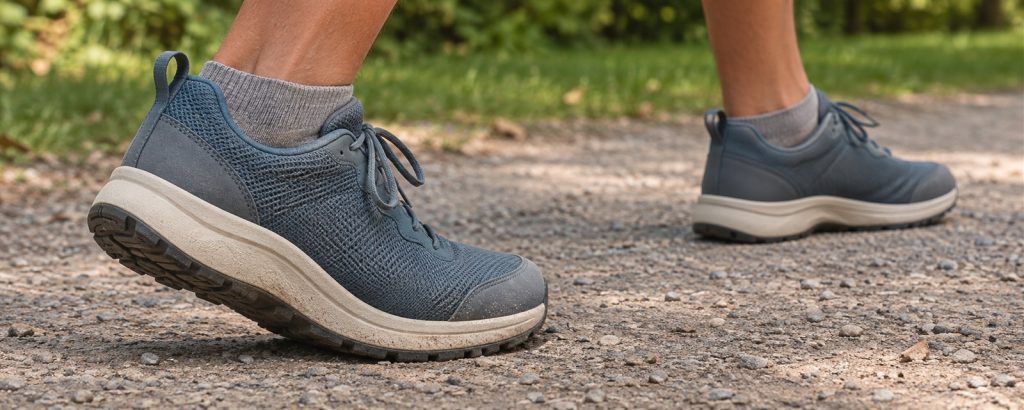
EVA foam is a practical starting point when you want lightweight cushioning for an athletic or casual shoe. Polyurethane, or PU, offers another range of sole systems, including lightweight formulations with adjustable hardness and elasticity. Choosing between them requires more than deciding which material sounds softer or more durable.
For your shoe project, the useful comparison is between specific sole constructions. Start with the part you are developing, then compare weight, underfoot feel, wear, aging, and production requirements. That gives you a way to narrow the options before approving a sample.
Start With the Part of the Sole You Are Comparing
EVA stands for ethylene-vinyl acetate. In footwear, it is commonly used as a foam for cushioning. PU stands for polyurethane; this comparison focuses on reactive PU systems used to form footwear components. TPU and expanded TPU are related terms, but their processing and structures should not be treated as interchangeable with these PU systems.
The midsole provides cushioning between your foot and the ground-facing outsole. The outsole is the contact layer, while the sole unit is the bottom assembly being supplied. A removable footbed sits inside the shoe and is a separate component.
An EVA midsole with a rubber outsole combines two materials with different jobs. Comparing that assembly with a PU sole means evaluating the construction as well as the material. Make sure both samples represent the same part of the shoe.
EVA vs. PU Soles at a Glance
This table highlights the decisions behind an EVA vs. PU sole comparison. Use it to organize sample requests; the entries describe material options and evaluation needs, rather than universal performance rankings.
| Factor | EVA | PU | What to Compare |
|---|---|---|---|
| Weight | Common choice for lightweight foam cushioning | Lightweight sole systems are also available | Same-size components, thickness, and density |
| Feel and cushioning | Foam formulation affects softness and response | Hardness and elasticity can be adjusted | Actual samples and comparable test results |
| Compression changes | Check recovery and cushioning after use | Check recovery for the selected formulation | Loading conditions and recovery time |
| Ground-contact wear | Assess exposed EVA or the separate outsole | Assess the actual ground-contact PU grade | Abrasion, flexing, and construction |
| Moisture and aging | Check aging data for the selected EVA formulation | Hydrolysis resistance needs specific attention | Relevant aging results and retained properties |
| Manufacturing | Expandable, cross-linkable injection compounds are one route | Reactive systems can be cast or directly injected | Supplier process and assembly requirements |
| Cost | Quote the specified grade and construction | Quote the specified system and construction | Tooling, quantity, finishing, assembly, and testing |
Weight, Cushioning, and Underfoot Feel
Compare Weight at the Same Size and Construction
A material label cannot tell you how much a finished sole weighs. A thick EVA midsole with extensive rubber coverage is a different proposition from a thinner PU unit. Ask for weights at the same shoe size and identify exactly what each measurement includes.
Density describes mass per unit volume. It helps explain component weight, but you also need the component’s dimensions. If one sample is lighter, establish whether the difference comes from its foam, its geometry, or the amount of outsole material. Each could require a different design decision.
Separate Softness, Cushioning, and Energy Return
Softness concerns how readily the material deforms. Cushioning concerns its response to an applied load or impact. Energy return concerns how much of the input energy is recovered during unloading. A soft feel under your thumb does not establish all three.
A 2012 study of running shoes with one EVA and two PU midsoles found that both foam category and hardness/density affected performance, with the tested EVA returning more energy than the tested PU.
That finding is specific to those shoes. For your samples, compare results obtained under matching conditions and keep hardness readings on the same scale. A density value and a hardness value answer different questions; neither replaces trying the complete shoe.
Durability: Compression, Abrasion, and Hydrolysis
Compression and Cushioning Changes
A sole may lose some thickness or change its cushioning response during use without showing much surface wear. Compression set describes the loss of thickness that remains after a material has been compressed under specified conditions and allowed a set time to recover. It is useful for assessing how a material retains its shape.
Repeated impact testing or a suitable wear evaluation addresses a different question: how cushioning changes with continued loading. Ask which property a durability claim actually describes. One test result cannot establish the useful life of the entire shoe. Nor should you assume that PU will outperform EVA on every durability measure.
Wear, Flexing, and Bonding
Abrasion concerns material removed from the contact surface. When an EVA midsole sits above rubber, the rubber is the layer being worn against the ground. Exposed EVA needs evaluation as a contact material in its own right. PU outsoles likewise need results for the grade you intend to use.
Rubber coverage is an option to evaluate, not a requirement for every EVA construction. Consider where it is needed and what it adds to the assembly. Also check resistance to cracking during flexing and, where layers are bonded, the strength of those bonds. An abrasion result cannot answer either question.
Hydrolysis and Storage Conditions
Hydrolysis involves chemical degradation through reaction with water. Polyether-based PU generally offers better resistance to hydrolysis than polyester-based PU. Still, the selected formulation needs supporting aging data, especially for prolonged storage in warm, humid conditions.
Useful evidence compares mechanical properties after controlled aging with untreated reference samples. Ask what was measured after exposure, such as flexing, strength, or abrasion. An aging-test duration is not a guarantee of years in storage or use. EVA should not be treated as immune to all forms of aging either.
Choosing a Sole for Your Shoe Project
Match the Sample to the Intended Use
For a lightweight athletic or casual design, include an EVA foam option in your initial comparison. If your supplier offers a lightweight PU system suited to the construction, evaluate that alongside it. Compare the proposed bottoms as they would actually be used, including any separate outsole.
For walking shoes or styles intended for long periods of wear, focus on the complete shoe’s feel and on how the cushioning behaves after loading. Record how each sample feels before and after loading, rather than judging it only by its initial softness. Neither material name establishes lasting comfort.
If humid storage is a concern, give the PU system’s hydrolysis resistance particular attention. Consider this early enough to influence the formulation and validation plan. A satisfactory initial fit or appearance does not settle an aging question.
Check the Manufacturing Route and Quote Scope
The supplier’s manufacturing route also matters. Some EVA compounds are designed to expand and cross-link during injection molding. Reactive PU systems use liquid components that react to form the sole material and can be processed by casting or direct injection. These are examples of available routes, not the only processes used across either material family.
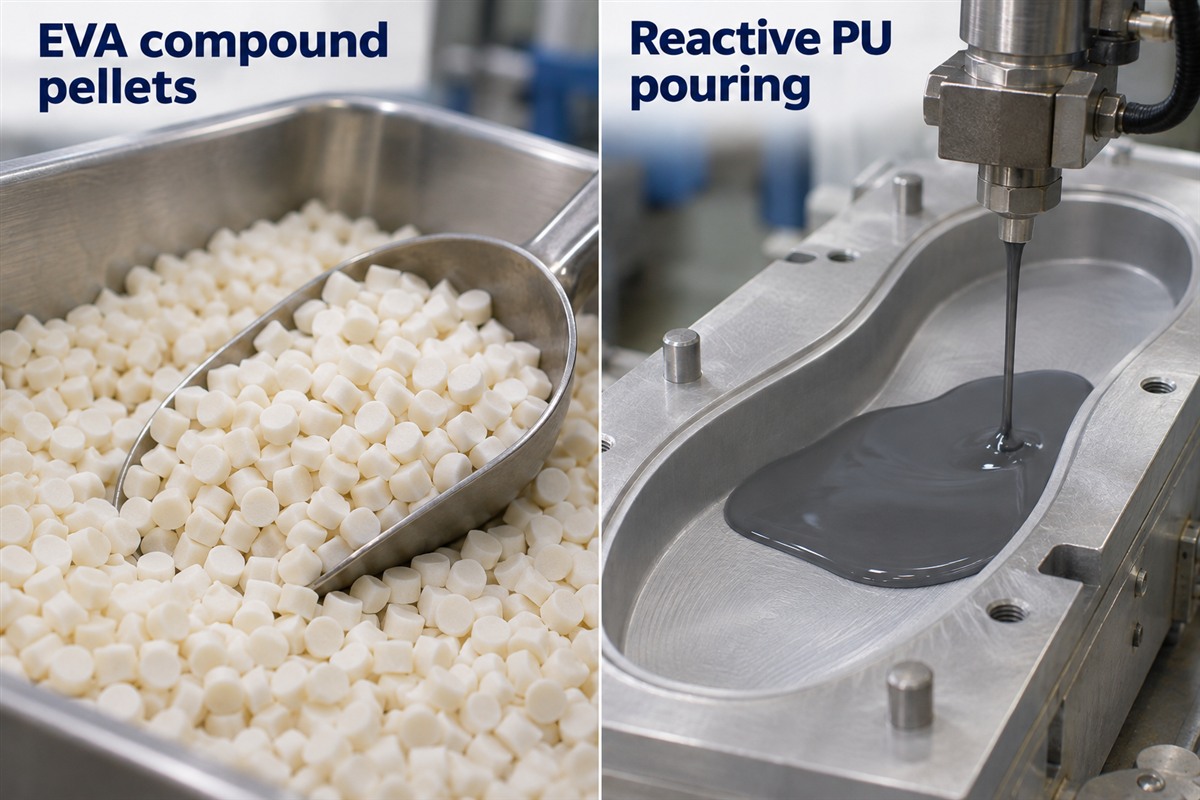
Confirm how your supplier plans to make and assemble the selected construction. Ask whether the sample represents that proposed production process, including any separate layers and bonding steps.
For cost, request quotations against the same requirements. Check quantities, size ranges, tooling, surface finishes, assembly, and testing. Comparing a loose midsole quote with a complete bottom-unit quote will not show which material is more economical for your project. Evaluate what you would receive at the quoted price.
What to Confirm Before Sampling
Give the supplier a brief that makes the alternatives comparable. Before requesting samples, agree on the following:
- Use and environment: Define the shoe’s intended activities, contact surfaces, and relevant storage conditions so the evaluation addresses the actual project.
- Sole construction: Identify the midsole, outsole, and any separate layers. State whether you need components or a complete assembly.
- Material specification: Request the material system or grade, finished density with units, and hardness with its scale and measurement conditions.
- Sample comparison: Specify a common shoe size and record component weights, dimensions, and the parts included in each measurement.
- Validation: Agree on the relevant performance checks, test conditions, and acceptance criteria. Include aging or bond evaluation where the construction calls for it.
- Production and quotation: Confirm the intended process, tooling requirements, and what the price includes, so sample approval refers to the construction you expect to order.
Keep these details with the sample record. If a material or structural detail changes, review whether the original comparison still applies.
FAQ
Can You Tell EVA and PU Soles Apart by Looking at Them?
Appearance and hand feel can offer clues, but they are not enough to confirm the material system or formulation. Treat visual identification as provisional. Check the supplier’s material description and records for the relevant component, particularly when a sole combines several layers. If the identity remains uncertain and matters to approval, arrange suitable material identification with the supplier or a qualified laboratory.
Is EVA or PU Better for Grip on Wet Surfaces?
Neither label establishes which finished sole will grip better. A slip-resistance result describes a particular footwear or sole specimen tested against a particular surface under defined conditions. Ask for evidence relevant to the intended use, including the floor and any water or oil contamination. A dry-surface result does not answer a wet-surface question, and a result involving oil does not by itself establish chemical resistance to oil. Compare the test conditions before comparing the scores.
Conclusion
Choose EVA or PU by working from the shoe’s requirements to a specific sole construction. EVA offers a familiar route to lightweight cushioning, while PU systems provide options across different components, formulations, and production methods. Your decision should connect sample performance with the intended use and the proposed manufacturing process.
For an OEM or ODM shoe project with HEVA, bring your intended use, sole layout, and weight and feel targets into the development discussion. Those details provide a useful starting point for evaluating options.