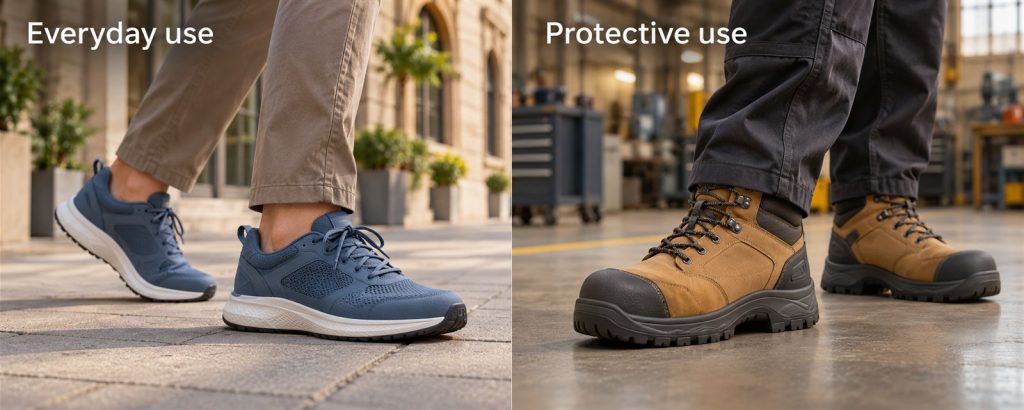
EU footwear compliance testing starts with the purpose of the shoe. An everyday training shoe and a shoe designed to protect someone from workplace hazards can require different evidence, even when they look similar.
Before requesting tests, define the intended use, the claims you plan to make, and the materials and construction of the actual product. Those decisions help determine which requirements apply and what the testing needs to demonstrate.
This guide explains how to compare the ordinary footwear and personal protective equipment (PPE) routes, review existing reports, and prepare a testing brief that reflects the shoes you intend to produce.
Start with Intended Use and Protective Claims
Begin with a description of how the shoe will be used and what, if anything, it is designed to protect against. Include the product specification, intended users, instructions, and proposed marketing claims.
For this article, ordinary shoes means conventional consumer footwear sold without a PPE purpose or another special regulatory status, such as a medical device. PPE is equipment designed and manufactured to protect a person against health or safety risks. Its scope also includes exclusions, so a protective-sounding feature does not settle the classification on its own.
A sporty appearance does not rule out PPE, and wearing a shoe at work does not automatically make it safety footwear. Likewise, a slip-resistance claim needs to be considered in context: what risk is being addressed, under what conditions, and for which use?
Resolve these questions before choosing a testing package. If the intended purpose falls within PPE legislation, establish the relevant risk category and conformity assessment route. If it does not, you still need to identify the safety requirements applicable to the consumer product.
Ordinary Shoes vs Safety Footwear: Compare the Requirements
Both routes require evidence appropriate to the product. The difference is how that evidence supports the applicable obligations.
For ordinary consumer shoes, the General Product Safety Regulation (GPSR) requires an internal risk analysis and technical documentation. Relevant testing can help demonstrate how identified risks have been addressed. The regulation does not turn this into one universal footwear test package.
For safety footwear within PPE scope, testing forms part of a wider conformity assessment process. Keep these distinctions in view:
| Decision point | Ordinary consumer shoes | Safety footwear within PPE scope |
|---|---|---|
| Safety evidence | Risk analysis and relevant supporting documentation. | Evidence supporting applicable PPE health and safety requirements. |
| Test selection | Based on product risks, applicable restrictions, and performance needs. | Based on intended protection, applicable requirements, and assessment route. |
| Key documents | Technical documentation and relevant test evidence. | Technical documentation, test evidence, EU declaration, and type-examination certificate where required. |
| CE marking | Not applied merely because the shoes are sold in the EU. | Required under the applicable PPE conformity assessment route. |
| External assessment | Determine testing needs from the product and applicable requirements. | Notified-body involvement depends on risk category and procedure. |
| Production | Maintain safety and the relevance of supporting evidence. | Maintain conformity; additional supervision applies under Category III procedures. |
A notified body is an organization authorized by an EU Member State to perform specific conformity assessment tasks under EU law. Its role depends on the PPE category and assessment procedure.
Under the PPE Regulation, Category I uses internal production control, known as Module A. Category II requires EU type-examination, Module B, followed by conformity to type based on internal production control, Module C. Category III generally requires Module B plus either supervised product checks, Module C2, or production quality assurance, Module D.
Do not assign every safety shoe to the same category. The risks the product is intended to address determine the route.
A laboratory test report, an EU type-examination certificate, and an EU declaration of conformity serve different purposes. The report records test results; the certificate concerns an assessed PPE type; the declaration is the manufacturer’s statement of conformity. A generic voluntary certificate cannot replace the required process.
GPSR does not apply to PPE in exactly the same way as it applies to ordinary consumer shoes. Where EU legislation sets specific safety requirements, GPSR applies only to aspects and risks those requirements do not cover, subject to its express exclusions. For products covered by EU harmonization legislation, those exclusions include Chapter III, Section 1—the section containing Article 9. Use the PPE Regulation to identify the applicable manufacturer obligations rather than copying the ordinary-shoe checklist.
Build a Test Plan Around the Actual Shoe
Separate Chemical Checks from Performance Tests
Start with a bill of materials (BOM) that identifies the components and materials in your current specification. Leather, textiles, plastics, rubber, coatings, adhesives, and metal parts may raise different questions. Include relevant treatments and finishes, rather than relying only on broad descriptions such as “synthetic upper.”
Ask which restrictions apply to the product and material, what the relevant conditions or exemptions are, and what evidence is needed. A chemical test on one component does not establish the physical performance of the finished shoe.
Product classification can affect the chemical assessment too. REACH Annex XVII Entry 72 covers specified substances in certain consumer products, including footwear. It also excludes certain materials and products from its scope, including footwear covered by the PPE Regulation. That exclusion does not exempt PPE from all REACH obligations. It is a reason to check each restriction’s scope instead of copying one chemical checklist across both categories.
Physical testing addresses a different set of questions. Depending on the construction, use, and claims, your plan might examine sole adhesion, flex resistance, abrasion, or other relevant properties. These are possible testing needs, not a statement that every listed test is legally mandatory for every shoe.
Keep the reason for each test visible: an applicable requirement, evidence for a safety assessment, or an agreed performance specification.
Match the Method, Requirement, and Edition
A method tells the laboratory how to test. A product requirement identifies what must be demonstrated. A report should make clear which method and requirement were used, including their editions.
ISO 20344 specifies test methods for footwear designed as PPE. ISO 20345 addresses safety footwear, ISO 20346 protective footwear, and ISO 20347 occupational footwear. These terms are not interchangeable, and ISO 20344 is not a universal certification standard for ordinary sports shoes.
The EU harmonized references checked in November 2026 include EN ISO 20345:2022 with A1:2024, EN ISO 20346:2022 with A1:2024, and EN ISO 20347:2022 with A1:2024. Confirm the applicable reference when arranging an assessment. The EN publication year and the underlying ISO publication year can differ.
Using an applicable harmonized standard can provide a presumption of conformity for the requirements it covers. It does not remove the need to check the product’s full scope, other applicable requirements, or the required conformity assessment procedure.
Check What Each Report Actually Covers
Before accepting an existing report, compare its sample description with the shoe you intend to produce. A matching product name is a starting point, but it may not explain differences in materials, colors, suppliers, or construction.
Use this review checklist:
• Sample identity: Can you connect the report to the relevant style, sample, and specification?
• Materials and source: Do the tested components correspond to the current BOM and supply arrangements?
• Variants: Which colors, sizes, or constructions are covered, and what supports any extension beyond the tested sample?
• Test scope: Was the test performed on a material, component, or finished shoe?
• Method and assessment: Does the report identify the test method and edition, show the results, and state any criteria used to judge a pass or fail?
• Limitations: Does the report exclude properties or conditions relevant to your intended use?
• Supporting documents: Where applicable, do the certificate, declaration, and technical documentation identify the corresponding product?
These are practical review questions, not a substitute for a laboratory’s or notified body’s assessment of coverage.
For example, an upper-material chemical report does not establish the adhesion performance of the finished shoe. Similarly, a report for one construction cannot automatically substantiate every other shoe sold under the same collection name.
If you want to use representative samples across a product family, ask for the coverage rationale to be documented. Do not assume that every variant always needs separate testing—or that similar-looking variants can always share results. Identify the differences and have their significance assessed.
A report is useful when you can explain both what it demonstrates and what remains outside its scope.
Reassess Evidence When the Product Changes
An approved sample can change before production. A revised outsole compound, different coating, new material source, or altered construction may affect the relevance of existing evidence.
Record the change before assuming the previous report still applies. Ask which properties or risks could be affected, who should assess the difference, and which documents need updating. For ordinary consumer shoes, keep the risk analysis and supporting documentation current and maintain procedures for consistent production.
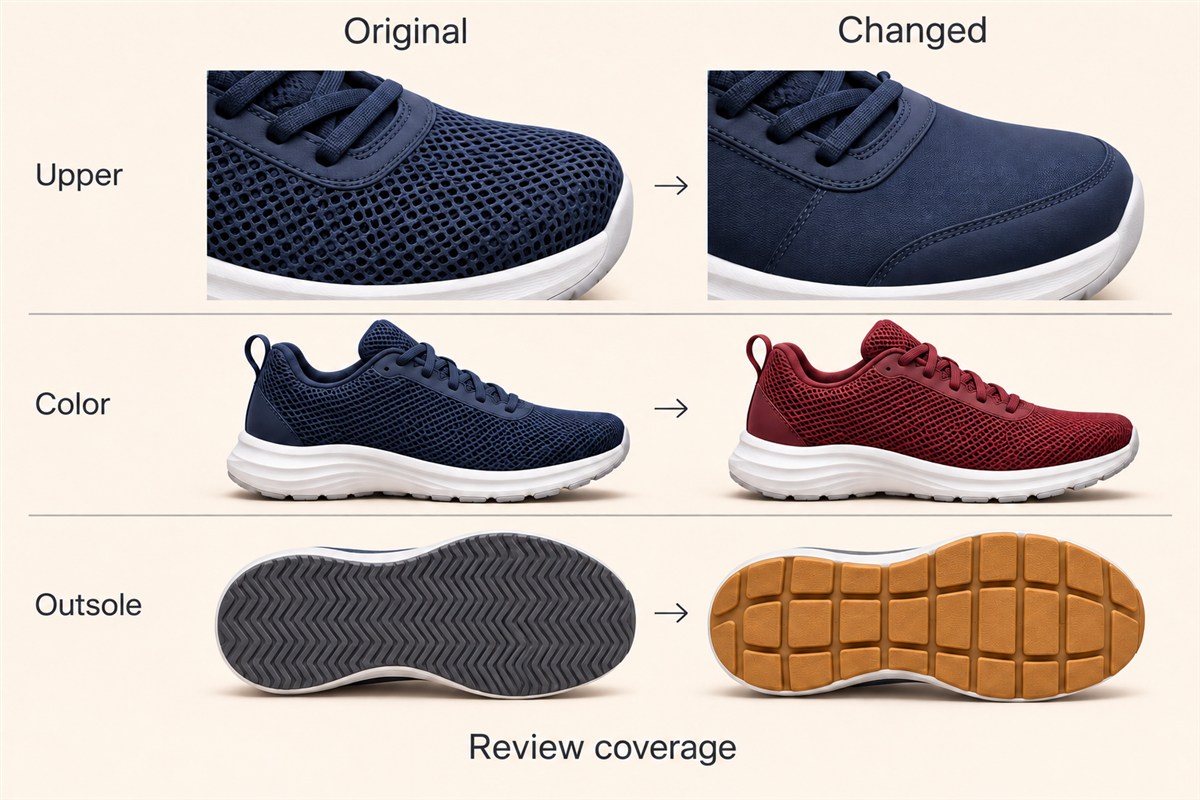
For PPE, changes to the approved type or technical documentation that may affect conformity or the certificate’s validity conditions must be addressed through the notified body holding the relevant documentation. For these changes, the manufacturer must obtain the notified body’s additional approval, documented as an addition to the original EU type-examination certificate. The need for further tests depends on the change and the assessment.
An EU type-examination certificate has a maximum validity period of five years. That is not a universal expiry period for footwear test reports, nor a guarantee that a modified product remains covered until the certificate expires.
Separate the questions: Is the document current? Does it cover this product? Has anything changed that requires reassessment? A date check alone cannot answer all three.
Prepare a Clear Testing Brief
Before approaching a laboratory, gather enough information to explain the product and the decisions you need help making:
• Intended use, users, and any protective or functional claims.
• EU destination markets and relevant customer specifications.
• Current shoe specification, BOM, and material or finish details.
• Styles, colors, and other variants proposed for coverage.
• Existing reports, certificates, and known changes since testing.
• Risks or performance questions that need assessment.
• The intended use of the report and any conformity assessment involved.
Ask the laboratory to identify the proposed test scope, sample requirements, methods, and limits of the resulting evidence. Where notified-body involvement is required, check its notification and scope in the European Commission’s NANDO database, and coordinate the required assessment before treating a laboratory quotation as the complete plan.
This gives everyone a common product description to work from and makes differences between proposals easier to understand.
FAQ
How Much Does EU Footwear Testing Cost, and How Long Does It Take?
Request a quotation against a defined scope. Costs depend on the product and assessment involved; scheduling also needs to be confirmed for the proposed samples and work. Ask whether the quote includes sample preparation, any required conformity assessment, and retesting after a failure or change. Confirm when the stated turnaround begins and what could affect it. A price or deadline without a matching scope is difficult to compare.
Can Your Shoe Supplier Arrange the Testing?
Discuss with your supplier whether it will coordinate testing and how that work will be documented. Agree who submits the samples, who receives the complete reports, and who checks that the results cover the production specification. Arranging testing does not, by itself, transfer the legal responsibilities attached to your role. If you have a product made and market it under your own name or trademark, check the manufacturer obligations that apply to you.
What If a Customer Requests Tests Beyond Your EU Compliance Plan?
Obtain the customer’s written specification and compare it with the scope already proposed. Identify which requests address applicable legal requirements, which support the safety assessment, and which are additional contractual performance requirements. Ask for clarification where a method, edition, or acceptance criterion is unclear. Customer approval and regulatory compliance answer different questions; document both where they apply, without presenting a customer’s private specification as a universal EU rule.
Conclusion
Start with the shoe’s intended use, then define the testing and assessment needed to support it. Check that every report relates to the actual materials, construction, and variants, and revisit that evidence when the product changes.
For your next development discussion, bring the current specification, BOM, claims, and available reports. A clear description of the shoe—and the questions still unresolved—makes it easier to agree on the work needed before production.