Requirements reviewed as of November 9, 2026.
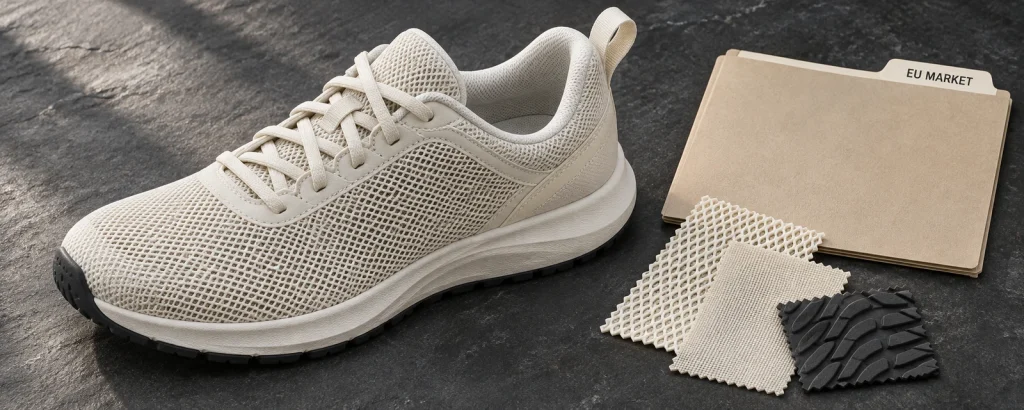
Before you approve a sports shoe for the EU market, establish what it is designed to do, who will wear it, and where it will be sold. Those decisions shape the materials, labeling, safety information, and records you need.
EU footwear regulations involve several connected checks. A material label answers a different question from a chemical test report, and neither settles who is responsible for the product. This guide explains how to organize those checks for ordinary sports shoes, from development through shipment and online listing.
Which EU Rules Apply to Your Sports Shoes?
Start with intended use and the claims you plan to make. Ordinary sneakers and sports shoes generally need attention to footwear material labeling, chemical restrictions, general product safety, and packaging. Shoes designed to protect against health or safety risks may fall under the Personal Protective Equipment Regulation, or PPE Regulation.
That distinction affects CE marking. Ordinary sports shoes do not automatically require CE marking simply because they are sold in the EU. CE must only be used where applicable EU legislation requires it. Footwear that qualifies as PPE follows the relevant conformity assessment route, including an EU declaration of conformity and CE marking.
Describe the actual protective purpose before choosing a route. An outdoor appearance or a waterproof claim is not enough to decide which regulatory route applies. Electronic features, medical purposes, or particular treatments may also require separate checks beyond this guide.
Check the product scope of environmental rules, too. Leather or rubber content alone does not bring finished footwear within the EU Deforestation Regulation. Its current Annex I does not list finished footwear under codes 6401–6405; separately traded materials and other goods require their own scope assessment.
Prepare the Footwear Material Labels
The Footwear Labeling Directive, 94/11/EC, identifies three parts of the shoe. Your material information should support a separate decision for each one.
| Shoe part | Basis for the 80% rule | Information to confirm |
|---|---|---|
| Upper | Surface area | Main material, excluding the accessories and reinforcements specified by the directive. |
| Lining and sock | Surface area | Materials making up the lining and sock lining. |
| Outer sole | Volume | Materials making up the outer sole. |

Identify the material accounting for at least 80% on the applicable basis. If no material reaches that threshold, identify the two main materials. Whole-shoe weight percentages cannot replace these calculations.
The prescribed material categories are leather, coated leather, textiles, and other materials. You can use the prescribed pictograms or written descriptions in the language or languages determined by the destination Member State.
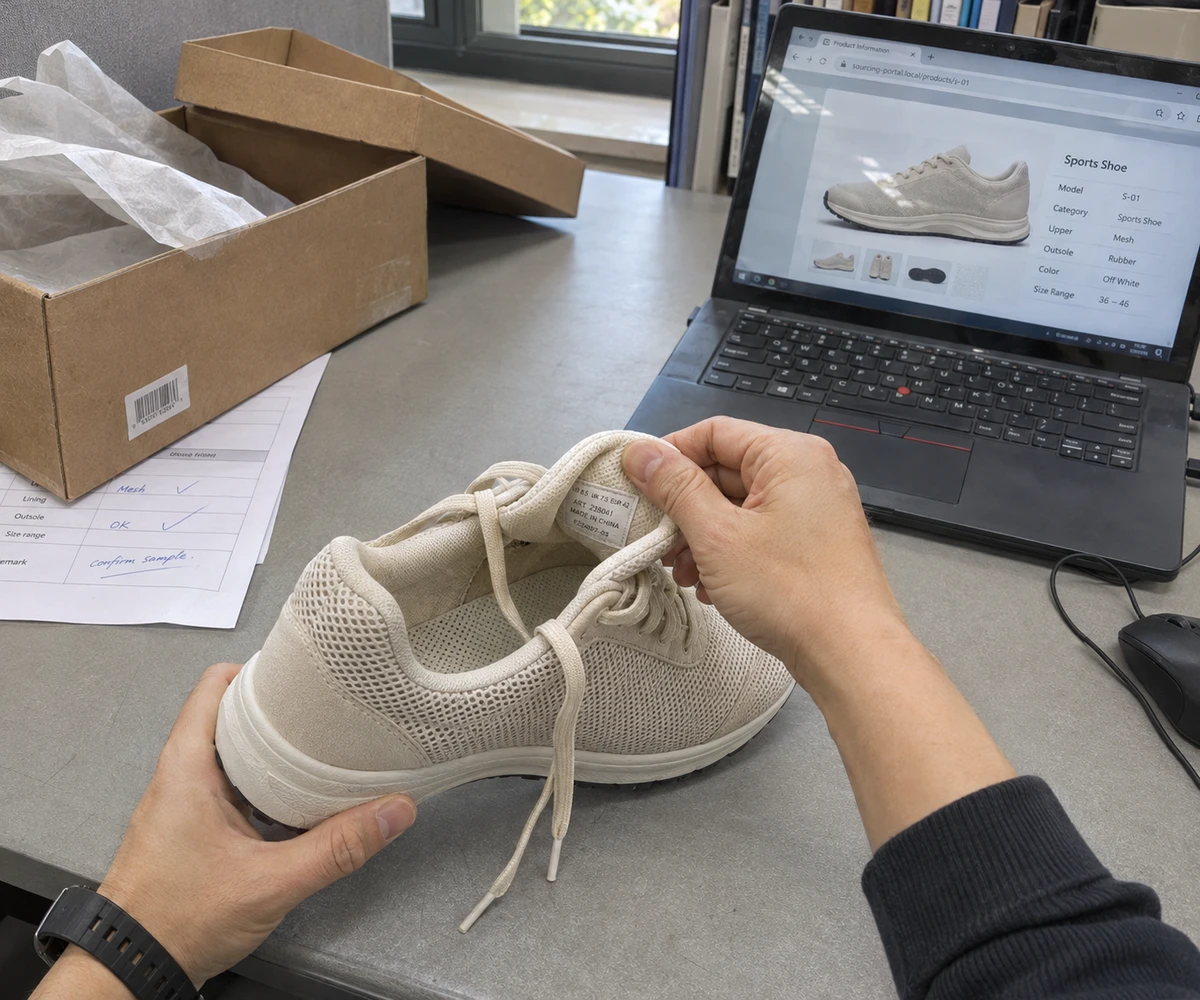
The label must appear on at least one shoe in each pair. Printing, an attached label, or another permitted method must leave it visible, securely attached, and accessible. A material description printed only on the shoebox does not meet this placement requirement.
Check the finished label against the approved construction before production. Keep this material label separate in your review from batch identification, business contact details, and safety information, which have their own requirements.
Match Chemical Requirements to Your Materials
Start With the BOM and Material Treatments
A bill of materials, or BOM, gives you a starting point for chemical checks. Identify the upper, lining, insole, sole, trims, prints, coatings, and adhesives, along with their suppliers, colors, and treatments. Material names alone may leave important questions unanswered: two fabrics can have different dyes or water-repellent finishes.
REACH restrictions depend on the substance, material, use, and exposure conditions. The examples below show why a single whole-shoe limit or standard test package is insufficient.
| Material or condition | Example restriction | Concentration basis |
|---|---|---|
| Textiles or leather with direct, prolonged skin or oral contact | Specified aromatic amines released by azo dyes: above 30 mg/kg, using the prescribed methods. | The article or dyed part; this is not a ban on every azo dye. |
| Leather in contact with skin | Chromium VI: 3 mg/kg or more. | Dry weight of the leather, including the relevant leather part. |
| Plasticized material in articles covered by the restriction | DEHP, DBP, BBP, and DIBP: 0.1% or more, individually or combined. | Weight of the plasticized material; the scope extends beyond PVC. |
| Rubber or plastic components with direct, prolonged or short-term repetitive skin or oral contact | Any listed polycyclic aromatic hydrocarbon (PAH): above 1 mg/kg in the relevant consumer-article provision. | The component; the limit is not the sum of all listed PAHs. |
These are restricted concentrations under the stated conditions, not a complete testing specification. Screen other applicable requirements, including dimethylfumarate, restrictions on relevant substances classified as carcinogenic, mutagenic, or toxic to reproduction (CMR), other REACH entries, and the Persistent Organic Pollutants Regulation. Keep substance-specific exceptions attached to the rule they qualify.
Keep PFHxA Scope and Dates Clear
For footwear intended for the general public, REACH Entry 79 restrictions apply from October 10, 2026. The thresholds are 25 ppb or more for the sum of PFHxA and its salts, or 1,000 ppb or more for the sum of PFHxA-related substances, measured in homogeneous material.
Check the entry’s specific exemptions and provisions for articles already placed on the market before that date. Earlier manufacture alone is not the same as earlier market placement. These PFHxA limits are not a single EU-wide limit covering every PFAS.
Separate Restrictions From SVHC Information Duties
The REACH Candidate List identifies substances of very high concern (SVHCs). Listing does not automatically ban a substance from every article. Under Article 33, an article containing a listed substance above 0.1% by weight triggers safe-use information duties, including at least the substance’s name. Information goes to article recipients; consumers who request it must receive it free within 45 days.
SCIP reporting is a separate obligation to assess for relevant EU suppliers of articles containing Candidate List substances above 0.1% by weight. The annual one-metric-ton condition for REACH Article 7 notification does not apply to Article 33 or SCIP.
Where a shoe incorporates components that qualify as articles under REACH, assess the 0.1% threshold for those articles rather than averaging it across the whole shoe.
Ask for material and component information that supports these assessments. For test evidence, check the sample identity, material or color covered, substances tested, methods, and results. A report headed “REACH” does not by itself establish coverage of your finished shoe.
Organize Product Safety, Traceability, and Compliance Records
Confirm Roles and Prepare the Safety File
The General Product Safety Regulation, or GPSR, has applied since December 13, 2024. For ordinary consumer footwear, it connects product safety with responsibilities before and after market placement. Where specific EU safety legislation applies, check the GPSR’s scope provisions rather than assuming every obligation applies identically.
Map the actual supply chain. A business that has shoes manufactured and markets them under its own name or trademark can be the manufacturer under the regulation. Outsourcing production does not remove that responsibility. An EU-established business placing footwear from a third country on the EU market may have importer obligations.
There must also be an appropriate EU-established economic operator responsible for the tasks specified by the GPSR. Confirm who fulfills that role. An additional third-party representative service is not automatically required for every project.
Before placing the product on the market, the manufacturer must conduct an internal risk analysis and prepare technical documentation. Start with the product description and essential safety characteristics. As appropriate, include identified risks, measures addressing them, relevant test reports, and standards used. Consider intended users, including children where relevant, and reasonably foreseeable use.
Manufacturers keep the relevant technical documentation for ten years after market placement; importers keep a copy for ten years after their placement. Supply-chain identity information has a separate six-year period following supply or receipt. Assign ownership so records remain accessible when staff or suppliers change.
Assign a contact to receive and escalate safety complaints. If a product is dangerous, the responsible business must take the applicable corrective action and make the required notifications.
Article 20 separately covers product-related accidents causing death or serious adverse health and safety effects. Confirm who must ensure notification through the Safety Business Gateway without undue delay, and how information reaches that person.
Check Product Identification and Online Offers Separately
Check type, batch, serial number, or another product identifier, together with the required manufacturer and importer contact information. Manufacturer and importer details include postal and electronic addresses. Moving required information to packaging or accompanying documents is subject to the conditions for that particular requirement.
Provide instructions and safety information where needed, in a language consumers can easily understand as determined by the destination Member State. Do not invent generic warnings for every shoe or assume all instructions are always unnecessary.
For online offers, Article 19 requires clearly visible product identification, including a picture and type, manufacturer contact details, and applicable warnings. Where the manufacturer is outside the EU, include the EU responsible person’s name and postal and electronic addresses.
Review three places separately: the physical shoe, its packaging or accompanying information, and the online offer. A complete listing does not automatically correct missing physical information, or vice versa.
Check Packaging and Destination-Country Requirements
Put the shoebox, bags, and protective inserts on a separate packaging list. The Packaging and Packaging Waste Regulation, or PPWR, generally applies from August 12, 2026, while individual requirements have their own dates and transitional provisions.
Identify your role under the packaging rules; it is not necessarily the same as your role for the shoe. For applicable requirements, confirm the packaging conformity assessment, technical documentation, and EU declaration of conformity. Packaging suppliers must provide the information needed by the packaging manufacturer. Relevant manufacturer records are retained for five years for single-use packaging and ten years for reusable packaging, measured from market placement.
Then check each destination country’s current registration and extended producer responsibility, or EPR, arrangements, alongside language requirements. Do not assume one registration or information package settles every market.
France illustrates why the country check matters. Its government guidance explains national PFAS restrictions applying to consumer footwear from January 1, 2026, including leather shoes. The national scope, thresholds, exemptions, and stock provisions require separate assessment from the EU PFHxA restriction. A supply agreement between businesses does not make shoes intended for consumers a professional-use product.
Separate Current Requirements from Upcoming Measures
Use an update list with dates, affected products, and responsible people. A regulation’s entry into force, its general application date, and a later product-specific requirement may represent different milestones.
| Measure | Status as of November 9, 2026 | Preparation task |
|---|---|---|
| PFHxA in footwear intended for the general public | The October 10, 2026 application date has passed; specific exemptions and transition provisions remain relevant. | Check finishes, homogeneous materials, and market-placement records. |
| PPWR | Generally applicable since August 12, 2026; individual requirements have separate timing. | Check the provisions relevant to your packaging and role. |
| Textile and footwear EPR | The revised Waste Framework Directive entered into force on October 16, 2025, with national implementation and scheme-establishment periods. | Verify current destination-country obligations and upcoming changes. |
| Footwear digital product passports | Requirements depend on applicable product measures. Footwear is outside the first working plan’s product priorities under the Ecodesign for Sustainable Products Regulation (ESPR), with a study planned by the end of 2027. | Track specific measures; do not assume every ordinary sports shoe already needs a DPP. |
| Destruction of unsold footwear | The EU-level ban applies to large companies from July 19, 2026, and medium-sized companies from July 19, 2030. Small and microenterprises are exempt; specific exceptions apply. National rules may apply earlier. | Review inventory handling, business size, and evidence for any exception. |
These measures address different responsibilities. An inventory rule or future product-data requirement should not be presented as a universal footwear import certificate.
What to Confirm Before Sampling and Shipment
For each task, record who is responsible, which documents support it, and what remains unresolved. The stages below are a practical way to manage preparation, not a legally prescribed sequence.
| Stage | Confirm | Who is responsible |
|---|---|---|
| Before sampling | Intended use, age group, countries, claims, BOM, business roles, and evidence plan. | Product development and the businesses responsible for compliance. |
| Before production | Approved construction and materials, label artwork, risk documentation, and evidence matched to the confirmed sample. | Development, production, and the relevant manufacturer or importer. |
| Before shipment and listing | Batch identification, contact information, packaging records, online content, and unresolved issues. | The relevant economic operators, with logistics and ecommerce teams. |
Record changes to materials, suppliers, treatments, intended use, or sales countries. Assess whether the existing evidence still supports the revised product before deciding what additional documentation or testing is needed.
At the final review, compare the actual shoe and packaging with the approved information. Keep physical marking and online-offer checks distinct, and record any gaps that need resolution before the relevant market-placement or sales step.
FAQ
Can One Test Report Cover Different Colorways?
Not automatically. Check whether the report and supporting records identify the materials, suppliers, colors, treatments, and samples relevant to the other versions. A different dye or finish can change the chemical assessment even when the shoe design stays the same. Have the responsible team assess whether the evidence covers the other colorways and what additional testing, if any, is needed.
Can You Use the Same Product Information in Every EU Country?
Keep a shared master record of product information, then review it for each destination country. Check required languages, applicable warnings, business details, and current national obligations. This helps you reuse consistent product facts while controlling market-specific differences. Even for the same shoe, check whether the packaging design and online description meet each country’s requirements.
How Should You Handle a Customer’s Restricted Substances List?
Compare the customer’s RSL version, material scope, limits, and evidence requirements with the applicable legal restrictions. Keep both sets of requirements visible in the project specification. A customer may request stricter limits or different reporting arrangements, but its list does not replace the law. Resolve differences before approving materials, rather than assuming a report prepared for one customer covers another.
Conclusion
Start EU footwear compliance work with a defined product, a clear supply chain, and a material list that reflects what will actually be produced. Use those inputs to prepare labels, assess risks and chemical requirements, and assign responsibility for packaging and product information. Keep country and timing checks current.
For an OEM or ODM sports shoe project with HEVA, bring your target markets, intended use, BOM, label artwork, and outstanding documentation questions to the development discussion.