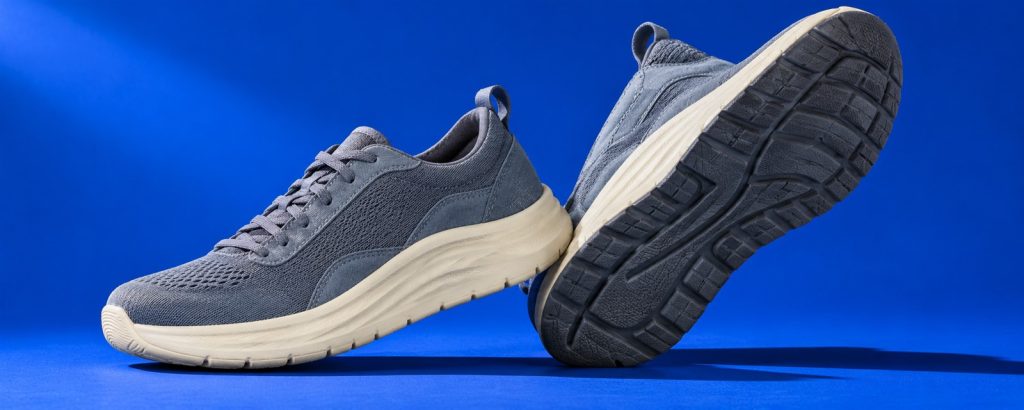
EVA foam is a useful starting point when you want a lightweight, cushioned sole. TPR is an option for the ground-contact layer, where the compound and tread need to suit the surfaces your shoe will encounter. A shoe can also combine the two.
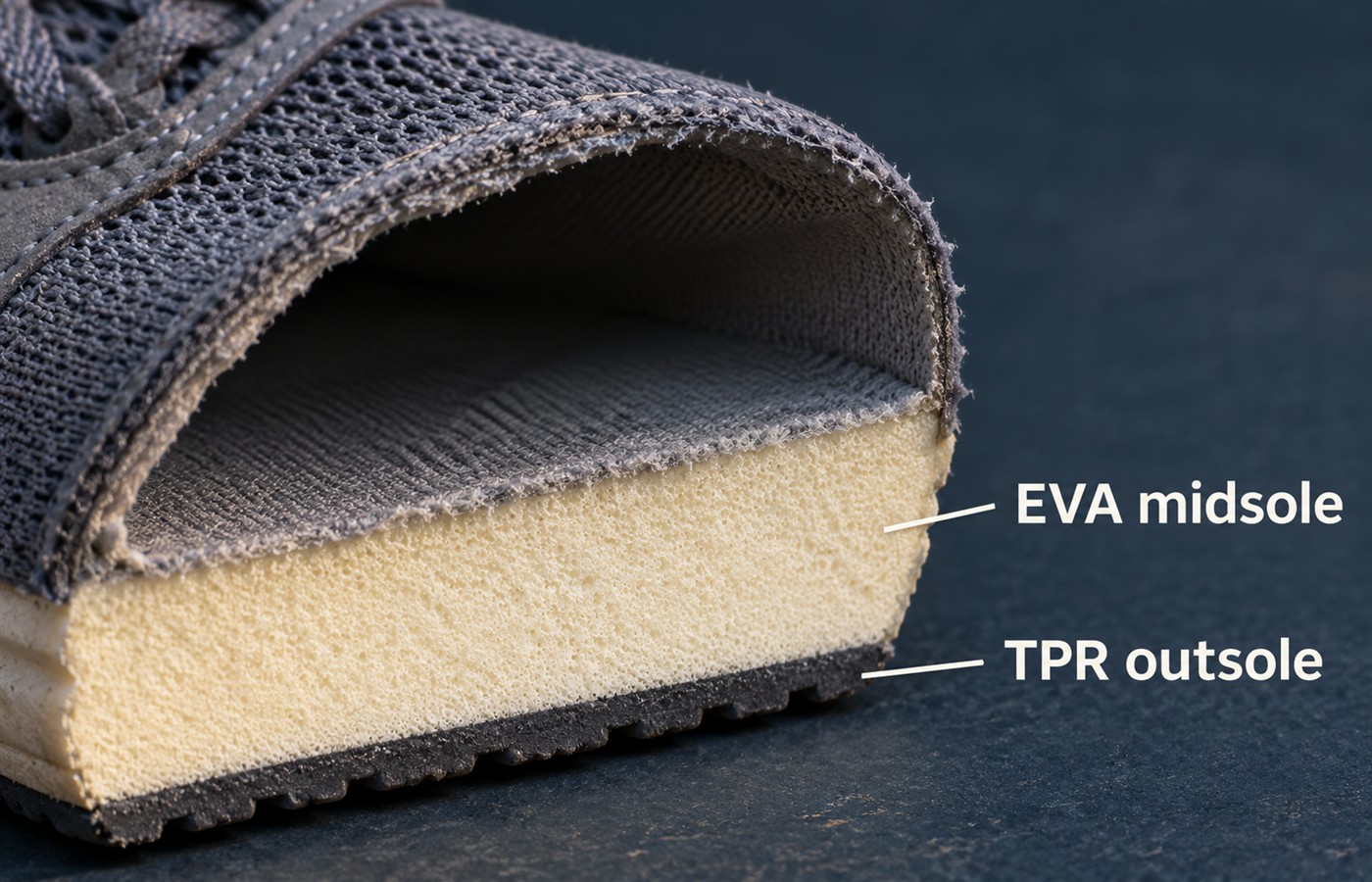
The important first step in a TPR vs. EVA sole comparison is identifying what each material does in the proposed shoe. An EVA midsole and a TPR outsole perform different jobs. Once you know which parts you are comparing, you can judge comfort, wear, grip, and cost more clearly.
What’s the Difference Between TPR and EVA Soles?
TPR stands for thermoplastic rubber. In footwear, the term commonly describes rubber-like compounds that can be processed using thermoplastic methods. It does not identify one fixed recipe, hardness, or level of performance.
EVA stands for ethylene-vinyl acetate. It is often used as foam in midsoles and footbeds, where cushioning and low weight matter. Suitable EVA compounds can also form soles that contact the ground. The properties of the finished foam depend on its formulation and processing; figures for the raw resin do not describe the finished sole.
Separate the material from its position in the shoe:
- The midsole sits between the foot and the outsole and can provide cushioning.
- The footbed is the component directly beneath your foot inside the shoe.
- The outsole forms the main ground-contact surface.
A description such as “EVA sole” may refer to an exposed foam sole, an EVA midsole with another material underneath, or a more complex construction. Ask for a breakdown of the components when the label is unclear. Appearance alone is not a reliable material specification.
TPR vs. EVA Soles at a Glance
The table below covers common EVA foam applications and TPR outsoles. Use it to compare their roles and the properties you need to verify in the proposed construction.
| Comparison point | EVA foam sole or component | TPR outsole |
|---|---|---|
| Main role | Cushioning in midsoles or footbeds; suitable formulations also serve as exposed soles | Ground-contact layer within a complete sole construction |
| Weight | Foaming supports lightweight designs; actual weight also depends on dimensions | Check the compound and amount of material used, then weigh the finished unit |
| Cushioning | Evaluate initial feel and how cushioning changes with repeated use | Assess the full underfoot construction, including any cushioning layer |
| Grip | Test exposed foam on the intended surfaces | Evaluate the selected compound and tread under relevant surface conditions |
| Durability | Check surface wear where exposed, compression set, and cushioning retention | Check outsole wear and flexing; assess cushioning components separately |
| Manufacturing and cost | Confirm the foaming route, dimensions, tooling, and any assembly operations | Confirm molding, tooling, and attachment requirements in the complete quotation |
How Do Comfort, Grip, and Durability Differ?
Weight and Cushioning
EVA foam is widely used in athletic footwear because it can provide lightweight cushioning. That makes it worth considering when reducing underfoot weight is a priority. However, a material name cannot tell you how much the finished shoe will weigh. Sole thickness, coverage, and the other components all contribute.
Compare samples in the same size and record what is included in each measurement. Weighing an EVA midsole against an assembled TPR-bottomed unit would leave part of the comparison out.
Softness describes how readily a material deforms under pressure. Shock absorption concerns its response to an impact, while energy return describes how much of the input energy is returned during recovery. Pressing a sample with your thumb gives an impression of local softness. It does not establish how the assembled shoe responds to repeated loading. A TPR outsole can sit beneath a cushioned construction, so a firm ground-contact layer does not, by itself, tell you how the whole shoe will feel.
Grip on the Surfaces You Use
Neither “TPR” nor “EVA” is a slip-resistance rating. Grip depends on the interaction between the sole and the surface, including the compound, tread, and any water or other contamination present.
If you are concerned about wet floors, a favorable dry-surface result does not settle the question. Ask which surface was tested, under what conditions, and whether the report describes the material, the sole unit, or the complete shoe. Compare results produced under compatible conditions.
The activity matters, too. Walking, running, and rapid changes of direction place different demands on footwear. Avoid treating a result from one test condition as a guarantee for every surface or movement.
Abrasion and Cushioning Retention
“Durable” can mean several things. Abrasion is material being worn away from the surface. Compression set concerns the deformation remaining after a material has been compressed and allowed to recover. Comparing shock absorption and energy return before and after repeated compression helps show how those properties hold up under repeated loading.
These properties need separate attention. An exposed EVA sole needs an appropriate balance of ground-contact wear and cushioning performance. With a TPR outsole beneath a foam layer, inspect the outsole’s wear and the foam’s cushioning retention separately. A bottom surface that still looks intact does not prove the cushioning is unchanged.
Also check how wear results are reported. For materials with different densities, grams lost during abrasion are not a sufficient basis for a direct ranking. A relevant abrasion method may report volume loss instead. Neither result, on its own, gives a reliable number of months the shoe will last.
When Should You Choose EVA, TPR, or a Combination?
Start with EVA Foam for a Lightweight Brief
Consider an EVA foam option when your brief prioritizes low weight and cushioning, such as a lightweight casual shoe. Specify whether the foam will be protected by an outsole or exposed to the ground.
For an exposed EVA design, ask whether the proposed formulation and sole geometry meet your wear and grip requirements. You should not assume that foam selected for a protected midsole is equally suitable for ground contact.
Evaluate TPR for the Ground-Contact Layer
If you are comparing TPR outsole options, start with the proposed compound and tread. Check their performance on your intended surfaces, then assess flexibility, finished weight, and how the outsole works with the rest of the underfoot construction.
If cushioning is a priority, include the midsole or footbed in the evaluation. Changing the ground-contact material alone may not address the underfoot feel you are trying to improve. Likewise, choosing TPR does not remove the need to check wet grip or abrasion performance.
Combine Materials When They Serve Different Jobs
An EVA cushioning layer with TPR underneath is one construction to evaluate when you want the layers to serve different functions. The amount and placement of TPR, the cushioning geometry, and the connection between them all deserve attention.
Compare the assembled result with your alternatives. Added components bring attachment and production considerations, and the final weight depends on the complete design.
For running footwear, this distinction is especially useful: an EVA midsole and a TPR outsole are not competing answers to the same question. Assess cushioning, stability, flexibility, and traction in the complete shoe before deciding whether the proposed construction fits the intended activity.
What Changes in Manufacturing and Cost?
A useful cost comparison starts with the same development brief: size range, order quantity, colors, construction, and performance requirements. The price of a raw material alone does not tell you what the finished sole will cost.
Ask what each quotation includes. Tooling, material consumption, molding or foaming, finishing, attachment, production losses, and inspection may be accounted for differently. Identify one-time tooling charges separately from recurring production costs, and compare the same scope before judging a price difference.
For a bonded construction, surface preparation, adhesive selection, drying, activation, and pressing all need to work with the selected materials. A drawing that combines EVA and TPR does not establish that the chosen parts will bond reliably in production.
To find out which option costs less for your shoe, compare quotations for the actual constructions and the work needed to meet the same requirements.
How to Compare Two Sole Samples
Imagine two proposals for the same everyday casual shoe: Sample A has an exposed EVA sole, while Sample B includes a TPR ground-contact layer. This is an illustrative comparison, not a test result or a HEVA customer case.
- Align the comparison. Use the same shoe size and intended activity. Record each layer, the sole dimensions, and the surfaces the shoe needs to handle. Keep differences in tread or thickness visible in your notes.
- Check the samples and supporting evidence. Compare finished weight and underfoot feel. Review relevant grip, abrasion, and compression results, checking the specimen, method, and conditions. Where components are bonded, include evidence that the proposed connection is suitable.
- Choose based on your priorities. Put the performance findings beside quotations covering the same scope. If both meet your required grip and wear criteria, use your remaining priorities—such as weight, cushioning, and cost—to choose between them. If one misses a required criterion, resolve that gap before treating its lower price or weight as an advantage.
If the two proposals use different thicknesses or tread designs, your conclusion concerns two complete constructions. You cannot attribute every difference to EVA versus TPR. That still gives you a useful decision: which proposal better meets this shoe’s requirements, and what remains to be resolved?
FAQ
Can You Compare EVA and TPR Hardness Numbers Directly?
First check the hardness scale and test conditions. A Shore A reading and an ASKER C reading cannot be compared as though they use the same scale. Ask for the scale and test details, rather than accepting a number labeled only “hardness.” Even comparable hardness readings do not establish equal cushioning, energy return, or grip in finished shoes.
Can You Use the Same Mold for EVA and TPR Soles?
Do not assume that changing materials is a simple swap. In crosslinked EVA foam injection molding, expansion affects the relationship between the mold cavity and the finished part. Have the manufacturer check the proposed compound, dimensions, molding process, and equipment against the existing tooling. Depending on the project, changes or new tooling may be needed. That is a project-specific assessment, not a rule that every EVA and TPR design must use entirely different tools.
Conclusion
Choose between TPR and EVA sole proposals by first identifying the part each material will play. EVA foam offers a starting point for lightweight cushioning; a TPR outsole needs to meet the ground-contact requirements of the particular shoe. A combination is another option when the layers have distinct jobs.
Compare actual construction, weight, cushioning retention, grip, wear, attachment, and quotation scope. For an OEM/ODM discussion with HEVA, bring your intended use, expected surfaces, reference construction, and main priorities. Those details give the sampling discussion a clearer starting point than a material name alone.