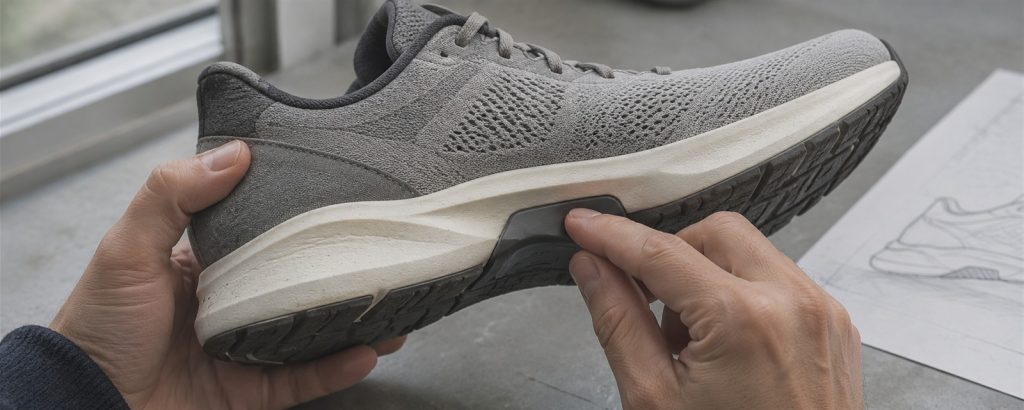
EVA foam is a common starting point for lightweight cushioning. TPU can serve different purposes depending on whether you mean a solid component or a foam. To choose between them, first identify the part of the shoe you are developing and what it needs to do. A cushioning midsole, a ground-contact outsole, and a support piece call for different comparisons—even when a supplier describes all three as part of the “sole.”
What Are You Comparing: EVA Foam, Solid TPU, or TPU Foam?
EVA stands for ethylene-vinyl acetate. TPU stands for thermoplastic polyurethane. These names identify material families; they do not describe a complete sole construction or guarantee a particular performance level. Start your comparison by separating the polymer, its physical form, and its position in the shoe.
In a typical cushioning discussion, EVA means EVA foam. For TPU, ask one more question: is the proposed component solid or foamed? A solid TPU support piece and a TPU foam midsole have different jobs. Treating them as one option can turn a useful material comparison into a misleading weight or comfort ranking.
TPU foam also covers more than one production route. Expanded TPU (ETPU) beads are one approach; other TPU foaming routes include supercritical-fluid injection. A process name alone is not enough to choose a material. Ask which TPU grade and foaming process the proposed sample uses.
Then label the component: midsole for cushioning, outsole for ground contact, or a separate support element. That gives your EVA-versus-TPU comparison a clear starting point.
EVA vs. TPU Soles: Key Differences
Use this table to organize the comparison. The material name helps you build a shortlist; the proposed grade, geometry, and test results help you choose.
| Factor | EVA foam | TPU: specify solid or foamed | What to compare |
|---|---|---|---|
| Weight | A candidate for lightweight cushioning. | Solid and foamed forms need separate comparisons. | Density, volume, and actual part weight. |
| Cushioning and support | Commonly used for lightweight cushioning in midsoles. | Solid grades serve outsole or support roles; foamed grades can cushion midsoles. | Role, geometry, and relevant performance data. |
| Wear and grip | Ground-contact use needs abrasion and traction checks for the selected foam. | Outsole grades are available for abrasion-resistant ground-contact parts; grip still needs testing. | Abrasion and traction as separate properties. |
| Flexibility | Depends on the foam and component design. | Depends on form, grade, thickness, and shape. | Bending behavior in the assembled shoe. |
| Processing and cost | Specify the formulation and production route. | Specify the form and production route. | Equivalent tooling, quantity, and assembly scope. |
Weight depends on both density and volume. A lower-density foam does not automatically produce a lighter finished component if the design uses more of it. Compare samples in the same shoe size, record their dimensions, and separate component weight from finished-shoe weight. If the uppers or outsole layers differ, finished-shoe weight will not isolate the weight difference between the components you are comparing.
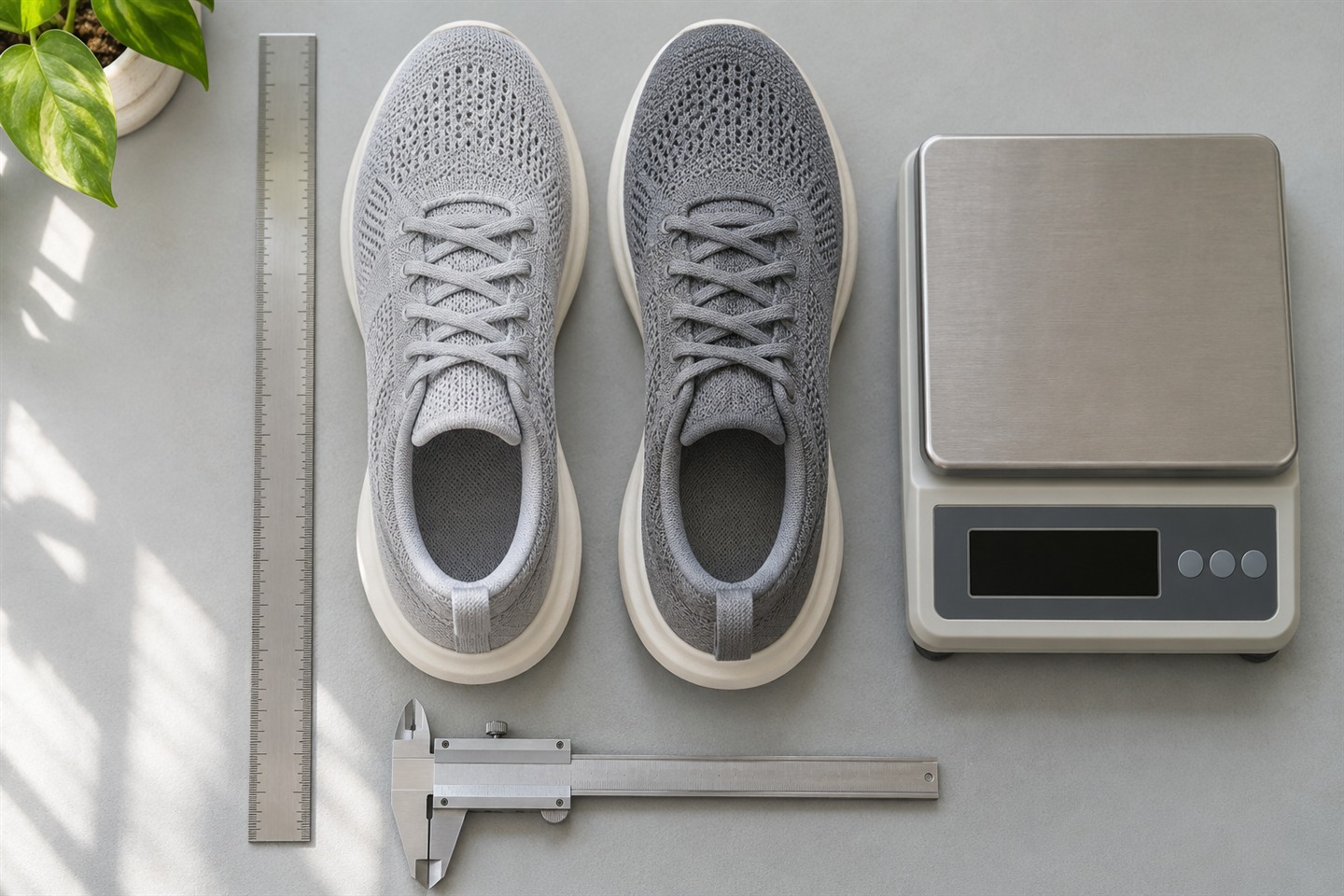
For cushioning, distinguish softness, rebound, and recovery after compression. A sample that feels soft when you press it may not give the response you want during use. Ask what each reported value measures and under which conditions. Compare data produced by compatible methods, then assess the sample in the intended shoe construction.
Durability also needs a specific meaning. Abrasion resistance concerns material loss from rubbing; flex resistance concerns repeated bending; bond strength concerns the connection between parts. A favorable result in one area does not establish the others or predict a fixed service life. Abrasion test conditions, including the abrasive and applied load, also affect the result. Grip requires its own assessment for the intended surface and conditions. For a cushioning component, consider whether cushioning performance needs to be assessed after repeated loading. Outsole abrasion results alone do not answer that question.
Use an agreed reference sample when discussing feel or support. Record what you want to retain and what needs to change. This gives the development team a more specific target than a request for a sole that is simply “softer,” “stronger,” or “better.”
For cost, compare equivalent quotes. Material grade, component size, tooling, production process, assembly, and order quantity all belong in the discussion. A material-price comparison alone cannot tell you which finished sole construction will cost less.
When Does EVA, TPU, or a Combination Make Sense?
If lightweight cushioning is your main requirement, EVA foam is a practical candidate to evaluate. Put the proposed EVA component into a sample with the intended thickness and shape. Check whether it gives the cushioning response and weight you want. If TPU foam is also under consideration, compare it in the same role, with clearly identified grades and comparable evaluation conditions.
If the component must support a specific area or contact the ground, first define that job. Solid TPU may be a candidate for either role, but its performance as a support piece does not tell you how it will perform as an outsole. For ground contact, evaluate wear and traction on the intended surfaces; for support, assess how the component affects movement and the feel of the assembled shoe.
If your requirements pull in different directions, consider assigning them to different components. You might need cushioning in one area and more localized support in another. Combining materials can be worth evaluating, provided the interfaces and assembly are included in development.
An activity label such as “running,” “walking,” or “hiking” is a starting point for the brief. It does not, by itself, prove that one material is suitable.
How EVA and TPU Can Work Together
For example, consider an EVA foam cushioning component paired with a solid TPU support piece. In this proposed design, the EVA foam is intended to cushion the foot, while the TPU piece provides support where needed. The ground-contact layer still needs its own specification; this example does not assume that TPU forms the outsole.
On a drawing, identify where each component sits, how far it extends, and how it connects to neighboring parts. That makes it easier to discuss whether a change concerns the material itself, the geometry, or the assembly. Changing the support piece can affect the assembled shoe even when the EVA formulation stays the same.
The combination still needs validation. Ask the development team to confirm the selected grades, the proposed joining method, and the checks for the finished assembly. Material names alone do not establish adhesive compatibility or whether parts can be molded together. Treat this as a design concept: the specific EVA–TPU pairing and its connections still need to be evaluated in a sample.
What to Confirm Before Sampling
Turn the comparison into a sample brief that the development team can act on. Agree on these points before treating two samples as equivalent:
- Use and surface: Describe the intended activity and ground conditions, including wet conditions where relevant. Keep cushioning expectations separate from traction requirements.
- Material and position: Identify each component, whether it is solid or foamed, and the proposed grade. Avoid leaving the specification at “EVA sole” or “TPU sole.”
- Weight and geometry: Set the comparison size and record component dimensions and weight. Note any differences in thickness, coverage, or added layers.
- Performance evidence: Agree on the properties to evaluate, the methods, and the conditions. Distinguish cushioning, recovery, abrasion, flexing, and grip instead of using one “quality” score.
- Connections and assembly: Identify the interfaces to check and assess the assembled shoe. A satisfactory material sample does not confirm that the complete construction will perform as intended.
- Quote scope: Confirm quantity, tooling, production process, and assembly requirements. Make sure both quotes cover the same deliverable before comparing totals.
FAQ
Can EVA and TPU hardness numbers be compared directly?
Not from the numbers alone. In Shore hardness testing, an instrument measures a material’s resistance to indentation. The scale, specimen preparation, and reading time affect how you interpret the result. Compare values only when the scale and test conditions are comparable. A Shore A result and an Asker C result are not interchangeable, and a larger number on a different scale does not prove that one sample is harder.
Does an EVA or TPU sole make a shoe waterproof?
No. The sole material name does not establish whether the finished shoe keeps water out. The upper, seams, openings, and connections between components also matter. If water resistance is a product requirement, specify the expected exposure and arrange an appropriate finished-shoe assessment. Keep that question separate from wet-surface grip: a shoe can resist water entering it without providing the traction you need on a wet floor.
Conclusion
Choose the component’s role before choosing between EVA and TPU. Compare EVA foam with TPU foam for cushioning decisions, and assess solid TPU for its intended structural or ground-contact role. Then check the proposed construction against your weight, performance, and cost requirements. If you are developing a shoe with HEVA, share your reference design, intended use, and target requirements so the material discussion starts with a clear brief.