Your shoe brand startup budget needs to cover product development, your first inventory order, getting that stock to you, preparing to sell, and operating after launch. A sample price or factory unit price covers only part of that commitment.
For your first sneaker or athletic shoe collection sold online in the U.S., build the budget around the development work involved. Adapting an existing style and developing a new sole involve different work, which needs to be reflected in your quotes. Public fees can give you useful reference points, but they cannot establish a complete launch price.
Start with development and tooling, add inventory and delivery costs, then include sales preparation and operating funds. The sections below separate those items, show sourced fee examples, and explain what you still need to price.
Choose Your Development Route
Before asking how much money you need, decide what you plan to develop. The important question is which parts of the shoe can be used as they are and which need work.
With an existing style, you might discuss branding, colors, materials, or other permitted changes. Confirm what is available and what each change affects. An existing design does not automatically mean every component suits your product or that adaptation is free.
Using an existing sole with a new upper introduces different questions. The upper—the part surrounding your foot—needs to work with the sole and the last, the form used to shape the shoe. Ask what pattern work, materials, construction development, and sample evaluation your design requires.
A new sole or dedicated component needs its own development and tooling discussion. Confirm which tools are needed, the sizes they cover, and whether any existing parts remain usable.
These routes describe work, rather than fixed budget tiers. Use them to establish a starting scope with your manufacturer. Avoid assigning a total before you know the deliverables, order quantities, and costs of bringing the finished shoes to market.
Shoe Brand Startup Cost Breakdown
Create a budget with a line for each service or purchase you need. Mark it as included, separately charged, optional, or awaiting a quote. An unknown cost belongs in the last category, rather than being entered as zero.
Design, Development, Samples, and Tooling
Ask what the development fee delivers: technical specifications, patterns and size grading, sample pairs, revisions, or tooling. A sample pair and a complete set of production tools are different deliverables. Check size coverage, ownership, maintenance, and any conditions for using or transferring tools.
Also identify the testing and inspection appropriate to your product, materials, intended use, and market. Ask for the scope and fee instead of assuming every sample package includes the same assessments.
The public prices below illustrate specific services. They were checked on October 29, 2026. Each belongs to the named provider and region; the footwear figures are supplier guidance, not industry averages or HEVA quotes.
| Fee / provider | Published amount | Region and date | Included scope / limits |
|---|---|---|---|
| Prototyping and samples Italian Shoe Factory | EUR 1,000–3,000 per style | Dubai; Italian supply chain. Checked Oct. 29, 2026; effective date unstated. | Package lists pattern work, last development and a final sample pair. Confirm production tooling, revisions, freight and taxes. |
| Prototype development Smerilli Design Manufacturing | ZAR 10,000–25,000 per style | George, South Africa. Checked Oct. 29, 2026; effective date unstated. | Project-dependent guidance; production quoted separately. Sample quantities, revisions and tooling coverage need confirmation. |
| Footwear consultation Brooklyn Shoe Space | USD 175 for 75 minutes | Brooklyn, New York, U.S. Checked Oct. 29, 2026; effective date unstated. | Consultation on design, construction, sourcing, development or production; not a sample or complete development package. |
| Basic subscription Shopify | USD 39/month paid monthly; USD 29/month equivalent paid yearly | U.S. pricing. Checked Oct. 29, 2026; effective date unstated. | Platform subscription with hosting. Check domain purchase, paid tools, creative work, processing fees and applicable taxes separately. |
| Trademark base application USPTO | USD 350 per class | U.S.; effective Jan. 18, 2025. Fee checked Oct. 29, 2026. | Electronic applications under Sections 1/44. Excludes attorney fees, additional classes and possible surcharges or later filings. |
Keep these amounts in their original currencies. The two footwear services have different scopes and locations; neither establishes a global development range. Do not add the rows into a startup total, treat optional consultation as compulsory, or assume a listed fee includes unmentioned taxes and shipping.
Your First Production Order and Packaging
Ask whether the minimum order quantity applies to the whole order, each style, each color, or a particular material. Then list the actual pairs by style, color, and size.
Calculate your order value by multiplying the quantity on each quoted line by its unit price, then adding the line totals. Break those quantities down by size, counting each pair only once. Check whether shoeboxes, labels, inserts, and shipping cartons are included before adding packaging separately.
Freight, Import Costs, and Receiving Stock
Work from the quote’s delivery terms to your receiving location. Confirm responsibility for transport, insurance, customs clearance, applicable duties and taxes, and onward delivery. Pricing needs the product details, origin, destination, shipment dimensions and weight, and a current service quote. A factory price alone does not establish your cost to receive stock.
Brand Setup, Your Website, and Launch Content
List branding and logo work, photography, product copy, website setup, and planned promotion. Separate a platform subscription from paid themes, apps, domain purchases, and outside design work. Add business registration, insurance, accounting, or other professional services where your setup requires them. The trademark fee above covers one filing item, not every administrative expense.
Operating Costs and Cash Reserves
Choose a planning period and list storage, fulfillment, customer shipping, payment processing, returns handling, and any staffing or founder pay you need to fund. Consider when a replenishment order would require cash. Keep planned expenses separate from money reserved for uncertainty; if a reserve becomes a specific expense, reclassify it rather than counting both.
If you are launching on your own, list the work you will handle yourself and the work you need to pay others to do.
Check which payment fees remain after a refund; Shopify Payments, for example, does not return the original credit card transaction fee. Keep that fee in your existing processing-cost line rather than counting it twice.
Compare Three Launch Scenarios Before You Request Quotes
Use the same launch brief to compare possible development routes. Keep the intended use, actual style/color/size quantities, packaging, destination, and sales preparation consistent wherever possible. If a route changes any of these, show the change alongside the quote.
This comparison records what needs pricing. It does not assign a startup amount to a route.
| Launch route | Starting resources to assess | Development / tooling to confirm | Quotes still needed |
|---|---|---|---|
| Adapt an existing style | Available design, last, sole and permitted branding options | Effects of your changes; sample work; usable tools and size coverage | Adaptation and samples; any extra tools; actual production order |
| New upper with an existing sole | Proposed sole and a compatible last | Upper patterns, construction, fit development, samples and tool changes | Upper development and samples; required tools; actual production order |
| New sole or dedicated components | Design brief and any reusable parts | Component development, tooling scope, sizes, samples and evaluation | Development and tools; samples/evaluation; actual production order |
Every route also needs packaging, delivery, brand setup, and operating costs checked against the same brief. The public fees in the previous table do not fill these gaps. Obtain project quotes, identify overlaps, and compare complete scopes before choosing.
Record what you already have as well: usable design files, approved components, or sales assets. Ask the provider to confirm whether those resources actually remove work from its proposal.
Plan Payments and Cash After Launch
Map Each Payment to a Date
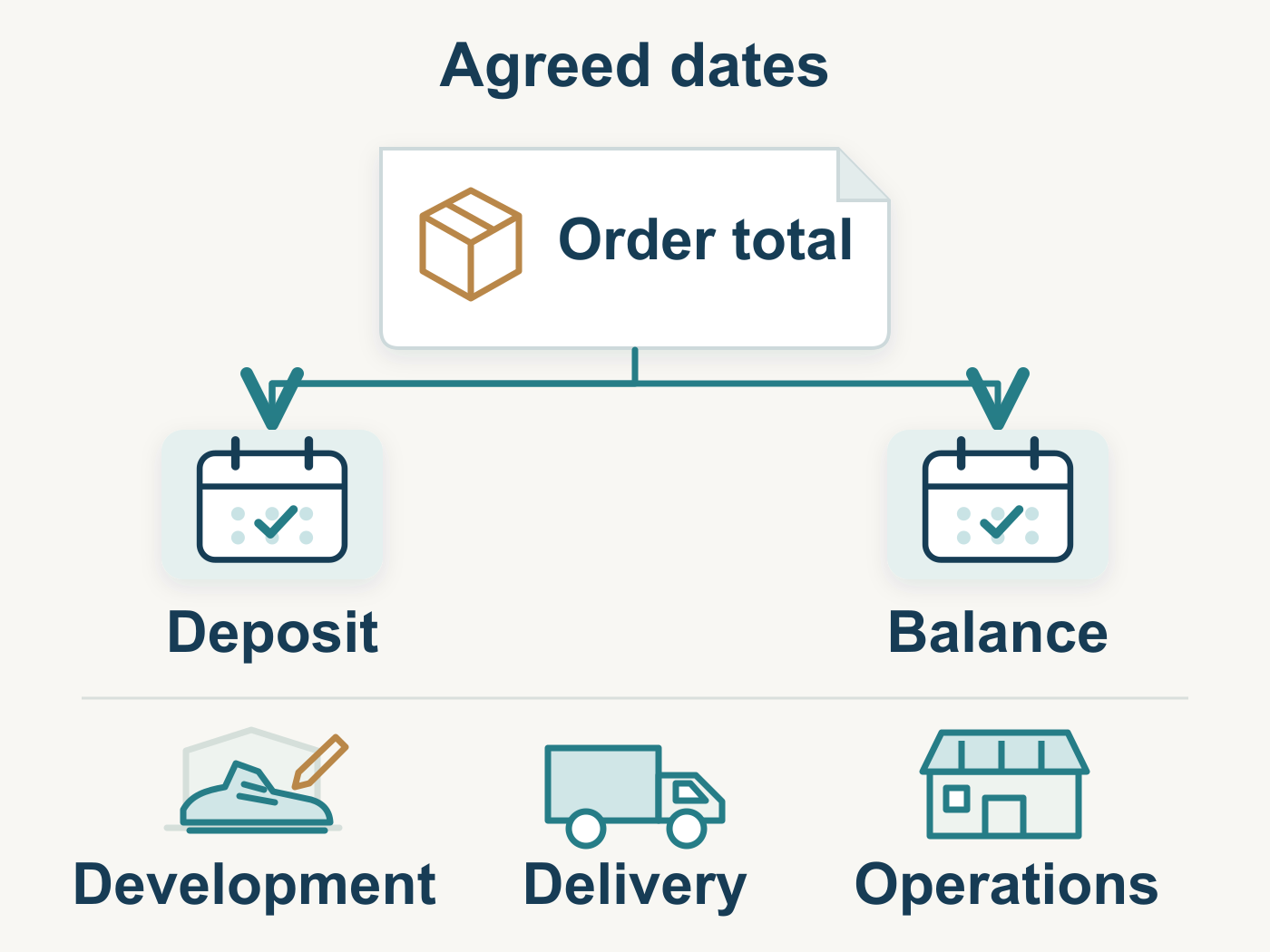
A project’s total cost and the amount due today answer different questions. Put each payment on a calendar, using the terms you actually agree.
Your schedule may include development and tooling payments, a production deposit, the remaining order balance, shipping and receiving costs, and website or content work. Confirm the sequence with each provider. Do not assume a standard deposit percentage or that the balance can wait until customers buy the shoes.
The deposit and remaining balance are payments toward the same order. Count the order value once in your expense budget, then split that amount across its payment dates.
For subscriptions, check whether the listed monthly price is billed monthly or is an equivalent based on annual billing. Then record how much is due and when.
Budget for the Period After Launch
Choose the period your operating plan needs to cover, then place storage, fulfillment, software, customer service, and other planned payments within it. Add timing for returns handling, any pay you need to draw, and a possible replenishment order.
For each payment date, record the cash you have and any incoming payments you can realistically expect to have available by then. Projected sales may arrive too late to cover an earlier bill, so flag uncertain income when checking for cash shortfalls.
Give reserves a purpose, such as a possible revision or an unplanned handling charge. A flat allowance does not show what it covers or prove you can fund the period you have chosen.
How to Keep Your First Launch Budget Under Control
Start with the range itself. Compare a focused selection of styles and colors with a broader launch, using the actual order quantities each option requires. A lower price per pair can still mean committing more money to inventory.
Ask which existing components suit the intended product. Reuse only helps your plan if the part is appropriate and the manufacturer confirms what work it removes. Include the samples and evaluations you need to check whether the shoe meets your requirements.
Clarify specifications before requesting development, and combine revision feedback into a clear set of decisions. Separate changes needed to meet the agreed brief from additional features you are considering.
Apply the same discipline to packaging and sales assets. Decide what you need to explain, sell, and deliver the product at launch, then price optional additions separately.
Compare proposals only after checking quantities, deliverables, currency, delivery terms, and exclusions. If the design, material, or order quantity changes, request an updated quote and payment schedule before revising your budget. Otherwise, you may be making a decision using a price that no longer describes the product.
What to Prepare for a Manufacturer’s Quote
A useful brief makes the product and the unresolved questions visible. Prepare:
- Shoe references, sketches, technical files, or an existing sample, with the intended use and target market.
- Styles, colors, sizes, and actual quantities, plus material and packaging preferences.
- Your receiving destination, timing goals, target budget, and the parts you still need help defining.
Ask for development, samples and revisions, tooling, production, packaging, and delivery to be identified clearly. A combined fee is fine if it clearly states what is included. Count those services once in your budget, even if they also appear elsewhere on your checklist.
Confirm the quote’s currency, validity period, tax treatment, exclusions, and payment dates. For tools, ask about size coverage and the relevant ownership and use conditions.
When comparing providers, keep their original quotes and note differences in scope. Resolve those differences before comparing totals. Your objective is to know what each payment buys, what remains unpriced, and which decisions could change the amount.
FAQ
Can You Start a Shoe Brand From Home?
You can plan a brand from home and discuss outsourcing development and production, but your operating location does not remove product or selling costs. Work out where samples and inventory will go, how orders will be handled, and what space you need. Check the local requirements and arrangements that apply to your situation before relying on a home setup. There is no separate universal startup price for it.
Do You Need Your Own Factory to Start a Shoe Brand?
You can work with a manufacturer instead of building a production facility. In that model, your budget covers the development and manufacturing work you commission, along with inventory, delivery, and selling expenses. Confirm who provides the technical work, samples, tools, and production services. Outsourcing changes who performs those tasks; you still need to understand their scope, charges, and responsibilities before committing to an order.
Can Preorders Reduce the Cash You Need Upfront?
Preorders may bring receipts forward. Before relying on that money for production or fulfillment payments, check your payment provider’s payout schedule and any account-specific holds. Allow for possible refunds rather than treating all receipts as money you can spend. For U.S. online orders, the FTC’s merchandise rule addresses shipping promises and delay or refund obligations. A preorder plan therefore needs realistic timing and the ability to meet those responsibilities; it is not a zero-cost launch.
Conclusion
Build your budget around a defined product and launch scope. Get comparable quotes, separate included costs from extras, and match payments to the cash you expect to have available. Use public fees as reference points, then build your budget from project quotes, your own operating costs, and cash reserves. To discuss your first collection with HEVA, share your design references, intended use, quantities, and destination, along with any questions about development or pricing.