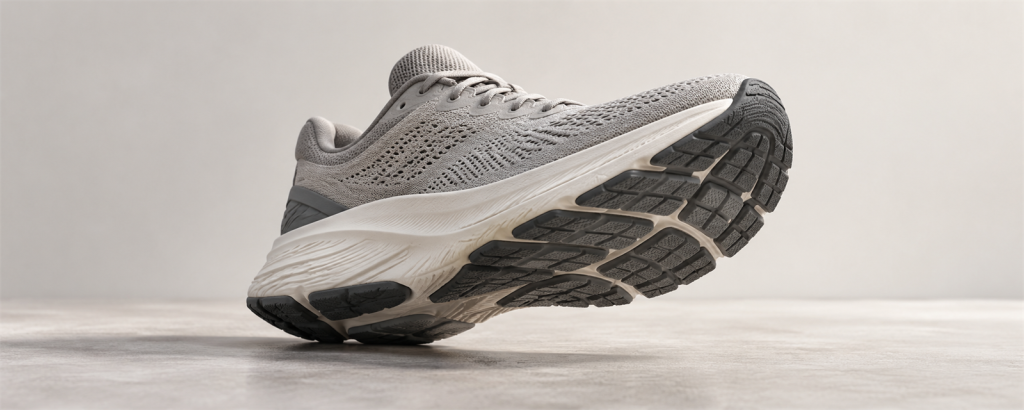
The sole is the bottom part of a shoe, between your foot and the ground. In everyday descriptions, “sole” may mean the ground-contact layer. In discussions of shoe construction, it can refer more broadly to the bottom assembly, which may contain several components.
That difference explains why a “rubber sole” description can leave questions unanswered. To understand the shoe, identify the part being described. Here’s how to find the components, tell the terms apart, and read a sole description more clearly.
Where Is the Sole of a Shoe?
Start by looking at the same shoe from three angles.
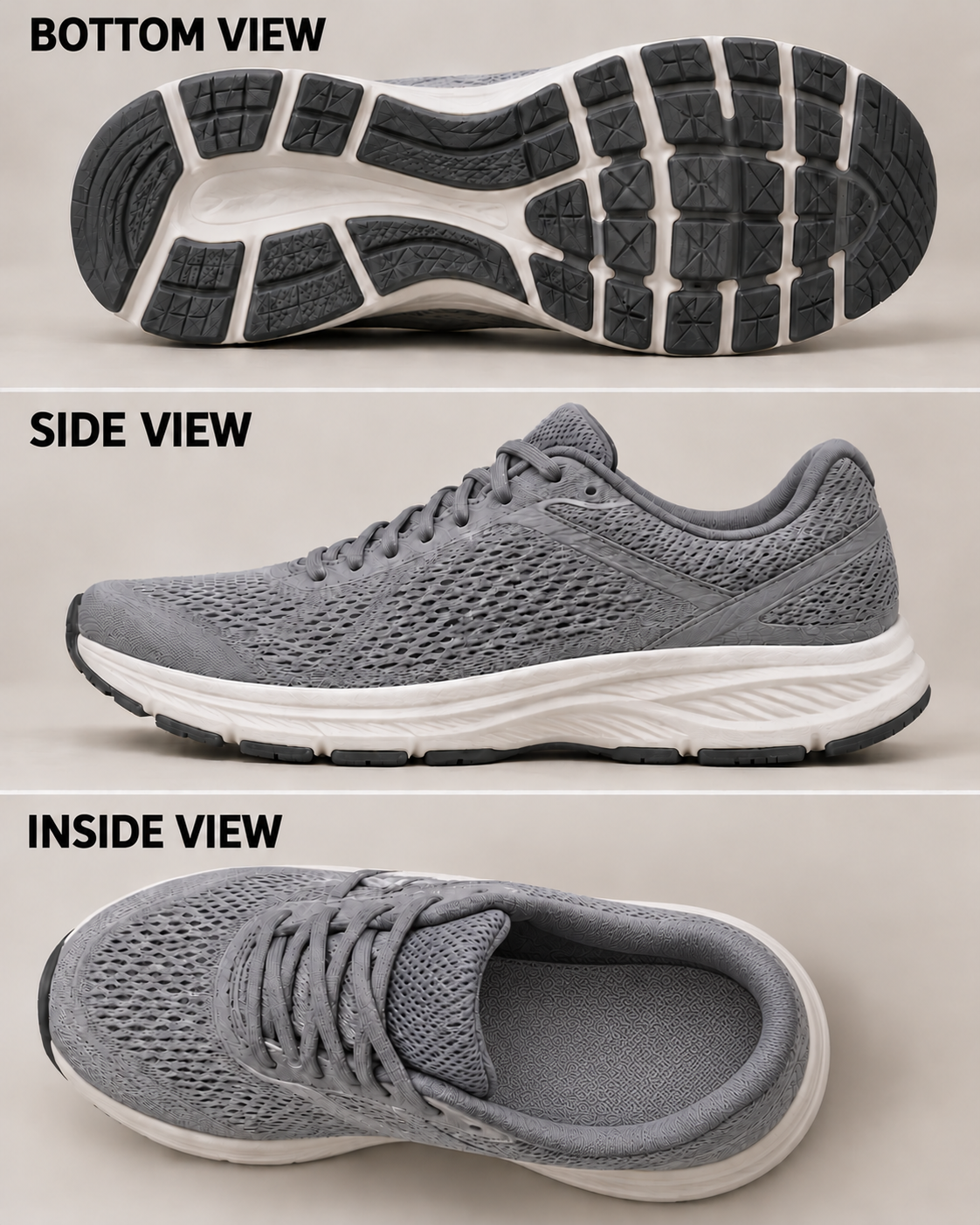
Turn it over. The outsole is the part designed to contact the ground. It may cover the bottom as one piece or appear as separate ground-contact sections. Look for the surfaces and tread that meet the floor when you stand or walk.
Look from the side. Follow the bottom structure to where it meets the upper, the part covering your foot. On a layered sneaker, you may see a cushioning section above the outsole. Other designs have edges that wrap upward or conceal joins. A visible line does not confirm the internal construction, and color alone does not identify a material.
Look inside. The surface directly beneath your foot is often a comfort insert. It may be removable or attached. Other components can remain hidden beneath it, so an inside view still does not reveal the complete bottom assembly. You do not need to take the shoe apart to understand the names.
Sole, Outsole, Midsole, and Insole: How They Relate
These terms describe different parts or aspects of the construction. “Sole” is the broader word whose meaning depends on context; “outsole” identifies the ground-contacting component more precisely.
The table below describes common roles. It is not a checklist of separate layers that every shoe must contain.
| Component | Typical location | Main role | Terminology note |
|---|---|---|---|
| Outsole | Ground-contact area | Wear surface and traction | May be described simply as the “sole.” |
| Midsole, when present | Between the foot-supporting base and outsole | Cushioning; contributes to overall feel | May be combined with other sole elements. |
| Comfort insole / sockliner | Inside, directly under your foot | Contact comfort and added cushioning | Can be attached or removable. |
| Structural insole (construction-dependent) | Beneath the comfort insert in applicable constructions | Base associated with the upper assembly | May be a lasting board or a Strobel insole. |
Why “Insole” Can Mean Different Parts
In retail descriptions, insole often means the comfort insert directly under your foot. You may also see it called a sockliner or footbed. Some inserts are removable, while others are attached inside the shoe.
In a manufacturing specification, insole can mean a structural base used in building the shoe. Its material and connection with the upper depend on the construction. Depending on the construction, that base may be a lasting board or a flexible Strobel insole. It serves a different role from a separate comfort insert.
This matters when a description says “PU insole.” Ask which part it means. If it describes a foam comfort insert, that tells you about one component. It does not tell you that the midsole or outsole is also PU.
Likewise, a familiar diagram showing an insole, midsole, and outsole is a useful starting point, but it cannot describe every shoe. Components can be combined or integrated, and a distinct cushioning midsole is not present in every construction. Check what the actual shoe uses rather than judging its quality by the number of layers you can count.
What Does the Sole Do?
The bottom construction separates your foot from the ground and helps the shoe handle the demands of use. On pavement, you may be concerned with surface wear and grip. Under your foot, you may be comparing cushioning, flexibility, or how the shoe feels as your weight moves through a step.
Those demands involve different components. The outsole’s compound, contact area, and tread affect its interaction with the surface. In many sneakers, the midsole provides much of the cushioning, with the comfort insert adding another underfoot layer. Shape and other structural components also influence how the shoe supports and moves with your foot.
Be clear about which contact surface you mean. Your foot sliding inside the shoe is a different issue from the shoe slipping against the floor. Describing both as “a slippery sole” can make the problem harder to explain.
Softness is also different from grip. Pressing a foam layer with your thumb will not tell you how the finished outsole grips wet tile. For that question, the ground-contact design, surface, and conditions all matter.
How to Read a Shoe Sole Description
Consider this example:
EVA midsole + rubber outsole
Each pair of words names a material and a component. EVA, short for ethylene-vinyl acetate, identifies the material family used for the midsole; rubber identifies the outsole material. The description separates the cushioning component from the ground-contacting part, although it leaves the exact grades, dimensions, and other construction details open.
You might also need to confirm whether the comfort insert is removable. That is another detail about the shoe, separate from identifying the midsole and outsole materials.
“Soft sole” leaves much more open. If you are reviewing a sample or discussing a change, work through three questions:
- Which component are we discussing?
- Where on the shoe do we want the change?
- What should feel or work differently, and under what conditions?
If the components are unclear, ask for a labeled cross-section or a specification that names each part.
For example, “I want more cushioning under the heel” gives the discussion a location and a goal. You still need to agree on which component and construction detail to adjust. It does not automatically mean making the ground-contact material softer.
When you want to compare materials in more detail, start with the component they will be used in. That keeps a broad phrase such as “rubber sole” from standing in for the complete shoe specification.
FAQ
Does Replacing an Insole Replace the Whole Sole?
No. Replacing a removable comfort insole changes the insert under your foot. It does not renew a worn outsole, replace the midsole, or repair other damaged bottom components. If you are considering a replacement, identify what needs attention first.
Does a Thick-Looking Sole Mean a Thick Outsole?
No. Some designs have sidewalls that rise around the foot, so the visible edge can extend above the level where your foot sits. That visible sidewall height is different from outsole thickness. If you need a measurement, confirm whether it describes the outsole, the complete underfoot construction, or the visible sidewall, and ask where it was measured.
Can Every Shoe Be Resoled?
Do not assume every shoe is a straightforward candidate for resoling. Ask the original brand or an experienced cobbler to assess the specific construction, overall condition, and damage. A service may need photos or a physical inspection before confirming a suitable repair. A material label or a photo of the bottom alone cannot establish what can be replaced successfully.
Conclusion
Understanding a shoe sole starts with identifying the part you mean. From there, read the material and construction description, then connect it to the performance you want to discuss. Specific component names make that conversation clearer than “soft” or “thick” alone. For a sneaker project, bring the intended use, the component in question, and the change you have in mind to HEVA as a concrete starting point for discussion.