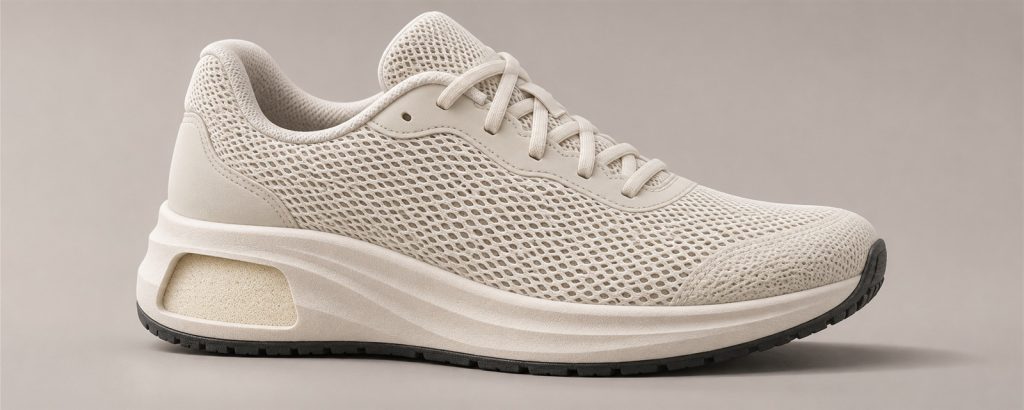
A Phylon sole usually refers to a sole that uses EVA-based foam, often in the midsole for cushioning. EVA stands for ethylene-vinyl acetate. The term tells you something about the foam, but it leaves an important question open: which part of the shoe’s sole does it describe?
That distinction matters when you read a product description or discuss a new shoe design. A shoe can have a Phylon midsole and a separate outsole made from another material.
What Does “Phylon Sole” Mean?
In footwear specifications, Phylon is commonly associated with molded EVA foam. Treat it as a starting point for understanding the material, rather than a complete specification.
A description that says only “Phylon sole” leaves several details unstated. It may not identify the ground-contact material, the molding route, or the properties of the particular foam. Naming each component clarifies where the foam is used; its molding process and properties need separate details.
Where Phylon Fits in a Shoe’s Sole
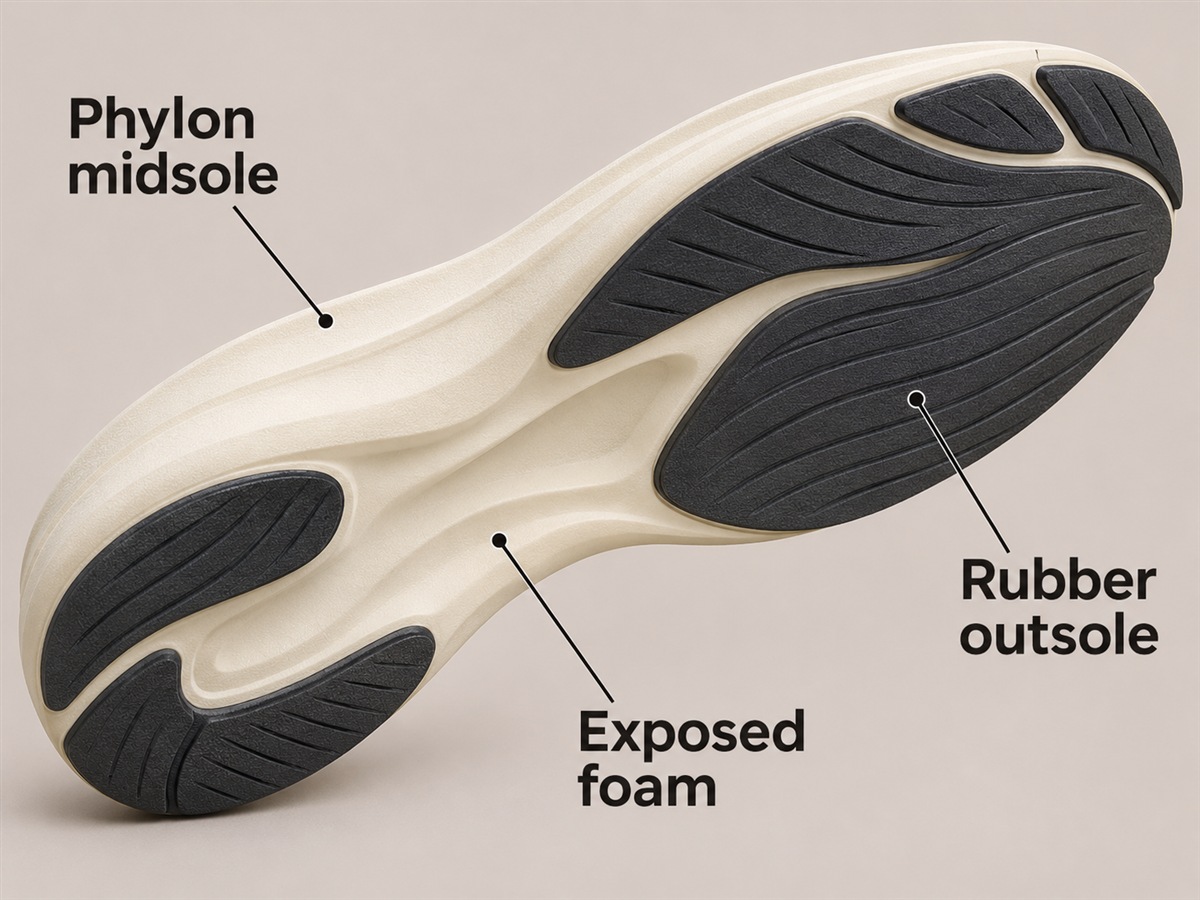
The midsole sits beneath your foot and provides part of the shoe’s cushioning. The outsole forms the ground-contact surface. Identifying these parts helps you understand what a material description actually covers.
Consider this illustrative specification:
Midsole: Phylon
Outsole: Rubber
Here, Phylon describes the cushioning component, while rubber describes the outsole. The specification is more informative than “Phylon sole,” although it still does not tell you how either material performs.
This example does not mean every Phylon sole must have a separate rubber outsole. Sole constructions vary, so check the particular design. If rubber is included, ask where it is placed and whether any foam remains exposed underneath.
The practical distinction is simple: a midsole material name cannot establish the material or performance of the ground-contact surface. When grip matters, you need information about that surface and evidence relevant to the conditions in which the shoe will be used. A Phylon label alone cannot provide it.
How Phylon Relates to EVA and Molding Terms
EVA is a polymer used to make footwear foam. Phylon commonly describes a molded foam made with EVA, so the two terms are related. A comparison that treats them as entirely unrelated materials can create confusion.
Traditional descriptions of Phylon refer to EVA foam pellets, slabs, or sheets that are compressed, expanded with heat, and then cooled in a mold. This provides useful background for understanding compression-molded Phylon. It does not establish one manufacturing sequence for every product carrying the name.
You may also encounter “injection Phylon” in equipment literature and footwear discussions. That wording points toward a molding process, but you still need to confirm the material used and the actual production route.
When reviewing a specification, separate two questions: What foam is being supplied, and how is the component formed? If the document uses an abbreviation, ask the supplier to define it in that context. Avoid assuming that similar labels describe identical compounds or processing steps.
Neither “compression molded” nor “injection molded” is a performance rating. The process description helps explain how a part is made; the finished component still needs its own evaluation.
What Phylon Is Used For—and What the Name Cannot Tell You
Phylon is used in foam midsole components where cushioning is part of the design. Foam compresses under load, allowing the midsole to contribute to how the shoe feels underfoot. That role explains its relevance to athletic footwear, but it does not make every Phylon construction suitable for the same activity.
Thickness is one concrete detail worth considering. SATRA’s TM159 overview covers cushioning tests for materials and assemblies, primarily footbeds and midsoles. Its cushion-energy assessment accounts for the product’s thickness. Evaluating a material or component therefore involves more than reading its name.
The Phylon name alone does not specify a hardness level. A quick squeeze can give you an impression of softness. It does not establish how the component will respond to repeated loading. Similarly, evidence about cushioning does not establish outsole wear or slip resistance. These are different questions requiring relevant evidence.
If you are asking whether a Phylon sole is good for running or walking, start with the actual shoe and its intended use. Review the cushioning component, the ground-contact construction, and the evidence available for that design. A generic material description cannot support a universal lifespan or a promise of grip.
How to Read a Phylon Sole Specification
When a specification stops at “Phylon sole,” use four questions to make the description more useful:
1. What material is specified?
Ask for a material designation or compound reference that can be tied to the proposed component. You do not need the supplier’s proprietary recipe to establish what is being discussed.
2. Which component uses it?
Confirm whether the term refers to the midsole or another part of the sole unit. Identify the ground-contact material separately.
3. How is that component formed?
Clarify the stated molding route and any abbreviations. Include that explanation in the specification for the component.
4. What supports the performance claims?
For any test result, establish which sample was evaluated and under what conditions. Check that the evidence addresses the property you care about.
These questions give a development discussion a concrete starting point. They also make it easier to notice when two descriptions refer to different components or provide different levels of detail.
FAQ
Is Phylon the same as Phylite?
The names should not be treated as interchangeable. A footwear patent describing both materials distinguishes EVA-based Phylon from Phylite, which it describes as a combination of Phylon and rubber. That distinction is useful when checking terminology, but it should not be extended into a universal formula for every supplier’s product. If a specification uses Phylite, confirm the material description attached to that component.
Can you identify Phylon from a sole’s appearance?
Appearance alone is not sufficient evidence for confirming the material. Technical descriptions associate fine wrinkles with some compression-molded Phylon midsoles, but that observation does not establish a reliable identification procedure. For a product photo or physical sample, seek the corresponding material specification. A surface detail can prompt a question; it should not replace documentation.
Conclusion
Understanding a Phylon sole starts with its usual meaning: EVA-based foam used in a sole component, often the midsole. A useful specification then identifies the component, its molding route, and the evidence relevant to its intended role.
If you are discussing an athletic shoe project with HEVA, bring the intended use and any existing sole specifications or reference samples. That gives the conversation a concrete basis for clarifying the construction and the development requirements.