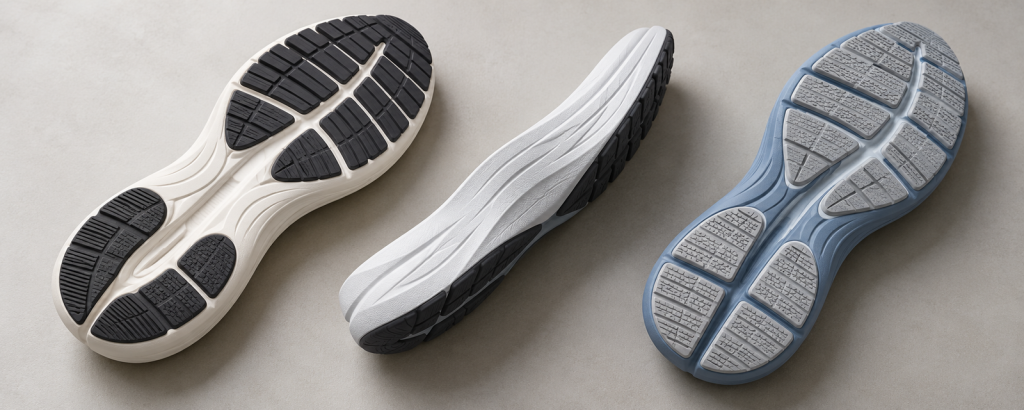
Phylon and EVA are closely related. EVA is a polymer used to make footwear foams, while Phylon commonly refers to an EVA-based foam shaped through a molding process. To compare them, look at the foam formulation, the molding process, and the finished sole.
For your shoe project, the useful questions are specific: Which part of the sole are you comparing? How should it feel and perform? What information would let you judge two samples fairly?
What Do EVA and Phylon Mean?
EVA: the material base
EVA stands for ethylene-vinyl acetate. In footwear, it is commonly used in foam components. A specification that says “EVA” identifies the material family, but leaves several practical questions open: the formulation, foam density, hardness, thickness, and manufacturing route.
Two soles described as EVA can therefore differ in feel, weight, and performance. To compare them, you need the specifications of the finished foam, rather than assuming the shared material name means they are equivalent.
Phylon: an EVA-based foam name
Phylon is commonly associated with molded EVA-based foam, especially compression-molded midsoles. It is not a separate polymer family competing with EVA. The name can tell you something about the type of component being offered, but it does not establish a single formulation or performance level.
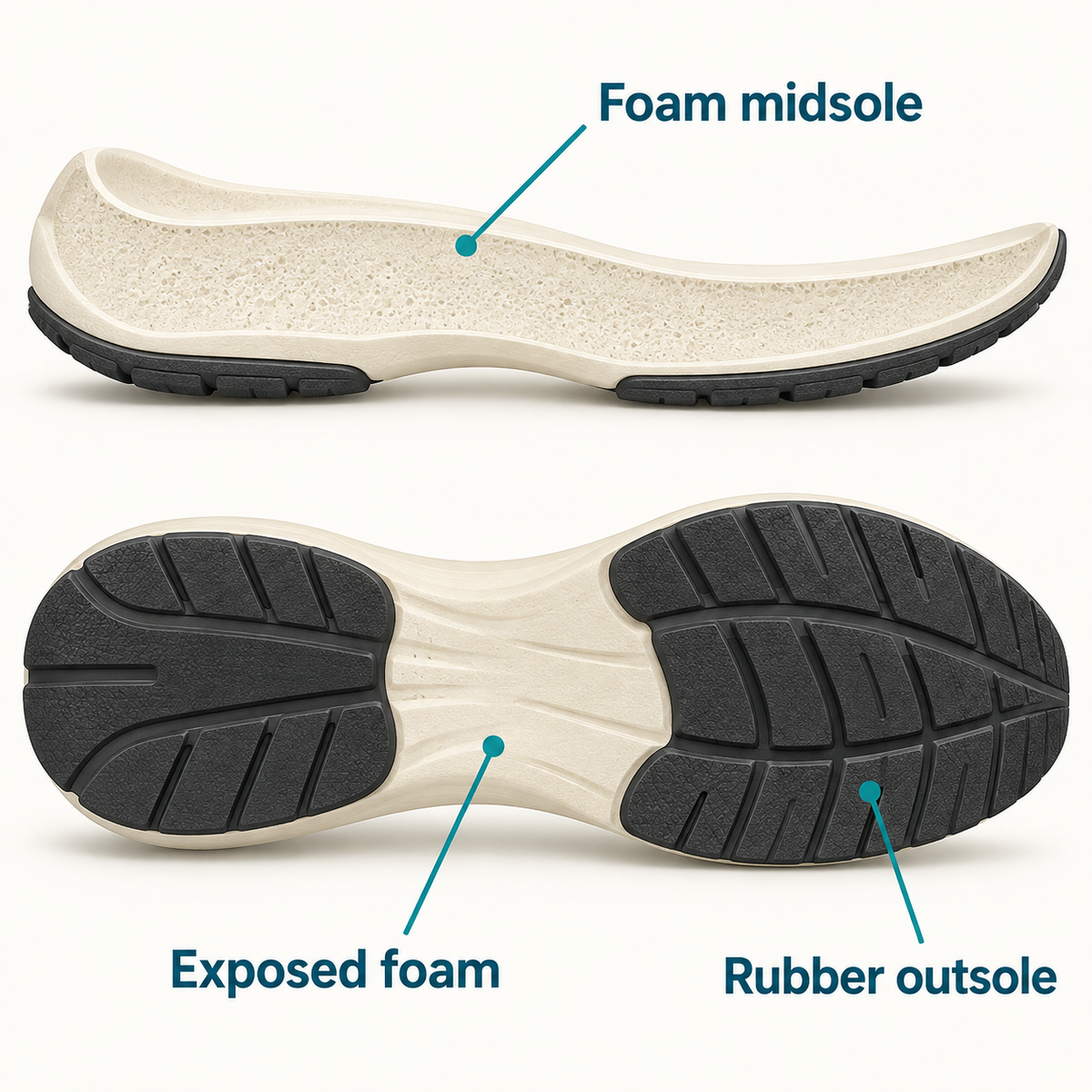
Also check what “sole” means in the description. The midsole is the cushioning structure under the foot; the outsole is the ground-contacting part. A shoe may combine a foam midsole with rubber coverage, or leave some foam exposed to the ground.
A Phylon midsole label alone does not tell you which material touches the ground or how the whole sole will wear.
How Are EVA and Phylon Soles Molded?
Traditional compression-molded Phylon
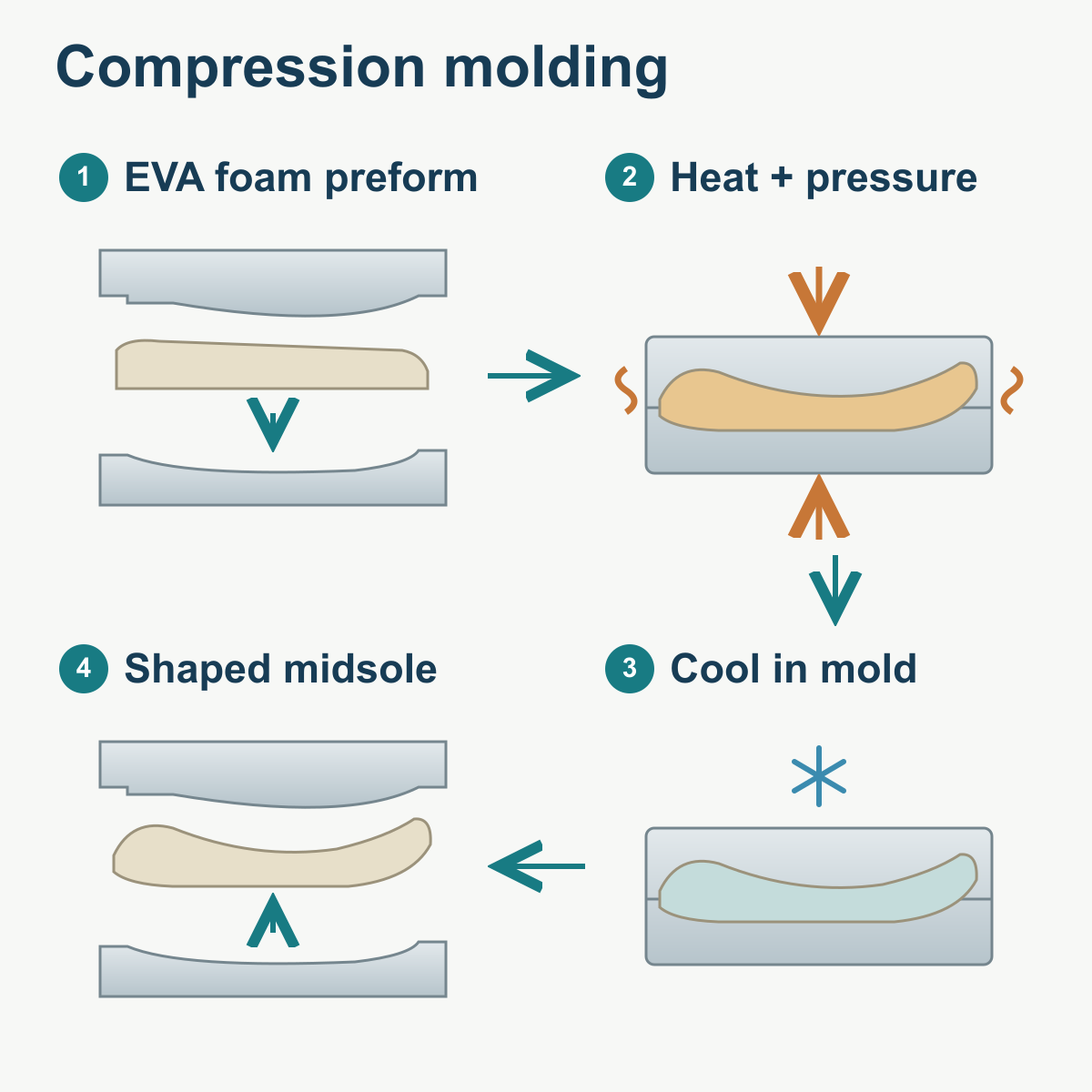
In a traditional compression-molding route, EVA foam material is placed in a mold, shaped under heat and pressure, and cooled to retain the intended form. Descriptions of this process include foam pellets, slabs, sheets, or prepared foam pieces as starting materials. The mold gives the component its intended profile and surface shape.
This is why Phylon is often discussed in terms of a processing route as well as a material. The EVA basis and the molding process describe different aspects of the same component. Both belong in a useful specification.
You may also encounter explanations that reduce the difference to “single-foamed EVA” versus “double-foamed Phylon.” That shorthand needs clarification from the manufacturer. Ask which preparation and molding stages it describes, rather than treating the number of stages as a quality rating.
Where injection Phylon fits
The footwear industry also uses the term injection Phylon for EVA-based components made through an injection-molding route. Confirm which process the manufacturer means rather than assuming every Phylon component is compression molded.
A practical question is: “What material and molding route will you use for this component?” Follow that with the finished specifications and a sample. A process name helps explain how a part is made; it cannot establish that the resulting sole will be lighter, softer, or more durable than another design.
What Should You Compare in the Finished Sole?
For a fair comparison, identify the properties that matter for your intended shoe and assess equivalent components or complete shoes. Use the table to check which details are missing before comparing results.
| Property | What affects the comparison | What to check |
|---|---|---|
| Weight | Size, foam volume, and outsole coverage | Actual mass of comparable components or shoes |
| Softness, cushioning, and rebound | Compound, structure, thickness, and assessment conditions | Separate hardness, cushioning, and rebound results |
| Durability | Compression, abrasion, flexing, and component connections | Evidence for each relevant type of wear or failure |
| Grip | Contact material, tread, surface, and wet or dry conditions | Performance on the intended surfaces |
| Cost | Component specifications, tooling, processing, and quantity | Whether the quotes cover the same specifications and charges |
Weight
A lightweight Phylon sole is possible, but the name is not a weight specification. Foam density and volume both matter, and the ground-contacting layers add to the mass of the sole unit.
For a useful comparison, weigh samples in the same size and record their construction. If one has a thicker midsole or more rubber coverage, account for that difference. A lighter sample may reflect a different design, not a general advantage of the material label.
Softness, cushioning, and rebound
Squeezing a sole gives you a first impression of softness. It does not tell you everything about its response underfoot. Hardness, cushioning under load, and rebound describe different aspects of the foam’s behavior. Cushioning concerns how the sole compresses under load, while rebound concerns the energy returned as it recovers.
Start by describing the feel you want, then compare the appropriate measurements and shoe samples. Record the hardness scale—for example, Asker C or Shore A—and use the same method and conditions for both samples. Readings from different scales are not directly interchangeable. Material results also need context: the thickness and construction of the finished shoe affect what you experience when wearing it.
Durability
Separate the ways a sole can change during use. Compression set concerns how much deformation remains after a specified period of compression and recovery. Abrasion concerns material worn away at the contact surface. Flexing and the integrity of component connections raise further questions.
These are different checks. A surface crease alone cannot replace an assessment of cushioning or wear, and a compression-set result cannot be translated directly into years of service. For cushioning that needs to hold up through repeated use, compare shock absorption and rebound before and after agreed repeated-compression testing. Ask what was tested, on which component, and under what conditions before accepting a broad “more durable” claim.
Grip
To assess whether a Phylon or EVA sole is slip resistant, look at the material that actually touches the ground, its tread, and the surface where the shoe will be used.
For the finished shoe, agree on test surfaces and dry or wet conditions that reflect its intended use. A favorable result on one surface does not establish grip everywhere, and adding rubber does not automatically answer every traction question.
Cost
A price comparison is useful only when you know what each quotation includes. Confirm the foam specification, sole construction, tooling charges, processing scope, and order quantity. Rubber coverage and other component differences should be visible in that comparison.
If the quotes cover different designs, ask for the differences to be identified before attributing the price gap to Phylon versus EVA. There is no reliable universal percentage you can apply to every project.
What Should You Confirm Before Sampling?
For everyday walking, describe the expected time on foot, the surfaces, and the fit and feel you want to assess during wear. For running, define how the shoe will be used, then assess its cushioning, flexibility, stability, and durability against those requirements.
Phylon and other EVA-based foam constructions can be considered for these uses, but the name alone does not tell you whether a particular shoe is suitable. A sample review should connect the proposed construction to your intended use, rather than start with an assumption that one label is always better.
Before sample development, put the following into the brief:
- Intended use and surfaces: describe the activity and conditions the shoe needs to handle.
- Target feel: explain the cushioning and flexibility you want, using a reference shoe where helpful.
- Sole construction: identify the midsole, exposed foam, and any separate ground-contacting coverage.
- Material and process: request the compound description, molding route, and relevant finished specifications.
- Assessment plan: agree on the shoe size, specimen dimensions where relevant, and sample quantity. Specify the hardness scale, which components or complete shoes will be tested, the methods, and acceptance criteria.
Keep the results tied to an identified sample version. If the foam, geometry, or outsole coverage changes, record the change so everyone knows which construction the earlier observations describe. That record gives you a clearer basis for approving a sample and discussing revisions.
FAQ
Is Phylon the same as rubber?
No. Phylon commonly refers to an EVA-based foam, while rubber may be used as a separate ground-contacting component or appear in a compound. If rubber content matters to your project, check the material specification. A product description combining “Phylon” and “rubber” should clarify which part or formulation each term describes.
Are Phylon soles non-marking?
The Phylon name does not guarantee non-marking performance. That claim concerns whether the actual contact material leaves marks on flooring under the relevant conditions. Confirm the intended floor and assess the specified sole material or unit. Non-marking, abrasion resistance, and slip resistance are separate properties, so evidence for one does not establish the others.
Does a Phylon sole make a shoe waterproof?
No. A foam’s response to water is only one part of the question. Water can enter a finished shoe through its upper, seams, or connections between components. If water resistance is a product requirement, assess the complete construction under agreed conditions instead of inferring whole-shoe waterproofing from the sole material.
Conclusion
The useful distinction between Phylon and EVA starts with material and process: EVA describes the polymer basis, while Phylon commonly describes a molded EVA-based foam. Choosing a sole requires the next layer of detail—its construction, specifications, and performance in the intended shoe.
Use comparable samples and clear assessment conditions to make that decision. To discuss a running-shoe development project with HEVA, bring your intended use, a reference design or sample, and the sole requirements you want to evaluate.