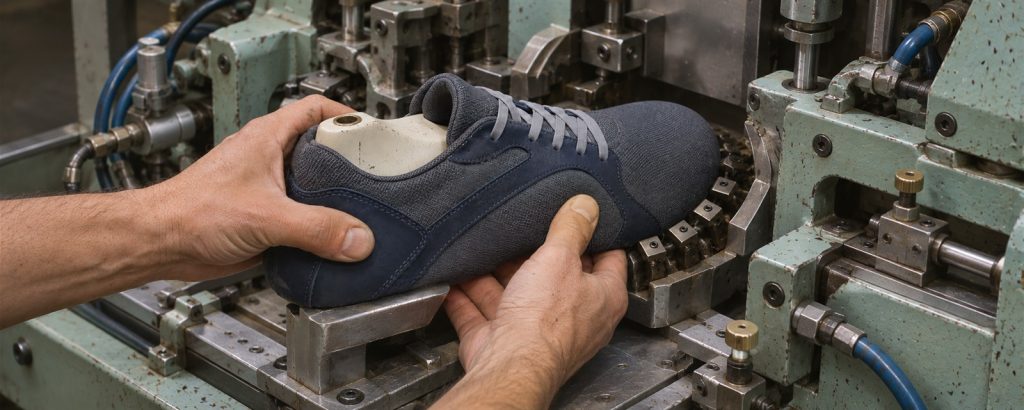
A stitched shoe upper still needs to take on the shape it will have in the finished shoe. During the shoe lasting process, that upper is positioned and shaped over a last. How this happens depends on the construction, materials, and components involved. Understanding those differences helps you follow a production process and describe what you see when reviewing a sample.
What Is Shoe Lasting?
Shoe lasting is the process of shaping an assembled upper over a shoe last. The upper is the part of the shoe that surrounds the foot; the last is the three-dimensional form used to shape it during manufacture.
The last provides the form, while lasting brings the upper into that form. Making or designing a last is a separate task. Attaching the sole is also a distinct operation, although the construction determines how these processes fit together.
Lasting involves more than getting an upper onto a last. The upper’s position, how the material is drawn around the last, and how well it retains its shape afterward all matter. An upper that looks smooth while supported by the last may change once that support is removed.
What Needs to Be Ready Before Lasting?
Start with the relationship between the upper and the last. The upper needs to correspond to the intended last, size, and construction. Its pattern and assembly affect how it sits on the form; extra pulling force should not be treated as a general solution for a mismatch.
The material combination matters, too. The outer material, lining, backing, and any toe or heel stiffeners form an assembly. A process that works for one combination may need adjustment when a component changes.
Before discussing machine settings, confirm which upper and last belong together, whether the upper has been assembled as intended, and how its bottom will be handled during lasting. These checks establish what the process is meant to shape.
During sample development, record which upper materials, lining, and reinforcements each sample uses. If that combination changes, flag it to the production team when reviewing how the upper forms on the last.
How the Shoe Lasting Process Works
The following stages explain the main functions involved. They are not a fixed machine sequence for every shoe: some operations are combined, and the treatment of the upper’s lower edge depends on its construction.
Prepare the Upper for Shaping
Where appropriate, the upper receives conditioning before it is placed on the last. Heat and moisture can help suitable materials soften for shaping. Some equipment also reactivates compatible toe and heel stiffening components before lasting.
The treatment must suit the actual materials and components. Steam is not a universal requirement for every upper, and a machine’s available adjustment range is not a recipe for a particular shoe. The technical team needs to establish suitable conditions for the assembly being used.
Position the Upper on the Last
The upper is fitted onto or arranged around the corresponding last. Its position determines where features such as seams and the heel area sit as shaping proceeds.
Check alignment before assuming that more tension is needed. Pulling and positioning serve different purposes: force draws material around the form, while positioning establishes where that material belongs. Lasting equipment may have separate controls for supporting the last and gripping the upper, reflecting that distinction.
Shape the Upper and Handle the Lower Edge
For a construction with an open lower edge, gripping tools can draw the upper around the last. On relevant machines, pincers grip and pull the material, while wipers fold and press the lasting margin—the extra material along the lower edge—toward the bottom. The margin is then secured as required by the construction.
Toe lasting addresses the front of the upper; side and heel operations handle other areas. These names do not necessarily mean three separate machines. Equipment can combine operations, so the useful question is what each operation accomplishes on that shoe.
A closed Strobel upper follows a different route. Its bottom has already been sewn closed, allowing the assembly to be fitted over the last. You should not expect to see the same open-margin folding process around its entire bottom.
Help the Upper Retain Its Shape
Shaping can leave residual stress in the upper. When the last is removed, elastic recovery can cause the upper to move partly back toward its earlier shape. Suitable setting treatment helps the material retain its new form.
Heat setting uses controlled conditions, including heat, moisture, and time where applicable, to reduce that tendency. The conditions actually reaching the upper can differ from those shown on a machine’s controls. The upper and its lining or backing also need to be considered together.
The timing of last removal and its relationship to sole attachment depend on the construction process. Confirm that sequence for the shoe you are reviewing.
How Strobel and Board Lasting Change the Process
Look at the underside of the assembled upper to understand why lasting methods differ. In Strobel construction, the upper is sewn to a bottom panel before it is fitted onto the last. In board lasting, the open lower margin is drawn around the last and secured to an insole board.
| What to compare | Strobel construction | Board lasting |
|---|---|---|
| Bottom before lasting | Sewn closed with a bottom panel | Open lower margin |
| Main shaping relationship | Closed assembly fitted over the last | Upper drawn around the last; margin secured underneath |
| What to confirm in the process | How the closed upper is positioned and shaped | How the margin is pulled, folded, and secured |
Combination constructions can use different approaches in different areas of the same shoe. This is another reason to confirm the actual bottom construction instead of inferring the whole process from a single operation.
You may also encounter the term slip lasting. Avoid assuming that every use of that term describes exactly the same Strobel assembly. Ask how the upper is closed and fitted onto the last. These construction differences explain the operations you see; by themselves, they do not prove that one shoe will be more comfortable or durable.
What to Check in the Lasted Upper and Finished Sample
A useful review separates what you can observe on the last from what you can assess after its removal. Compare the sample with the agreed design or reference sample, and describe differences without immediately assigning a cause.
While the Upper Is on the Last
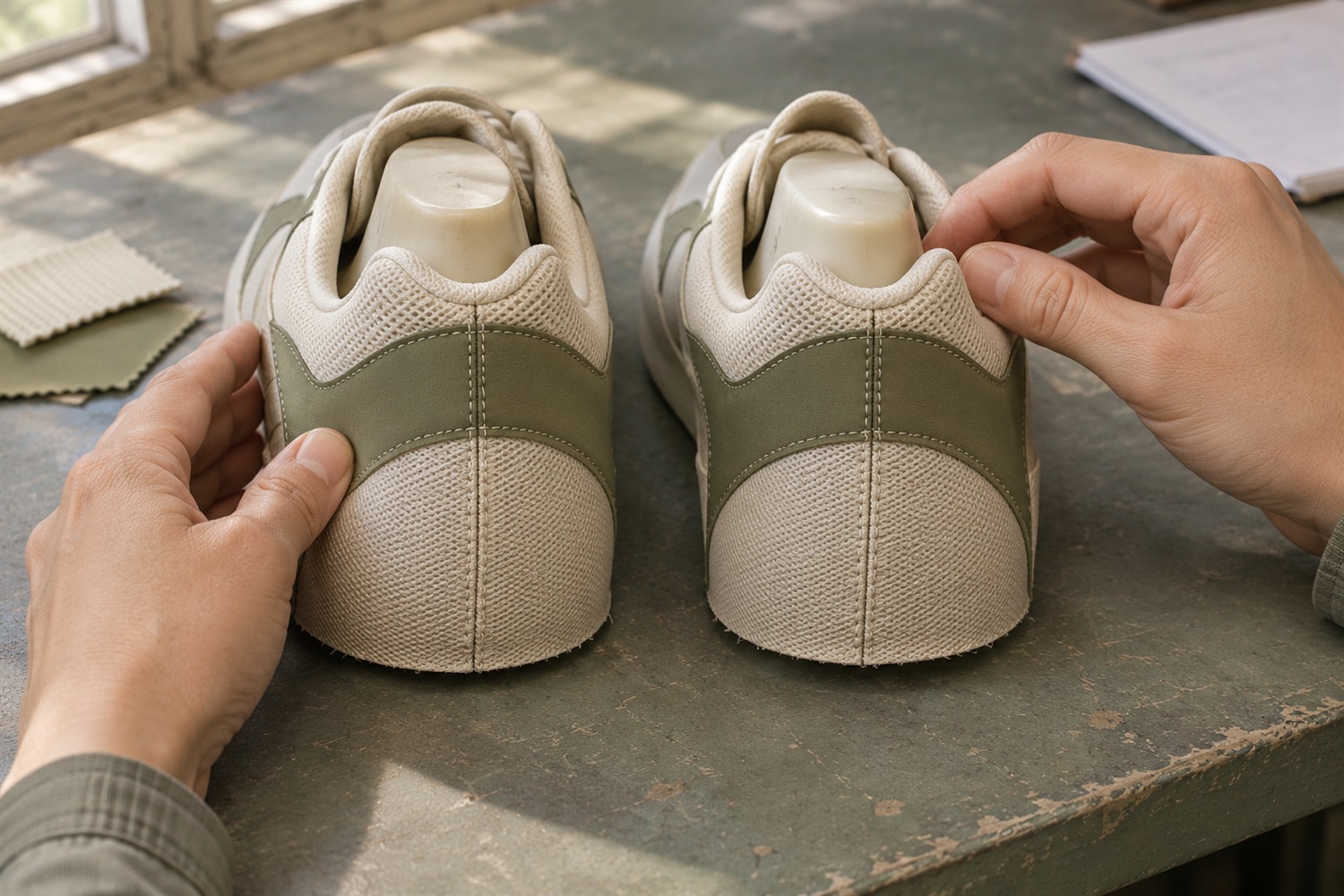
Look at the toe and heel positions, seam paths, and corresponding areas of the left and right shoes. Note unusual folds, wrinkles, or areas that appear displaced. Consider whether a feature belongs to the design before treating it as a defect.
Record where the issue appears and at which stage you observed it. A short description such as “the heel seam appears shifted on the right shoe while on the last” gives the technical team something specific to investigate.
After Last Removal and During Fit Review
Check whether the upper retains the intended shape once the last no longer supports it. Review the finished shoe’s fit separately through the agreed fitting process. A smooth exterior does not establish comfort, fit, or performance.
Visible problems can involve the pattern, material combination, stitching, positioning, or forming conditions. A wrinkle alone does not tell you which factor caused it. Describe where the problem appears and when it develops, then work with the technical team to investigate before requesting a change to heat or pulling force.
FAQ
Is shoe lasting always done by machine?
No. Uppers can be lasted using hand tools or machinery, depending on the production method and construction. A machine can carry out specific forming operations, but the process still requires a suitable upper, last, and setup. If you are comparing production methods, ask which operations are performed by hand and which are mechanized; “machine lasted” alone tells you little about the complete route.
How long does shoe lasting take?
There is no single useful duration without defining what is included. A machine cycle is different from the time needed for upper preparation, setting, and any related waiting stages. Ask the production team to explain the timing for the specific construction and material combination. A machine’s advertised output should not be converted directly into the total processing time for a finished pair.
Conclusion
The shoe lasting process brings an assembled upper into the shape of its last through suitable preparation, positioning, forming, and shape retention. Construction determines how the bottom is handled, while the material combination influences how the upper responds.
When reviewing a process or sample, confirm those inputs and distinguish between the upper’s appearance on the last and its behavior afterward. For your next development discussion with HEVA, identify the intended construction, material combination, and shaping concerns so the sample review starts with clear, specific requirements.