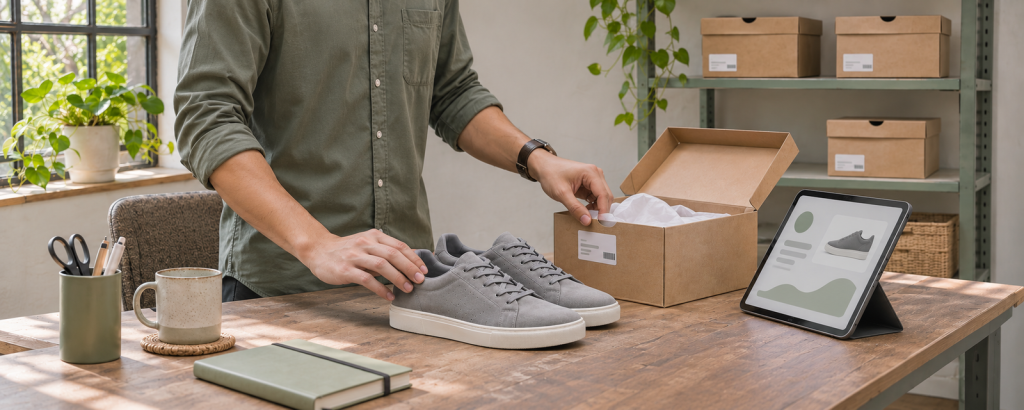
To start a shoe business, decide who you want to serve and what you will sell, choose how to source your products and fulfill orders, and check whether the numbers work. Then arrange your business setup, sales channel, and order process before opening for sales.
Your starting point matters. Selling existing shoes, developing your own brand, and using a supplier to fulfill orders involve different commitments. The steps below help you choose a workable combination and identify what you need to confirm before spending more.
1. Define Your Customer and Product Focus
Start with a specific use and customer. “Casual sneakers for adults who want one understated pair for commuting and everyday wear” gives you more to investigate than “shoes for everyone.” It suggests questions about fit, styling, price, and where those customers currently shop.
Treat that description as a hypothesis. Look at competing products and talk with potential customers about their recent purchases:
- What did they buy, and what did they pay?
- What worked well, and what made them return or stop wearing a pair?
- Which alternatives would they consider before buying yours?
Use the answers to narrow your first assortment and price assumptions. Reviews can reveal questions to investigate, but a few complaints do not prove a large unmet need. Likewise, likes and encouraging comments are not purchase commitments.
If you are wondering which shoes sell the most, bring the question back to your intended customers. A popular category may still be a poor starting point if you cannot offer a clear reason to choose your products or reach people at a manageable cost.
2. Choose Your Business Model
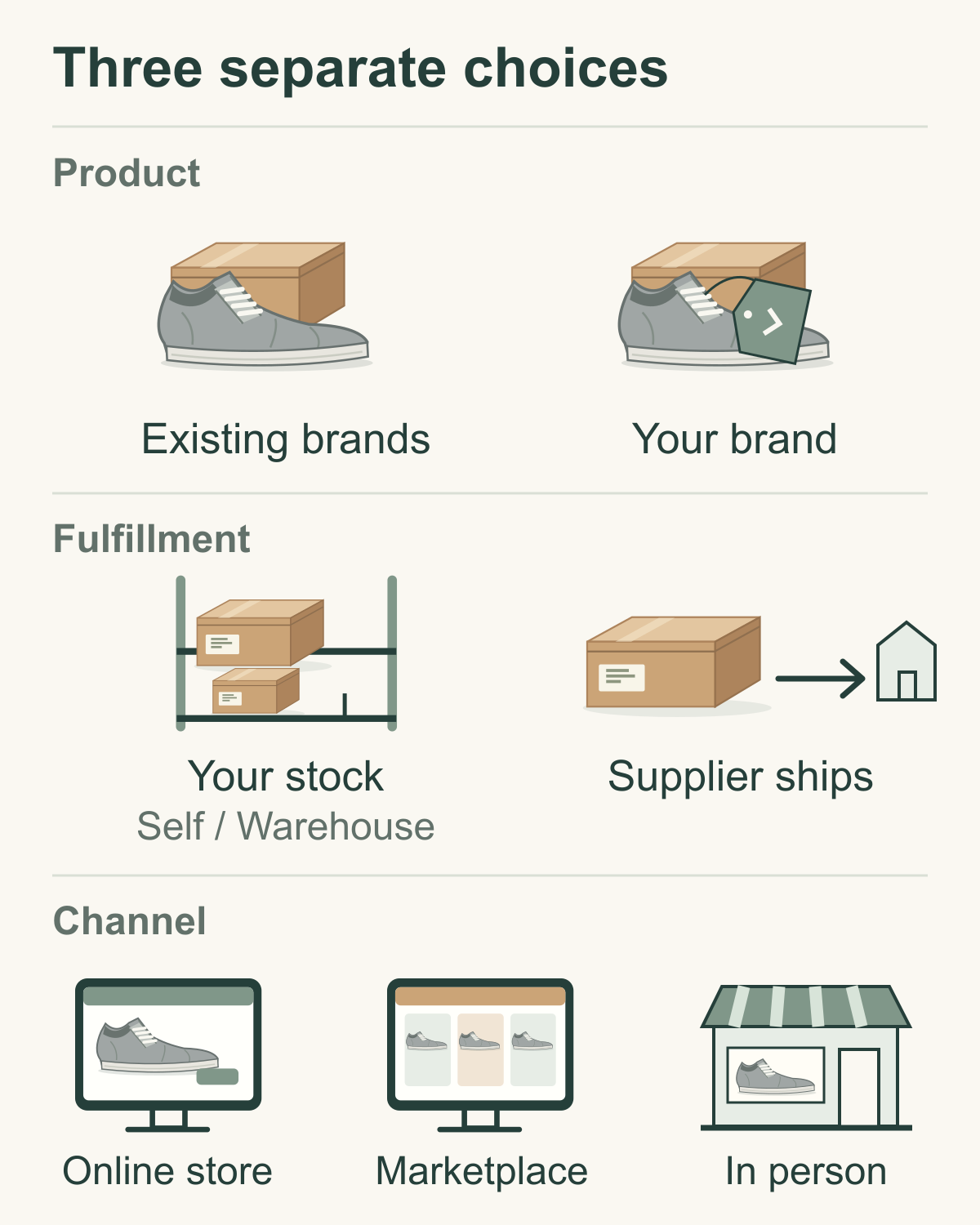
A shoe business model involves three separate choices: whose products you sell, how inventory and orders are handled, and where customers buy. Keeping those decisions separate makes the options easier to compare.
Choose Your Product and Brand Approach
You can purchase existing shoes for resale or build your own shoe brand. The latter does not require owning a factory: you can work with a manufacturer on an existing style or a more involved development project.
Ask what customization actually includes. A “white label” or “private label” offer might allow branding changes while keeping the underlying shoe largely unchanged. Changing the fit, construction, or outsole can involve different development work. Confirm the available changes and sample process rather than relying on the label.
Print-on-demand, or POD, may let you add artwork to available footwear. That is a different scope from developing a new shoe structure.
Decide Who Holds Stock and Fulfills Orders
You might buy inventory and ship it yourself, use a warehouse, or work with a supplier that ships directly to customers. With POD, printing or production happens after an order under the provider’s terms. These are possible combinations, not a complete list:
| Starting approach | Product control | Stock and fulfillment | Confirm before committing |
|---|---|---|---|
| Resell existing shoes | Select available products | Buy stock; ship yourself or use a warehouse | Order quantities, size availability, replenishment, and returns |
| Own brand with contract manufacturing | Changes depend on the agreed development scope | Plan production, inventory, and outbound fulfillment | Samples, development costs, minimums, and payment schedule |
| Supplier dropshipping | Within the supplier’s available range | Supplier ships customer orders | Stock updates, charges, shipping times, and problem handling |
| Footwear POD | Artwork within available product options | Provider makes or prints and fulfills orders | Samples, per-order charges, production time, and return coverage |
Online, in-store, and home-based describe your selling or operating setup. They can combine with different supply arrangements. Choose a starting combination based on the product control you need, the cash you can commit, and the work you can manage.
3. Check Your Costs, Pricing, and Cash Needs
Build a Budget for Your Chosen Model
There is no single useful startup figure for every shoe business. Build a budget around your chosen scope:
- Before launch: samples, product development where needed, initial stock, business setup, photography, and store setup.
- Ongoing operations: premises, software, storage, bookkeeping, and other recurring commitments.
- Sales-related expenses: product costs, packaging, payment or channel fees, fulfillment, shipping, marketing, and returns.
Not every item applies to every model. Mark estimates clearly and replace them with quotes. Check what each quote includes so you do not count the same charge twice. A deposit and balance are two payment dates for one purchase, not two separate purchases.
The cash budget tracks when you pay; the per-sale calculation below tracks what each sale costs. Keep those views separate.
Check Your Margin and Payment Timing
Subtract all costs that vary with a sale from the revenue it generates. What remains is its contribution toward fixed expenses; it is not net profit. Classify marketing and other expenses according to how you incur them, since they may contain both fixed and variable parts.
For a simplified example, assume one pair per order, total variable costs of $60 per pair, and monthly fixed expenses of $1,000:
| Selling price | Variable costs per pair | Contribution per pair | Pairs to cover monthly fixed expenses |
|---|---|---|---|
| $80 | $60 | $20 | 50 |
| $75 | $60 | $15 | 67, rounded up |
Divide fixed expenses by the positive contribution per pair to calculate this simplified break-even quantity. These are illustrative figures, not industry averages or a HEVA quote. The example assumes one product, unchanged costs, no returns or chargebacks, and revenue excluding collected sales tax. Your forecast should account for refunds and related costs without counting them twice. This simplified break-even example does not show how much startup funding you need or what your after-tax profit will be.
Next, put payments on a calendar. When does the supplier charge you? When can you use customer payments? When might you need to refund an order or buy replacement stock? With some POD services connected to your online store, the supplier charges you separately from the customer’s payment to your store, so the timing can leave a cash gap.
If you want to start a shoe business with no money, begin by researching customers and gathering quotes. Removing upfront inventory may reduce one expense, but it does not establish that you can fulfill orders without funds.
4. Find the Right Supply Partner
Your model determines who you should approach. A wholesaler supplying existing products, a dropshipping or POD service, and a shoe manufacturer offer different things. Establish that the supplier provides the service you need before comparing prices.
Make your first questions specific:
- Existing stock: Which styles, colors, and sizes are available, in what quantities? How are shortages and replenishment handled?
- Supplier fulfillment: How do orders reach the supplier? When are you charged, and who handles damaged, missing, or incorrect items?
- Own-brand production: What can be changed, what samples are required, and what are the minimum order quantities, payment terms, and production assumptions?
Review samples appropriate to your plan before committing to stock or customer promises. Check the product against your intended use, fit expectations, and descriptions. One sample does not establish that every size or future production pair will be identical.
For overseas sourcing, clarify which transport and import-related charges the quote includes and who handles each stage. Check the safety, testing, and documentation requirements that apply to the specific product and use. A supplier’s general assurance is not a product-specific assessment. Feed any additional costs back into your budget before confirming the order.
5. Set Up Your Business and Sales Channels
Check Business Requirements and Your Name
For a U.S. business, check the requirements for your location and activities. Review your business structure and registration, applicable tax registrations and permits, operating location, and payment and recordkeeping arrangements. An LLC or an employer identification number, or EIN, is not automatically required in every situation. An EIN is also not a sales license or resale certificate.
You may be able to start a shoe business from home, but check local zoning and other applicable requirements. Think through storage, deliveries, customer visits, and returns before treating your home as the operating location.
Check your proposed name before investing heavily in packaging or branding. Domain availability does not establish trademark clearance. A search for potentially confusing similar marks should look beyond an exact-name match.
Choose Where You Will Sell
Start where your intended customers can find you and where you can manage the work. An online store needs a way to attract visitors, explain fit, take payments, and handle delivery. Marketplaces have their own fees and operating rules. A physical store requires a location and staffing plan, alongside the inventory customers expect to try on.
You do not need to open every channel at once. Compare the costs, daily workload, and customer experience of your first channel, then check those assumptions against the budget. If you sell across channels, decide how you will keep stock information consistent.
6. Get Ready to Take and Fulfill Orders
Prepare Product, Size, and Stock Information
Use product images and descriptions that accurately represent what you will supply. Give customers clear size information and explain how to use any measurements. Check the supplier’s sizing information against the product you reviewed; a generic size chart may not describe the same fit.
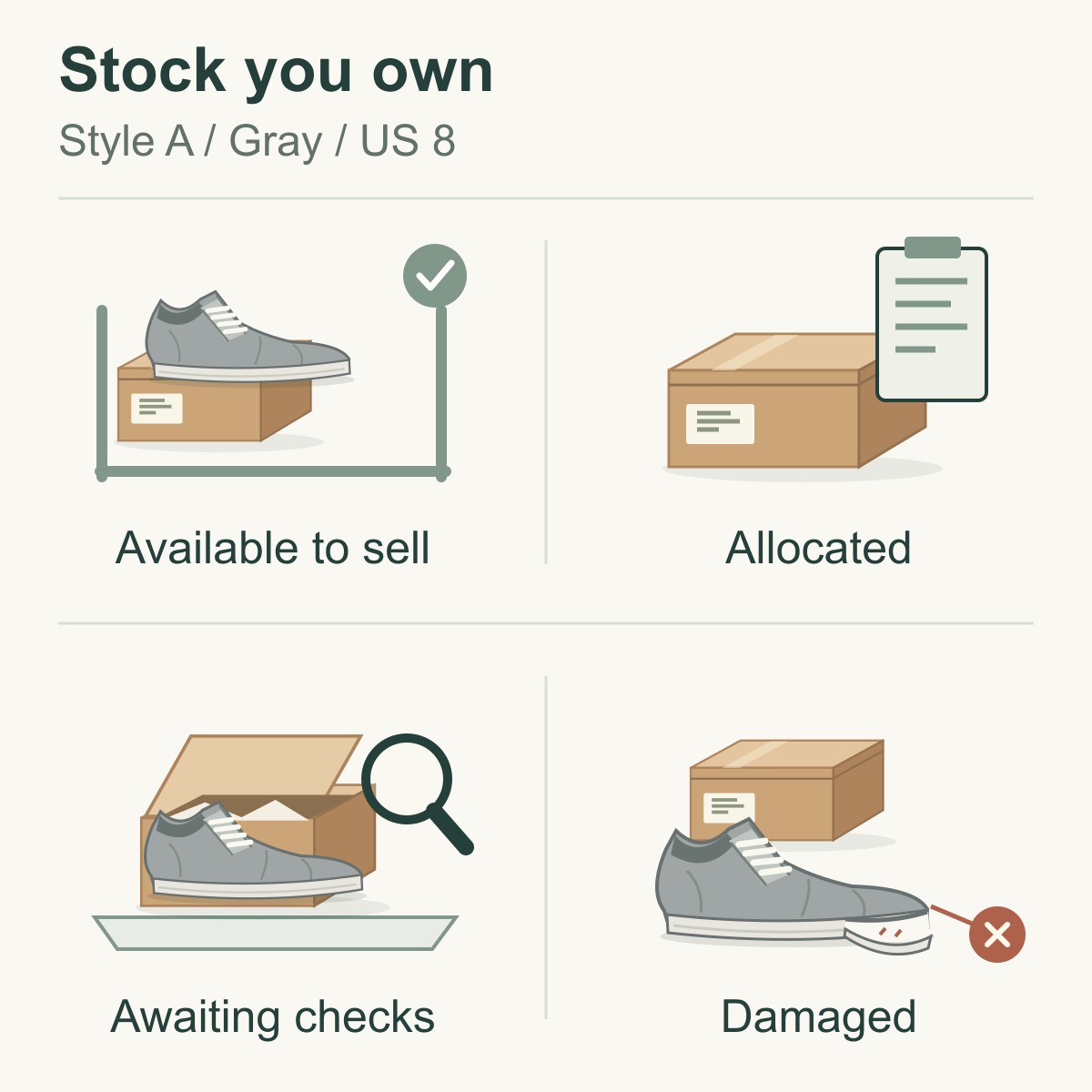
Track availability by style, color, and size. Having 100 pairs does not tell you whether the size a customer wants is available. For stock you own, assign quantities to those combinations. Keep pairs already allocated to orders, damaged pairs, and stock awaiting checks out of the quantity available to sell. For supplier fulfillment, establish how availability updates reach your sales channel.
Set Shipping and Return Expectations
Build shipping promises around confirmed stock or production arrangements, order processing, and carrier handoff. Keep the dispatch date distinct from the expected arrival date.
For U.S. orders covered by the FTC’s Mail, Internet, or Telephone Order Merchandise Rule, shipping promises need a reasonable basis. If you cannot ship as promised, follow the applicable delay-consent and refund requirements. Using a third party to ship does not automatically remove your responsibility. Preorders also need a feasible fulfillment plan and funds available for required refunds.
Decide how customers should report a fit issue, defect, or delivery problem. Specify the return address, assessment process, and refund or replacement terms. Check which costs your supplier covers and which you must bear. Ask your supplier what evidence it needs for problem claims and when those claims must be submitted. Supplier coverage may exclude a customer’s wrong-size choice even when you offer an exchange. Your customer policy must also meet applicable legal requirements.
Walk Through an Order Before Launch
Use your platform’s testing process to check size selection, checkout, shipping charges, tax settings, notifications, and stock changes. Confirm that the person handling fulfillment receives the right information.
Prevent test orders from accidentally triggering paid production or shipping, and restore normal payment settings afterward. A simulated checkout does not verify actual transit time; check the physical fulfillment arrangements separately. Also make sure you know where to find an order when a customer asks for help.
7. Launch, Review Results, and Plan Your Next Step
Choose an initial activity you can track: announce availability to people who asked for updates, publish content showing the product and fit, or try an appropriate local selling opportunity. Pick an approach that matches the customer research, and record the time and money it takes.
Review results by channel and by style, color, and size. Look at sales alongside exposure, time available for sale, stockouts, expenses, and reasons for returns. Low sales alone do not tell you whether demand is weak. A size that was unavailable could not sell.
Before expanding the range, decide whether the evidence supports replenishment, a product or description change, or more customer research. Check the cash and lead time needed for the next order.
Keep a short shoe business plan that records:
- Your target customer, use case, and first product range.
- Your brand, supply, inventory, and fulfillment choices.
- Your first sales channel and customer acquisition activity.
- Your price, expense assumptions, and payment calendar.
- Who handles orders, customer questions, returns, and supplier problems.
- Your biggest unanswered question and the next action to investigate it.
Update the plan as quotes, samples, and sales replace your assumptions.
FAQ
Do I Need Shoe Design Experience to Start?
You can sell existing shoes without designing them. For your own product, you can arrange design and development support, but you still need to explain the intended use, assess samples, and make decisions. Identify what you can evaluate yourself and where you need help with fit, materials, or construction before committing to a development project.
Can I Start a Shoe Business Part-Time?
A part-time start can be workable if the operating tasks fit the time you can provide. Map out when orders, customer messages, supplier questions, and delivery problems need attention. Arrange coverage where needed and set realistic service expectations. A smaller assortment may help you manage the workload, but outsourcing shipping does not eliminate customer support.
Can I Add My Own Shoe Brand After Starting as a Retailer?
Yes, but treat the new product as a separate investment decision. Retail sales can reveal customer preferences and recurring fit questions. They do not prove demand for a product customers have not tried. Revisit the product brief, development budget, supplier choice, and sample evaluation, and test interest in the new offer before making a large commitment.
Conclusion
Starting a shoe business means connecting a clear customer need with a product, supply arrangement, and sales process you can support. Use quotes and samples to check your assumptions, then make sure the money and order handling work before you take on more commitments.
If your next step is an own-brand casual shoe or sneaker, outline the intended use, gather reference styles, and list your expected quantities and remaining questions. Bring those details to HEVA to discuss product development, sampling, and manufacturing, with the scope and terms confirmed for your project.