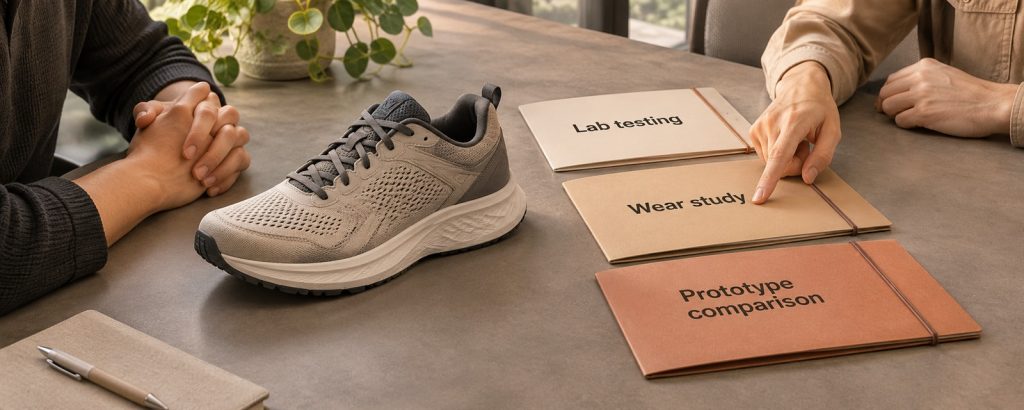
A search for the best companies for footwear testing can lead you to very different services: a laboratory report, a study with athletes, or a comparison between your prototype and shoes already on the market. Start with the decision you need to make. Are you checking a specified requirement, investigating a failure, or choosing between designs?
The providers below describe relevant services on their official websites. This is a starting shortlist, not a ranking based on independently measured service quality. Confirm the proposed work with the team that will actually perform it.
Footwear Testing Companies at a Glance
Use this table to identify companies worth discussing your project with. The project suggestions are based on published services, not confirmed packages. Capabilities overlap: a broad testing organization may also offer development support, while a footwear specialist may provide routine laboratory tests.
| Provider | Publicly described services | A project to discuss | What to confirm |
|---|---|---|---|
| Intertek | Materials, components, whole shoes; inspection | Several test needs across one shoe | Methods and performing laboratory |
| SGS | Physical and chemical testing; product evaluation | Material risks or footwear performance | Sample configuration and report scope |
| Bureau Veritas | Performance tests, failure analysis, inspection | Sole separation or another failure | Measurement versus diagnosis |
| Eurofins | Physical, chemical, fit, and wear assessments | Performance and usability questions | Team and assessment plan |
| Hohenstein | Testing, fit and comfort, inspection | Fit or comfort evaluation | Participants and size coverage |
| QIMA | Laboratory testing and inspections | Testing alongside production checks | Separate assignments and reports |
| TÜV SÜD | Chemical and mechanical testing; quality support | A defined laboratory test program | Product, method, and report requirements |
| SATRA | Footwear testing, comfort, fitting | Whole-shoe comfort or fit development | Assessment and target population |
| CTC | Physical testing, LivingLab, method development | A development question needing tailored tests | Protocol and interpretation |
| Exos | Study design, participant testing, analysis | Performance during a defined activity | Population, movement, and environment |
| RunRepeat | Prototype testing and database benchmarking | Comparing a prototype with reference shoes | Modified methods and intended use |
What Each Provider Offers
The profiles below highlight differences in service focus. Capabilities overlap, so these summaries should not be read as the limits of what each provider offers.
Intertek
Intertek describes testing for footwear materials, components, and complete shoes, alongside fit assessment, consulting, and inspection. Its published physical testing services include flexing, slip resistance, and bond strength.
That breadth makes it a candidate when your project spans several parts of a shoe. For example, you may need separate information about an upper material and the assembled product. Identify those questions in your request, then confirm the methods and the laboratory responsible for each test.
SGS
SGS lists chemical and physical testing for footwear and leather products, with services addressing strength, slip resistance, fit, sizing, and defects. Its footwear service information also covers components such as straps and fasteners.
A useful discussion starts with the sample configuration: a material swatch, a component, or a finished shoe. If you are investigating a problem, specify that purpose. Ask whether the proposed work includes interpretation of the defect or only the requested measurements, and what report you will receive.
Bureau Veritas
Bureau Veritas describes whole-shoe flexing, sole adhesion, slip resistance, waterproofness, aging, and root-cause analysis. It also lists production inspection services.
The distinction between measurement and investigation is particularly relevant if a shoe has failed. A sole-adhesion result and an explanation of why separation occurred are different deliverables. When discussing a project, ask whether the scope includes documentation of the failure location, analysis, and a discussion of findings. Do not assume those services are included in a routine test price.
Eurofins
Eurofins’ footwear service page covers physical and chemical testing, along with fit, ergonomics, wearability, and fault diagnosis. Its described services include abrasion, flexing, impact, traction, and water-related performance.
Discuss Eurofins’ services when your development question involves both material performance and how the shoe performs in use. Be specific about the combination you need. Confirm which team will perform the work, how the assessment will be structured, and whether the deliverable includes interpretation that helps you compare design options.
Hohenstein
Hohenstein separates its footwear offering into physical testing, chemical testing, fit and comfort, inspection, and certification. Its fit information describes tools such as foot scanning and pressure mapping, as well as assessments with test participants.
For a fit project, discuss the intended population, size range, and wearing task before choosing the assessment. A result from a particular group should be interpreted within that scope. Also clarify whether you are purchasing a development assessment, testing for a specified requirement, or a separate certification service.
QIMA
QIMA describes footwear laboratory testing and separate inspection services, including physical, mechanical, and chemical checks. Its footwear coverage includes athletic shoes.
It is a candidate to consider when you need to coordinate sample testing with production checks. Keep the two assignments clear: which samples go to the laboratory, what is checked at the factory, and which report documents each activity? A laboratory result on submitted samples should not be presented as evidence that every pair in a shipment has the same measured performance.
TÜV SÜD
TÜV SÜD’s footwear and leather offering includes chemical and mechanical testing and quality support. To discuss a project, send the product description and requested methods. Confirm that the proposed laboratory can test the relevant material or construction and provide the report you need; a group-wide service description does not establish what every location can offer.
SATRA
SATRA’s footwear services include slip resistance, durability, breathability, fastening assessments, comfort, and fitting. Its published comfort offering combines wearer trials with laboratory assessment, while fitting services include last assessment and work for specific populations.
These services are relevant to questions that extend beyond a single material measurement. If you are working on fit or comfort, explain who the shoe is for and what type of footwear you are developing. Ask which assessment addresses that question and what the findings will allow you to conclude about the tested footwear.
CTC
CTC describes conventional footwear testing alongside its LivingLab and test-method development work. Its published facilities include motion capture, force plates, pressure measurement, and a walking and running simulator used to assess cushioning.
For development work, discuss whether an existing method answers your question or whether the project needs a tailored approach. Request an explanation of the output and its intended use. A development method may help you compare designs without automatically serving the same purpose as a customer-specified test report.
Exos
Exos presents athletic footwear research as a process that can include study design, participant recruitment, protocol execution, and quantitative and qualitative analysis. Its published work includes footwear interactions in sport-specific settings.
Consider this type of service when you need to understand performance during a defined activity. Describe the intended users, movement, environment, and comparison you want to make. The research team can then propose an appropriate study. Results from one activity or participant group should not be generalized to every sport or wearer.
RunRepeat
RunRepeat offers prototype testing and comparisons against its shoe database, with reporting through a private benchmarking dashboard. Its published deliverables include charts, downloadable results, and process media.
The method distinction matters: RunRepeat explicitly describes modifications to methods based on ASTM, ISO, and SATRA standards. Those results can inform comparisons within its testing system, but you should not assume they are interchangeable with an unmodified standard-method report. Confirm the intended use, comparison set, confidentiality arrangements, and sample handling before commissioning work.
Match the Service to Your Footwear Project
Comparing a New Running Shoe Prototype
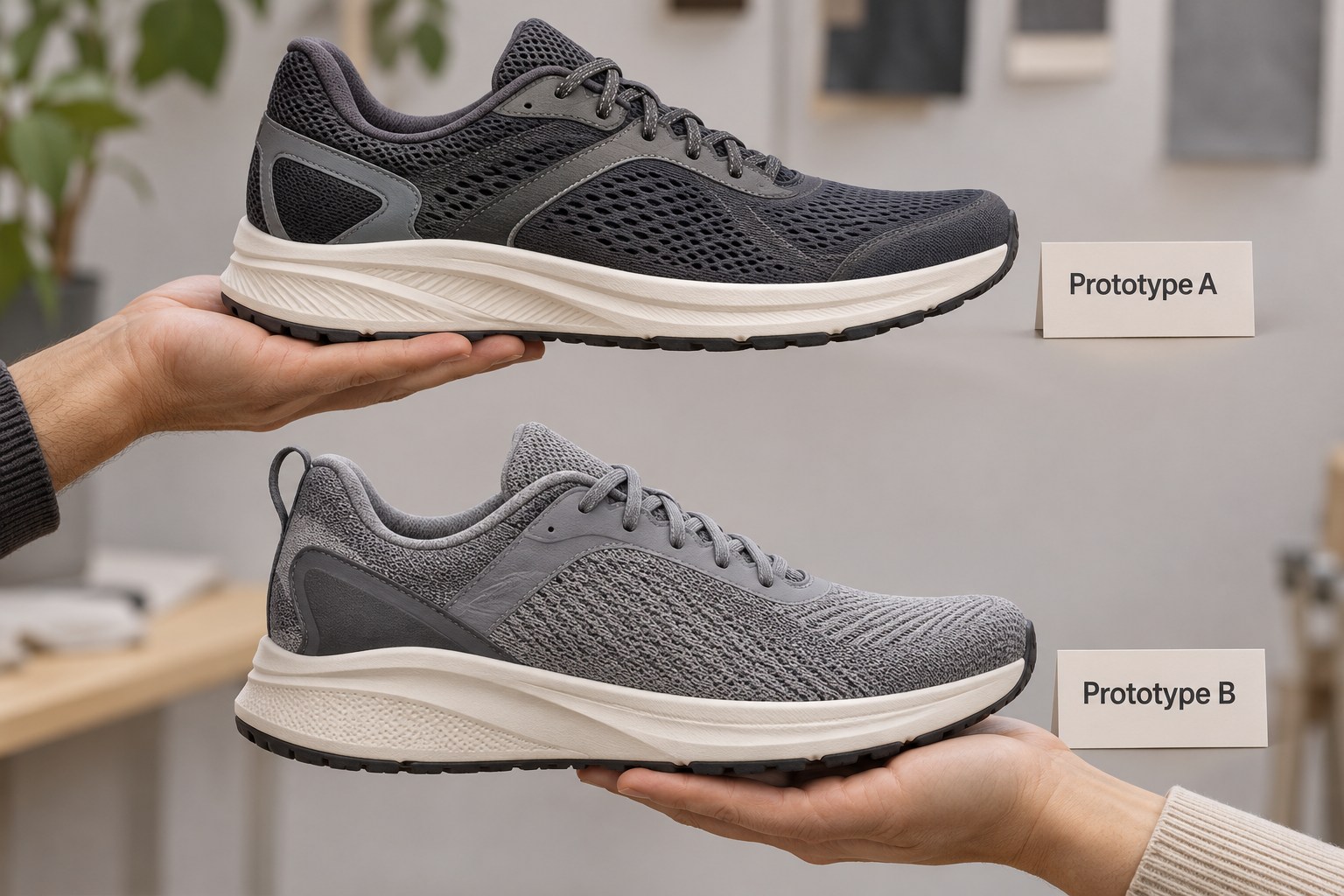
Suppose you are deciding between two prototypes. First describe the decision: are you comparing a measured property, assessing fit, or studying how the shoes perform during running? Those questions may call for different services.
For a laboratory comparison, agree on the reference shoes, methods, sample configuration, and conditions. For a study with participants, discuss the intended population and activity with the research team. You may need both types of evidence, but neither should be added without a clear purpose.
Keep any customer-required testing separate in the brief. A useful development comparison does not automatically meet a separate reporting requirement.
Investigating Sole Separation
If an outsole separates from the upper, explain where the problem appeared and what is known about the sample. Ask the provider to distinguish the proposed strength testing from any investigation of the failure.
A measured result alone should not be used to assign the cause to an adhesive, material, or production step. If diagnosis is the goal, agree on the investigation and its deliverables before sending samples. Ask how findings will be documented and whether follow-up testing of a proposed change would require a separate assignment.
Preparing for Production
Before production, list the questions that belong in the laboratory and those that need a factory check. Material or whole-shoe performance testing and checks of workmanship, pairing, labeling, or packaging serve different purposes.
One organization may be able to coordinate both. Still, identify the samples or production lot covered, the team performing each activity, and the reports you expect. This gives you a clearer basis for decisions than a single, undefined request to “check the quality.”
What to Confirm Before You Send Samples
Send the same core brief to each shortlisted provider. That makes differences in the proposals visible and gives each team enough context to explain its recommended approach.
Product and Purpose
Identify the shoe category, construction or component, development stage, and question you need answered. Include the target market and any requirements supplied by the customer receiving the report. A prototype comparison and a report intended to satisfy a specified requirement should be identified as different assignments.
Methods, Laboratory, and Report Acceptance
Ask for the method and version, any modifications, relevant sample conditions, and the laboratory that will perform the work. Confirm whether any part will be subcontracted.
If accredited testing is required, check that the relevant activity is included in that laboratory’s scope of accreditation. ISO/IEC 17025 accreditation does not automatically cover every test a laboratory offers. Confirm the receiving party’s requirements before relying on the proposed report.
Deliverables and Interpretation
Specify what you need to receive: measured results, a comparison dataset, photographs, an investigation report, or a discussion of findings. Ask to see a suitable report example if available. Make clear whether you need pass/fail reporting and who supplies the applicable acceptance criteria. A test method does not necessarily define the acceptance criteria for your product.
Samples and Retesting
Have the provider confirm the sample quantity, sizes, preparation, and any conditioning needed for the agreed work. Discuss whether additional samples should be reserved for investigation or retesting. If a prototype changes, ask which parts of the original plan remain relevant rather than assuming that the previous results transfer to the revised shoe.
Confidentiality, Handling, and Quote Boundaries
For an unreleased design, resolve confidentiality and data-use terms before shipment. Confirm whether results can be shared or published, who can access the data, and what happens to samples after testing.
Compare footwear testing cost against the agreed scope. Check which tests, analysis, meetings, and repeat work are included. Request a project-specific price and turnaround time, including when the proposed schedule begins and what could change it.
FAQ
Can a Lab Outside the U.S. Test Footwear for the U.S. Market?
An overseas laboratory may be suitable, but its address alone does not determine whether the report will be accepted. Confirm the required methods, relevant accreditation scope where applicable, and the conditions set by the customer or authority receiving the results. International recognition can support acceptance; it does not guarantee acceptance for every purpose. Check those requirements before commissioning the work, including when you choose a laboratory located in the United States.
How Many Pairs of Shoes Should You Send for Testing?
Get a quantity from the provider after the test plan is defined. The number depends on the agreed work and sample requirements; a single pair should not be assumed sufficient for an entire program. Tell the laboratory which sizes and components are available, and ask whether conditioning, destructive testing, or potential retests affect the submission. If prototypes are limited, discuss that constraint before shipping rather than reducing the quantity without agreement.
Can Factory Test Results Replace an Independent Lab Report?
It depends on the intended use and the receiving party’s requirements. Factory results may contribute to development or internal quality decisions, but they do not automatically satisfy a requirement for independent testing. If a customer specifies a third-party report, follow that requirement. Equally, do not dismiss a factory result solely because of its origin: review the method, sample information, and purpose. Agree on the evidence needed before deciding which work must be commissioned externally.
Conclusion
Choose footwear testing companies around the decision you need to make and the evidence required to support it. Use the shortlist to identify relevant services, then compare methods, the proposed laboratory, and the actual deliverables. Keep development comparisons, required reports, and production inspections clearly defined.
If you are planning an OEM or ODM athletic footwear project with HEVA Sport, bring the product brief and testing requirements into the development discussion. That gives sample planning and production preparation a clearer starting point.