When you estimate import duty on shoes for a U.S. order, the useful answer is a dollar amount tied to the shoes you plan to ship. A percentage by itself leaves several questions open: Which styles does it cover? What value does it apply to? Does the rate also include an amount per pair?
Build the estimate one line at a time. Confirm the product information and customs value, apply the appropriate rate to each line, then total the results. Keep additional duties and other import costs visible so an ordinary-duty subtotal does not become your entire shipping budget by mistake.
The example below shows that process using published U.S. tariff rates checked on November 19, 2026 and hypothetical order figures. It demonstrates the arithmetic; it is not a current duty quote.
Gather the Details for Each Shoe Style
Before opening a calculator, assemble a short record for each style. Start with:
Style number and specification version, including relevant upper, outsole, and construction details.
The U.S. HTS classification and the information supporting it.
Country-of-origin information and the basis used to establish origin.
Customs value, quantities, and the units required for the calculation.
The applicable rate, its source and version, and the date or entry circumstances being assessed.
Keep these details together. A correct rate applied to a different sample version can produce a convincing number that does not describe your shipment. Likewise, a supplier’s price list may identify the style without explaining the material or construction details needed to check its classification.
Use separate worksheet rows when the calculation inputs differ. That might mean separating two styles, or separating quantities with different values or applicable duty treatment. This is a practical budgeting layout, not a prescribed customs form.
Give unresolved fields a visible status such as “classification pending” or “value adjustment to confirm.” A blank value that your spreadsheet treats as zero can hide a missing decision. You should be able to trace every calculated subtotal back to its inputs.
Establish the Customs Value
The invoice total is a starting point for review. It is not automatically the value to which you should apply a duty rate.
Where transaction value is the applicable valuation method, the price paid or payable may require specified additions. Check whether qualifying packing costs, selling commissions, assists, royalties, or proceeds are already included before adding them again. Transportation and related charges also require the appropriate treatment and supporting information; do not automatically add or subtract every shipping charge.
An assist can include a mold supplied directly or indirectly by you, free or at reduced cost, for production of the imported goods. A separately paid mold needs its own review. First determine whether it qualifies as an assist, then establish its value and an appropriate allocation. Dividing a tooling invoice equally across an arbitrary number of orders does not establish that allocation.
Valuation sources: 19 CFR 152.103 sets out the transaction-value rules, including additions and assist valuation/apportionment; 19 CFR 152.102(a) defines assists. These provisions support the valuation method, not the hypothetical order amounts used later.
For your worksheet, record the confirmed customs value separately from the commercial price. Keep a note explaining any difference and the documents used to resolve it. If the valuation method or a required adjustment remains unsettled, label the resulting calculation provisional rather than presenting it as a completed estimate. Missing information about a required addition can also mean transaction value cannot be determined under that method; marking a worksheet provisional does not resolve the valuation issue.
Match the Calculation to the Duty Rate
Read the rate as an instruction about both the calculation and its units. For the following formulas:
V = the customs value for that line, in dollars.
Q = the quantity for that line, in pairs.
r = an applicable percentage expressed as a decimal.
s = an applicable dollar amount per pair.
An ad valorem rate is a percentage of value:
Ordinary duty = V × r
A specific rate is an amount per stated unit. If that unit is a pair:
Ordinary duty = Q × s
A compound rate combines both components:
Ordinary duty = (V × r) + (Q × s)
These formulas are the arithmetic expression of the rate formats, not separate tariff rules. The worked example uses the percentage and compound rates in the cited USITC schedule. Check the actual rate wording before choosing a formula; a statistical reporting unit does not, by itself, tell you how duty is charged.
Next, review any additional duty provisions separately. Record the basis and calculation required for each applicable measure. Do not assume that every charge uses the same base, or that one duty is calculated on top of another duty.
Once you have confirmed which rates apply, enter them alongside the corresponding values and quantities in your order worksheet. Resolve any uncertainty about the applicable rate before relying on the calculated amount.
Worked Example: Ordinary Duty on a Two-Style Order
Assumptions and scope
The quantities and customs values below are hypothetical teaching inputs, not HEVA prices, market benchmarks, or a customer order. For this exercise, assume that each style has been correctly classified, its customs value established, and the General rate in Column 1 confirmed as applicable. No preferential treatment is assumed.
The ordinary-duty rates are taken from the USITC online HTS, 2026 Revision 23, checked November 19, 2026. They are used to illustrate the calculation, not to quote the total duty for a current shipment. For an actual shipment, verify the schedule and all applicable measures for the relevant entry circumstances.
Rate source: USITC online Harmonized Tariff Schedule, 2026 Revision 23, checked November 19, 2026, subheadings 6404.11.89 and 6404.11.90, Column 1 General. The online schedule may change after this date.
Example inputs
| Style | HTS rate line | Pairs | Assumed customs value | Ordinary-duty rate used |
|---|---|---|---|---|
| A | 6404.11.90 | 500 | $10,000 | 20% |
| B | 6404.11.89 | 300 | $3,000 | $0.90 per pair + 20% |
These are two separately classified hypothetical styles. The values work out to $20 per pair for A and $10 per pair for B. Those figures fit the respective value brackets in the cited version, but value alone does not establish either classification. The complete material, construction, and other applicable conditions must also be satisfied. The example uses eight-digit rate lines; it does not supply a ten-digit statistical reporting number for real merchandise.
Calculate Style A
Style A has a percentage rate in the cited version:
$10,000 × 0.20 = $2,000 ordinary duty
Divide that line’s duty by its quantity:
$2,000 ÷ 500 pairs = $4.00 per pair
Calculate Style B
Style B has two components. Calculate each before adding them:
Value component: $3,000 × 0.20 = $600
Quantity component: 300 pairs × $0.90 per pair = $270
Ordinary duty: $600 + $270 = $870
Its ordinary-duty amount per pair is:
$870 ÷ 300 pairs = $2.90 per pair
Using only the 20% component would leave out the $270 quantity component. Multiplying the per-pair amount by cartons or individual shoes would introduce a different unit error.
Total the order
Ordinary-duty subtotal: $2,000 + $870 = $2,870
Total quantity: 500 + 300 = 800 pairs
Average ordinary duty: $2,870 ÷ 800 = $3.5875 per pair
For a budget display, that average is approximately $3.59 per pair. Retain the underlying precision in the worksheet. This display choice is not a statement about customs-entry rounding requirements.
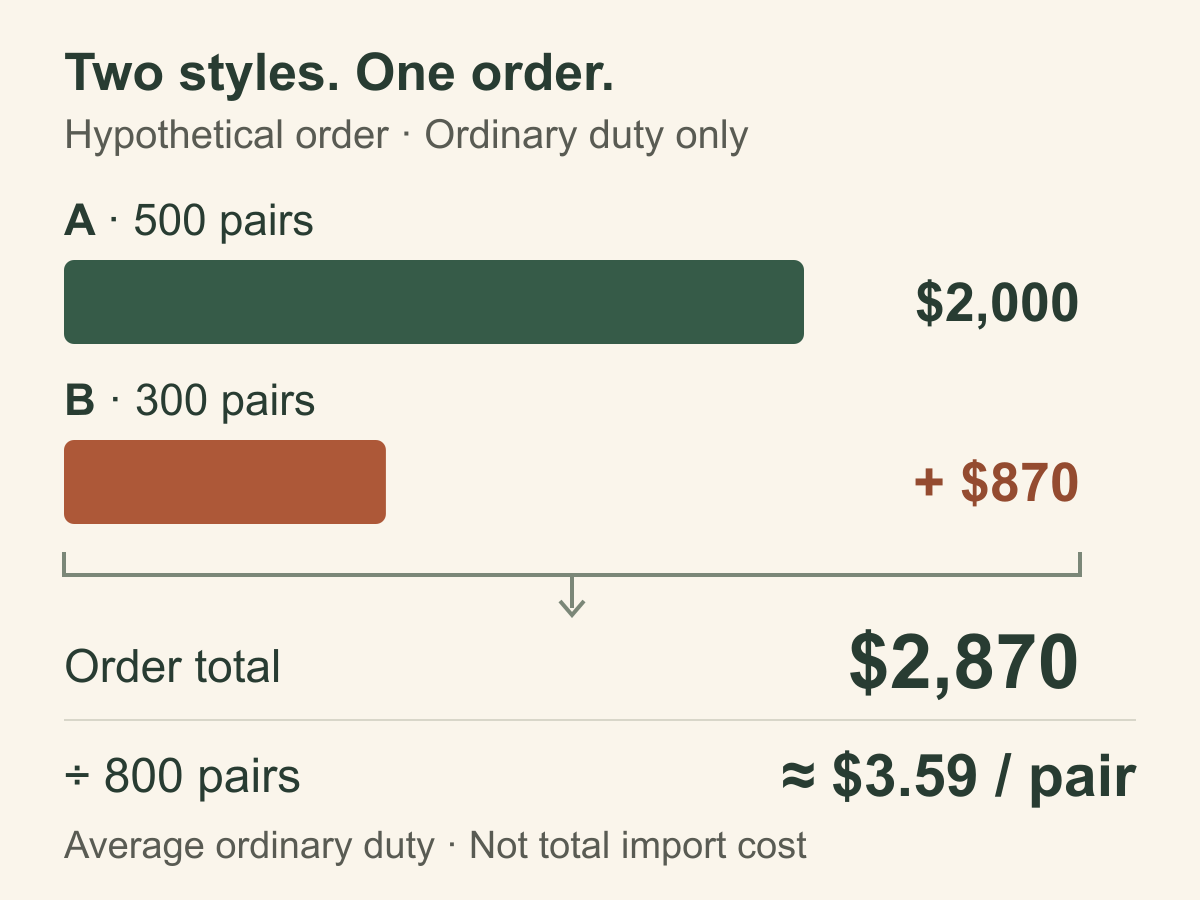
The order average does not replace the style-level figures. In this example, ordinary duty remains $4.00 per pair for Style A and $2.90 for Style B. If you change the quantity mix, the order average changes too.
Calculation basis: the formulas above expand the two published rate formats using the explicitly assumed values and quantities. The order total and per-pair figures are arithmetic results, not amounts quoted by USITC.
What the example excludes: additional duties, preferential-treatment adjustments, other government fees, brokerage or carrier charges, freight, and insurance have not been quantified. They are not assumed to be zero. The $2,870 figure is only the illustrated ordinary-duty subtotal.
Separate Duty from Other Import Costs
After calculating duty by line, organize the wider budget by what each amount represents. A compact summary can use these groups:
| Cost group | What to record |
|---|---|
| Ordinary customs duty | The amount calculated from the applicable ordinary rate and its required value or quantity basis. |
| Additional duties | Any other applicable duty measures, with their own source, effective-date check, and calculation. |
| Other government fees | Applicable charges assessed separately from the ordinary-duty calculation. |
| Brokerage and carrier services | Commercial charges for the services included in your arrangements. |
| Freight and insurance | Transport and coverage costs, reconciled with what your existing quotes already include. |
Leave a “to confirm” amount beside unresolved items. Keep the supplier quote, freight quote, and broker’s estimate available so you can identify what each already covers. When a charge appears in more than one document, check whether it is the same charge before adding it twice.
This separation also makes revisions easier. A freight quote can change without changing the arithmetic of a percentage-based ordinary-duty line, provided the confirmed customs-value inputs remain the same. A change to customs value, by contrast, requires you to revisit every calculation that uses that value.
Avoid naming the bottom line “total import cost” until its scope is clear. A duty subtotal and a completed landed-cost budget answer different questions.
Check Your Estimate Before Shipping
Keep the estimate tied to the version of the order you expect to ship. Before relying on it, compare the worksheet with the final specifications, invoice information, and quantity breakdown.
A practical final check is:
Do the style numbers and specification versions match the goods being shipped?
Are the classification and origin assumptions still supported?
Have the customs values and any adjustments been resolved without double counting?
Do quantities and calculation units agree?
Have the applicable rates, additional measures, and relevant dates been checked again?
Are unresolved amounts visible, with someone assigned to confirm them?
Record who checked the inputs, when they were checked, and which source version was used. That short trail is more useful for a repeat order than a total copied from an old email.
Timing source: under 19 CFR 141.69, applicable rates generally relate to the time of entry, subject to specified exceptions and other provisions. Do not assume that placing a purchase order locks in the rate.
If the shoe changes after sampling, send the revised details for classification review before reusing the estimate. HEVA can help organize the footwear specifications and order information needed for that discussion; the final customs treatment still needs to be established for your shipment.
FAQ
Can I use the HS code on my supplier’s invoice?
Use it as a reference to check. A code used for export in the supplier’s country may not provide the complete U.S. HTS classification. Ask for the product facts behind it and confirm the U.S. classification and statistical reporting detail before carrying its rate into your worksheet. Our footwear HS code guide explains how six-digit HS codes relate to U.S. tariff and statistical reporting detail.
Does a free ordinary duty rate mean there are no other import charges?
No. A free ordinary rate describes that part of the tariff treatment. It does not establish that additional measures, government fees, or commercial service charges are absent. Keep those items on your checklist until their applicability is resolved.
Can I use a previous shipment’s duty calculation for a repeat order?
Yes, as a working reference. Recheck the inputs and applicable treatment rather than copying the old total. Even when the shoe appears unchanged, the quantity mix, customs value, or relevant tariff provisions may differ. Retaining the old calculation’s sources makes that comparison much easier.
Conclusion
A useful estimate of import duties on shoes connects each dollar to a confirmed input. Start with the style details and customs value, apply the correct rate format to each line, and keep additional duties and other import costs separate. Then review the figures against the shipment you actually plan to make.
For an OEM or ODM footwear project, bring the style specifications, planned quantities, and outstanding product questions to your discussion with HEVA. Organizing that information early gives you a clearer basis for customs review and order budgeting.