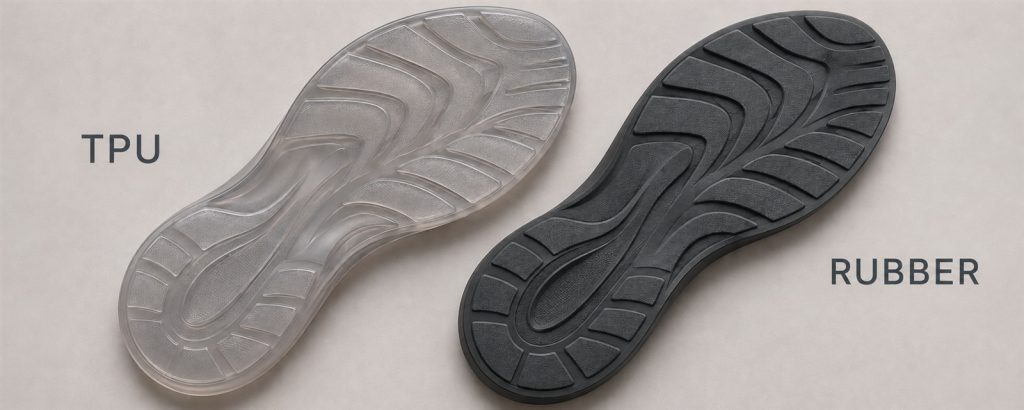
TPU can be worth exploring when your outsole design calls for transparency or detailed molded features. Rubber remains a useful benchmark when you already have a compound and construction that perform well in the intended conditions. Neither material name, however, tells you which finished outsole will grip better, last longer, or cost less.
A useful TPU vs. rubber sole comparison starts with the shoe you want to develop: where it will be worn, how it needs to move, and how it will be made. This guide compares solid TPU and conventional vulcanized rubber outsoles—the parts that contact the ground.
TPU and Rubber Outsoles: What Are You Comparing?
TPU stands for thermoplastic polyurethane. It can be softened with heat and molded into components, but its properties vary by grade. A TPU outsole, a rigid TPU support plate, and a foamed TPU midsole have different jobs. Data for one should not stand in for the others.
The rubber discussed here is vulcanized rubber: a rubber compound cured to form a crosslinked structure. The compound and its processing conditions matter. “Rubber” is no more a complete performance specification than “TPU.”
Ask which material actually touches the ground and which grade or compound is proposed. Then check whether the comparison concerns a material test piece, a molded sole unit, or a completed shoe. Those are different levels of evidence.
If one proposal uses a solid outsole and another includes exposed foam or a separate support component, record that difference. You may still compare the proposals, but you are comparing constructions as well as materials.
Compare Grip, Wear, Flex, and Weight
Use these factors to frame the comparison before deciding which sample to develop.
| Factor | TPU outsole | Rubber outsole | What to verify |
|---|---|---|---|
| Grip | Dedicated traction grades are available. | Compounds can be developed for particular surfaces. | Finished tread, surface, and dry/wet conditions. |
| Wear | Abrasion performance is grade-specific. | Wear performance is compound-specific. | Comparable abrasion results, flexing, and bond integrity. |
| Flex | Grade and section geometry both matter. | Compound and section geometry both matter. | Bending and twisting in the intended construction. |
| Weight | Weight varies with grade, thickness, and coverage. | Weight varies with compound, thickness, and coverage. | Same-size component weight, thickness, and coverage. |
Grip Depends on the Surface and Tread
There is no sound basis for treating every TPU outsole as slippery or every rubber outsole as slip-resistant. Dedicated TPU traction grades exist, just as rubber compounds are developed for particular uses. The tread and contact conditions still need to suit the shoe.
For example, stopping and changing direction on a court creates a different design brief from walking on wet pavement. Start with the surface and movement, then ask for evidence that addresses them. A result described only as “good wet grip” leaves too much unanswered.
Check how the result was obtained. A smooth material specimen tested against a specified tile does not establish how a finished tread will behave on every wet surface. Use comparable test conditions for the candidate outsoles and assess the intended shoe construction.
Abrasion Resistance Is Only Part of Durability
Abrasion tests help you compare resistance to material loss under the stated conditions. They do not directly predict how many months or miles a shoe will last.
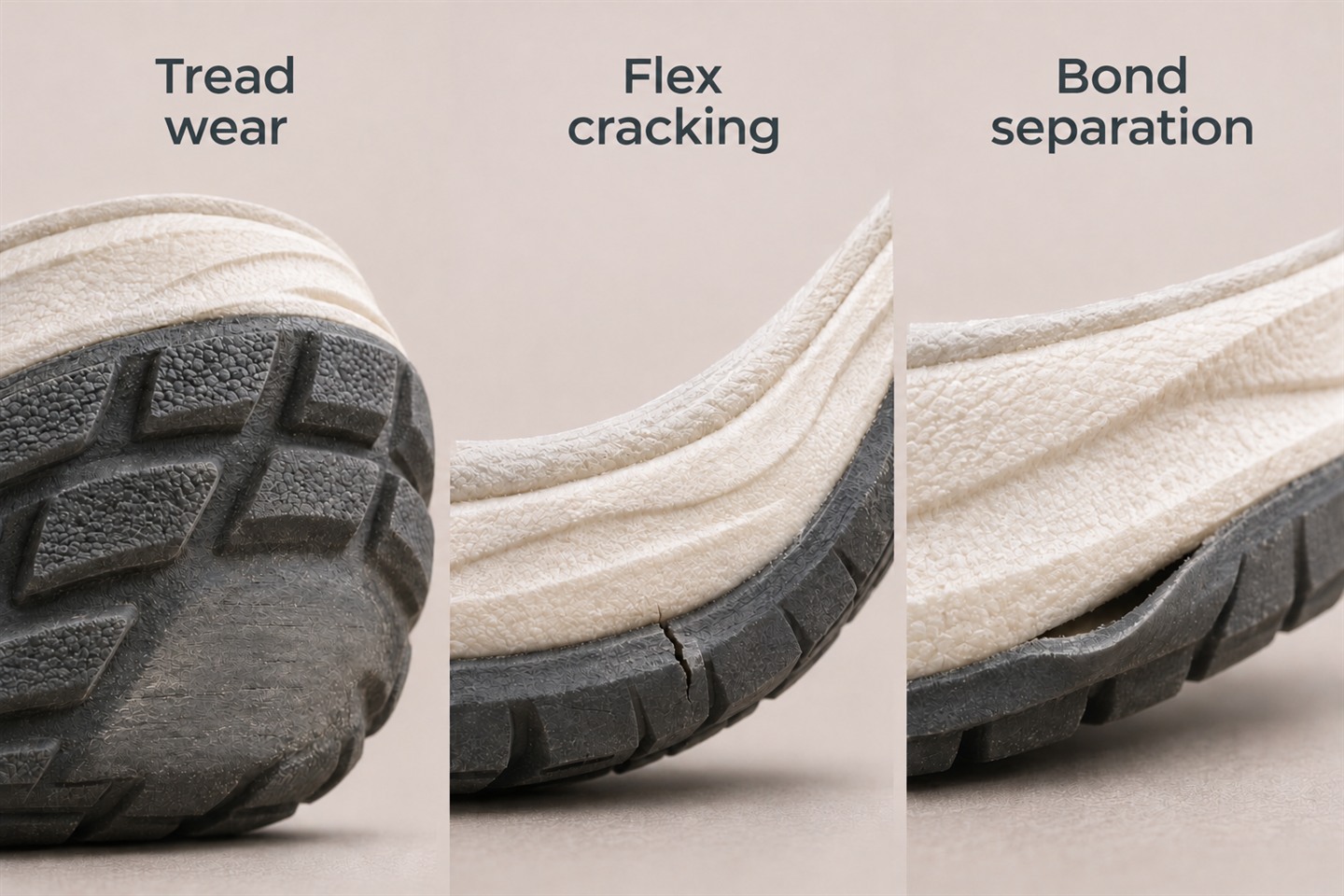
An outsole also needs to withstand repeated flexing and remain attached to the rest of the shoe. A favorable abrasion result does not answer those questions. Review wear, cracking, and bond performance separately rather than combining them into a single “durability” rating.
When comparing reports, check the method, specimen, temperature, and units. If these differ, ask for clarification before using the numbers to select a material. Keep any claim about better wear performance tied to the tested compound and conditions.
Compare the Finished Outsole’s Flex and Weight
When evaluating a thinner TPU design, compare its weight and flex with the original construction, then check whether it still meets the wear requirements. That does not prove TPU is inherently lighter than rubber. Thickness, ground coverage, and the complete construction all affect the comparison.
Weigh the same size of each proposed outsole and record those design differences.
Consider both bending along the shoe and twisting through it. Also keep flexibility separate from cushioning: the midsole, footbed, and other components contribute to underfoot comfort. Choosing an outsole material alone will not determine how comfortable your running or walking shoe feels.
Match the Material to Your Outsole Design
A transparent or translucent outsole is a practical reason to investigate suitable TPU grades. It may let you show color or details beneath the ground-contact layer. The requirement should be specific: how clear should the part be, which areas need to remain visible, and what surface finish should the sample have?
TPU should not be specified simply as “clear material.” Confirm the grade, color, and appearance requirements with the supplier. Transparency does not establish grip, resistance to yellowing, or long-term color stability. Rubber should not be ruled out solely on the assumption that it cannot offer a translucent appearance.
For fine textures, molded details, or thin sections, review what the proposed material and tooling can reproduce. The smallest feature in a drawing is not automatically a reliable production detail. Ask for a sample that shows the features you intend to approve.
Keep a rubber option in the comparison if it meets the appearance and performance brief. For a transparent TPU design, confirm that the selected grade also meets your wet-grip, appearance, and bonding requirements.
Compare Manufacturing and Finished-Outsole Cost
Check the Molding and Bonding Route
TPU and vulcanized rubber require different processing controls. TPU pellets absorb moisture, so drying and handling must follow the requirements of the selected grade. Vulcanized rubber requires an appropriate cure. Both materials have industrial molding routes; rubber production should not be assumed to be entirely manual.
Next, establish how the outsole will connect to the midsole or upper. Surface preparation, adhesive selection, and assembly conditions need to suit the materials involved. A change from rubber to TPU—or the reverse—requires a fresh review of that connection.
A rubber surface may need treatment before bonding with a polyurethane adhesive. That is a reason to confirm the complete bonding system with the supplier, not to assume that one glue works across all compounds. Evaluate the bond in the intended shoe construction, including the outsole-to-midsole connection where relevant.
Compare Quotes for the Same Deliverable
Raw material price is only one part of outsole cost. A useful quotation comparison covers the same size range, order quantity, design, and delivery scope. Ask what each price includes:
- Tooling and any development charges.
- Material use, colors, and separate molded components.
- Molding, surface preparation, and assembly.
- Inspection requirements and whether the quoted price includes allowances for scrap and rejected parts.
Distinguish an existing sole design from a newly tooled one. Also check whether the quote is for a loose outsole, an assembled bottom unit, or a completed shoe. Otherwise, an apparently cheaper option may simply include less work.
There is no reliable universal answer to whether TPU or rubber is cheaper for your project. Compare the cost of meeting the same requirements, including the manufacturing and assembly steps needed to deliver an acceptable result.
Decide Which Outsole to Sample
Choose the first sample around your highest priority. If a transparent appearance is central to the design, begin by reviewing TPU grades with relevant appearance and outsole data. If you already have a rubber outsole that performs well on the target surface, keep it as a reference when evaluating alternatives.
Where grip is the deciding factor, shortlist proposals with evidence relevant to the surface and conditions. Where cost and production feasibility lead the decision, compare complete quotations for designs that meet the same brief.
Give the supplier a short comparison brief:
- The intended surface, activity, and dry or wet conditions.
- Your priority performance requirements and agreed evaluation methods.
- The proposed material, outsole geometry, sample size, and weight target.
- The appearance and assembly requirements.
- The components and work that the quotation must include.
Ask the supplier to include the material and sample configuration in each test report. When reviewing a lighter or more flexible sample, note what changed in the design so that the benefit is not attributed to the material alone.
If the available evidence does not resolve the choice, decide which question the next sample needs to answer and agree on a test that addresses it. That gives the next sample a clear purpose and helps you avoid repeated revisions based on general claims such as “better quality” or “more durable.”
FAQ
Are TPU and Rubber Outsoles Non-Marking?
Neither material name guarantees a non-marking outsole. The relevant question is whether the actual sole material leaves marks on the flooring during use. Color alone is not sufficient evidence.
If non-marking performance matters for an indoor shoe, include it in the brief and ask how the proposed outsole will be assessed against the intended flooring. Confirm that the sample being evaluated uses the specified sole material.
Can TPU Outsoles Break Down in Humid Conditions?
TPU’s resistance to hydrolysis—degradation involving water—depends on the grade and exposure conditions. Grades with hydrolysis resistance are available, so it is misleading to describe all TPU as either vulnerable or immune.
Ask for information relevant to the proposed grade and the expected use and storage environment. Moisture absorbed by raw pellets before molding is a separate processing issue from degradation during the life of the shoe. Neither a material name nor a pellet-drying instruction establishes a universal storage life or proves that the completed shoe is waterproof.
Conclusion
Choose between TPU and rubber by comparing the outsole designs that can meet your brief. Appearance may guide the initial material shortlist, but grip, wear, flexibility, assembly, and cost need evidence from the proposed construction. Keep a proven option as a reference and use sampling to resolve the remaining questions.
For your next footwear development discussion with HEVA, bring the intended surface, outsole drawing or reference, and your main performance and appearance priorities. Those details give the team a concrete starting point for reviewing feasibility and sampling.