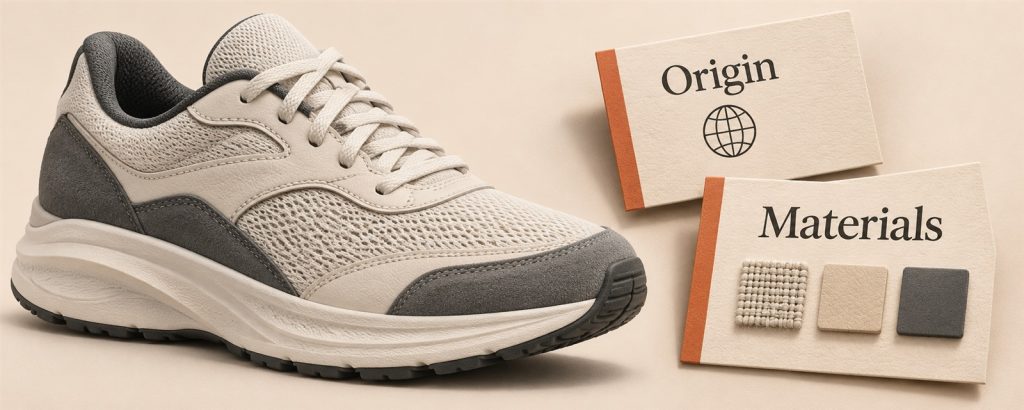
Before you approve a label for a new sports shoe, confirm where you will sell it, who will wear it, and what it is made from. Those decisions affect the information you need and where it belongs.
Footwear labeling requirements in the U.S. and EU overlap in some areas, but the same artwork does not automatically work for both. Imported shoes entering the U.S. need country-of-origin marking unless an exception applies. The EU has a specific footwear material-labeling system, alongside separate product identification and contact-information requirements.
This guide focuses on ordinary consumer sports shoes. For children’s footwear, wool-containing products, or protective footwear, first check which additional rules apply.
Footwear Labeling Requirements: US vs. EU at a Glance
Use this comparison to organize your label specification. The details below explain the conditions behind each row.
Information | U.S. | EU | What to confirm |
|---|---|---|---|
Origin | Imported-shoe origin marking, subject to exceptions. | The footwear material directive itself does not require an origin mark. | Actual origin and any separately applicable requirements. |
Materials | Accurate claims; check leather and special-material rules. | Required material identification for three footwear parts. | Composition and applicable classification. |
Identification | Children’s-product tracking applies where relevant. | GPSR product identification and economic operator details. | Product scope and responsible companies. |
Language and placement | Origin generally in English; readable and sufficiently permanent. | Material-label and GPSR placement rules differ; language depends on the information and destination. | The placement and language rules for each field. |
Keep retailer requirements in a separate part of the specification. A retailer’s size code, barcode layout, or stock-control field may be important to your order without being a universal legal requirement. Ask what each field is for before treating it as mandatory for every market.
What to Check for Shoes Sold in the U.S.
Country-of-Origin Marking
For imported footwear, confirm the country of origin before choosing the wording. The shipping country or your supplier’s office address does not, by itself, establish where the shoes originate.
Under U.S. customs marking rules, the country-of-origin marking generally needs to be in English and easy for the ultimate purchaser to find and read. The marking must remain legible and sufficiently permanent through normal storage, display, and delivery unless deliberately removed.
A sticker is not automatically unacceptable: the rules expressly allow paper or pressure-sensitive labels under specified conditions. A sewn label is not automatically acceptable either if the origin is hard to find or unreadable.
Check the actual shoe and attachment method. Do not assume that printing the country on the box replaces marking the shoe; container-only marking depends on an applicable exception. Product-specific rulings and origin determinations may need separate review.
Material Claims, RN Numbers, and Care Information
Start with the material specification, especially when the shoe includes leather or a material that resembles it. The Federal Trade Commission’s (FTC) leather guides address misleading descriptions of leather and imitation-leather products, including footwear. A commercial material name should not leave someone with the wrong impression about what a component contains.
If a component looks like leather but is not, clearly disclose its non-leather nature. The FTC guides call for the relevant disclosures on the product or an attached tag, label, or card that remains with it until the consumer receives it. Advertising also needs the disclosure where leaving it out would create a misleading impression of the material.
Compare the wording on the shoe, packaging, and product listing with the supporting material information. The guides explain deceptive-practice concerns; they are not a product certification.
Also avoid copying a clothing label checklist onto a shoe. The FTC’s Textile Act guidance excludes outer footwear from its general textile labeling coverage. Wool-containing products require a separate check under the Wool Act; the footwear exclusion is not a blanket exemption from every labeling rule.
An RN, or Registered Identification Number, is not a universal requirement for shoes. Where the relevant textile or wool identification rules apply, a qualifying business name may be used instead of an RN.
Footwear is also excluded from the FTC Care Labeling Rule’s definition of textile wearing apparel. You can still provide useful care directions, but distinguish voluntary guidance from a requirement under that rule.
Additional Checks for Children’s Footwear
Where shoes qualify as children’s products, check the Consumer Product Safety Commission’s (CPSC) tracking requirements. Permanent, visible, legible marks on the product and packaging, to the extent practicable, must allow the required source information to be determined.
That includes the manufacturer/importer or private labeler, production location and date, and batch or other manufacturing information. Plan how those details connect to the production records before finalizing the layout.
Tracking marks and a Children’s Product Certificate serve different purposes. The tracking requirement itself is not a safety rule requiring CPC certification; other applicable safety rules may still require a CPC.
What to Check for Shoes Sold in the EU
Three Footwear Parts and Four Material Categories
Under Directive 94/11/EC, EU footwear material labeling addresses three parts separately:
• Upper: the outside portion attached to the sole.
• Lining and sock: the lining and insole forming the shoe’s interior.
• Outer sole: the bottom component exposed to wear and attached to the upper.
The four material categories are:
• Leather: Tanned hide or skin retaining its original fibrous structure. Any surface coating or glued finish must be no thicker than 0.15 mm. Material made by breaking leather down into fibers or particles and reforming it into sheets is not leather under this definition.
• Coated leather: Leather with a surface coating thicker than 0.15 mm but no more than one-third of the material’s total thickness.
• Textiles: Natural, synthetic, or nonwoven textile materials.
• Other materials: Materials outside the preceding categories.
These are defined categories, so translate your component specification into the appropriate category before choosing a symbol. A supplier’s sales name alone may not establish the correct classification.
How the 80% Rule Works
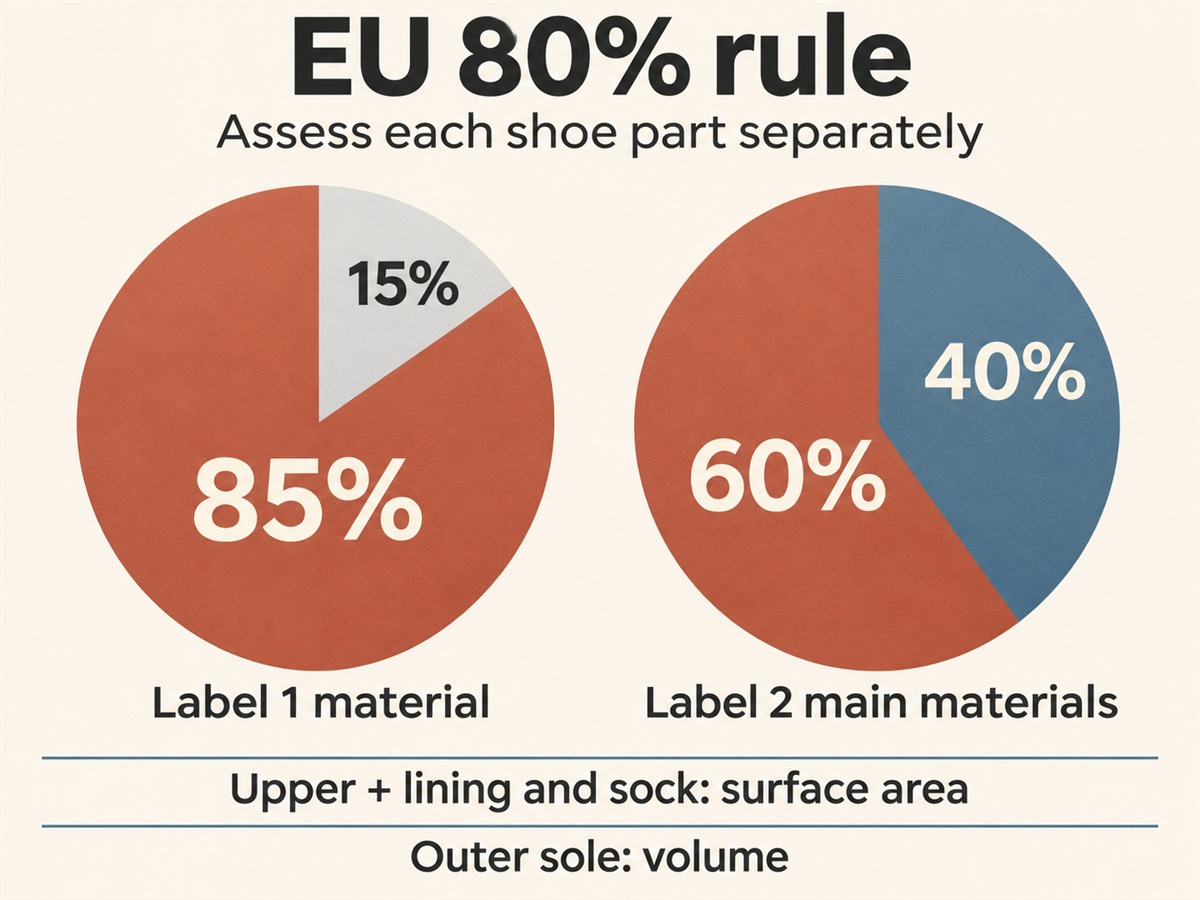
Assess the upper by surface area, and do the same for the “lining and sock” component. Assess the outer sole by volume. Identify the material making up at least 80% of the relevant part.
If no single material reaches that threshold, identify the two main materials for that part. Do not calculate the result from total shoe weight or assume that the label must print every material percentage.
For the upper, the calculation excludes accessories and reinforcements such as ankle patches, edging, ornamentation, buckles, tabs, eyelet stays, and similar attachments.
Ask your development team and manufacturer to establish the composition on the correct basis. A bill of materials helps identify components, but a list of material names alone does not demonstrate their area or volume shares.
Where the Material Label Goes
The material label must be attached to at least one shoe in the pair. It must be visible, securely attached, accessible, and large enough for the information to be understood.
The system permits prescribed pictograms or written indications. If you use words, check the language requirements of the destination country. Do not assume that English wording accepted by your internal team is sufficient everywhere you intend to sell.
These placement rules are specific to the footwear material label. They should not be replaced with a different rule’s permission to put certain information on packaging.
GPSR Identification, Contact Details, and Online Offers
The General Product Safety Regulation, or GPSR, adds information tasks beyond describing the materials. Treat the following as separate entries in your specification:
• Product identification: a type, batch, serial number, or another identifying element must be visible and legible. Packaging or an accompanying document is the alternative when the product’s size or nature prevents marking the product.
• Manufacturer details: identify the manufacturer and provide postal and electronic contact addresses, including a different single contact point where applicable. These belong on the product, or on packaging or an accompanying document where that is not possible.
• Importer details: where there is an importer, its identification and contact details have their own requirement. The product is the starting location, with packaging or an accompanying document allowed where product placement is not possible.
• EU responsible economic operator: identify the operator fulfilling the Article 16 role. Its identification and postal and electronic contact details may appear on the product, packaging, parcel, or an accompanying document.
Confirm the legal roles in your supply chain before inserting company names. Under the GPSR, placing a product on the market under your own name or trademark makes you responsible as the manufacturer, even when another factory makes the shoes. The responsible operator requirement does not automatically mean you need to purchase a separate representative service. Nor should a preference for cleaner artwork be treated as proof that product marking is impossible.
Instructions and safety information depend on whether the product can be used safely as intended without them. Where required, check the language understood by consumers in the destination member state.
For online offers, clearly display manufacturer identification and contact details; the EU responsible person’s details when the manufacturer is outside the EU; product identification, including an image and type; and applicable warnings or safety information.
A QR code can supplement the information. It does not provide a general replacement for the physical information required by the GPSR.
Can You Use One Label for Both Markets?
You may be able to share some information, but decide field by field before committing to a common label.
Start with one accurate product record: the style identification, component materials, origin information, and production references. Then check how each market uses those facts. The same material specification can support different disclosures; the same company name may not fulfill every economic operator role.
Review these items before approving shared artwork:
• Does each market receive the information required for this product?
• Are the wording, symbols, and languages appropriate?
• Are the correct companies identified for the relevant roles?
• Does each item appear in a location permitted by its own rule?
• Can production and sales teams keep the shoe, packaging, and listing consistent?
Check any country or place names added with company addresses. For U.S. imports, a non-origin place name that could mislead the purchaser can trigger a requirement for the actual origin to appear nearby in at least comparable lettering, with wording such as “Made in.” Certain U.S. place names used in trademarks or trade names follow a separate rule.
The answer may be shared artwork or separate market versions. Neither approach is inherently sufficient. Keep the market decisions in the specification so a later change does not silently remove information needed in one destination.
What to Confirm Before Approving Label Artwork and Production
Before approving artwork, agree on who will supply the facts and who will confirm their use. Your factory can help with component and production information, while the relevant market responsibilities still need to be assigned correctly.
Use the following checklist as a project-control tool. The suggested division of work does not redefine anyone’s legal obligations.
Check | Evidence to review | Who should confirm |
|---|---|---|
Market and product scope | Countries, age group, intended use, sales channels. | Brand project lead and the parties responsible for the destination market. |
Material basis | Component BOM, supplier details, and the EU area/volume assessment where relevant. | Development team and manufacturer. |
Wording and company details | Origin basis, material descriptions, identifiers, addresses, and languages. | The parties responsible for the applicable market requirements. |
Location and attachment | Artwork placement notes and an actual labeled sample. | Development/QC team with the person reviewing market requirements. |
Production version | Approved artwork, sample reference, and batch-code linkage. | Production and QC teams. |
Packaging and online offer | Matching style information, with the required content for each medium. | Packaging and sales/e-commerce teams. |
Review an attached label on a physical sample, not only an enlarged artwork file. Check whether the required information is easy to find, remains legible at its actual size, and uses an attachment method appropriate to the applicable requirement.
Keep the approved artwork and sample reference together. During production review, compare the version actually used with those references and verify that variable information belongs to the right batch. A correct fixed label can still be paired with the wrong production code.
Version numbers, approval records, and sample photographs are useful ways to manage this work. They are project recommendations here, not a claim that every jurisdiction prescribes the same document format or inspection frequency.
FAQ
Do You Need to Review Labels When Materials or Suppliers Change?
Review whether the existing information is still supported. A material substitution could affect the description or EU material category; a production change could affect origin or traceability information. A supplier change does not automatically mean every label needs reprinting, but it is a reason to check the facts.
Ask what changed, which statements or codes depend on it, and whether the approved specification remains accurate. Record that decision before carrying the old artwork into the next production run.
Can a Retail Barcode Serve as a Tracking Label?
A barcode’s ability to scan does not establish that it meets children’s-product tracking requirements. The marks must allow the required source information to be determined. CPSC permits coded information when consumers know whom to contact to interpret it.
Check what your code actually retrieves and how it connects to production records. A code identifying only a retail style is not, by itself, evidence that the necessary production details are available.
Does a Correct Label Mean the Shoe Is Fully Compliant?
No. Label review addresses information and marking duties. It does not, by itself, establish material safety, satisfy applicable testing or certification requirements, or substantiate performance claims.
Keep labeling within the wider product review. Ordinary sports shoes, children’s shoes, and protective footwear may have different obligations. Use the finished label as one approved part of the product file, rather than as proof that every requirement has been met.
Conclusion
Confirm the product scope first, then check the information and placement required in each market. For the U.S. and EU, shared product facts can support the process, but each label decision still needs the right basis.
Before production, bring the material specification, label artwork, and physical sample together for review. That gives your team a concrete way to spot mismatches while changes are still manageable.
If you are developing sports shoes with HEVA, bring your target markets, component details, and existing label artwork into the development discussion. These inputs help connect label preparation with sampling and production planning.