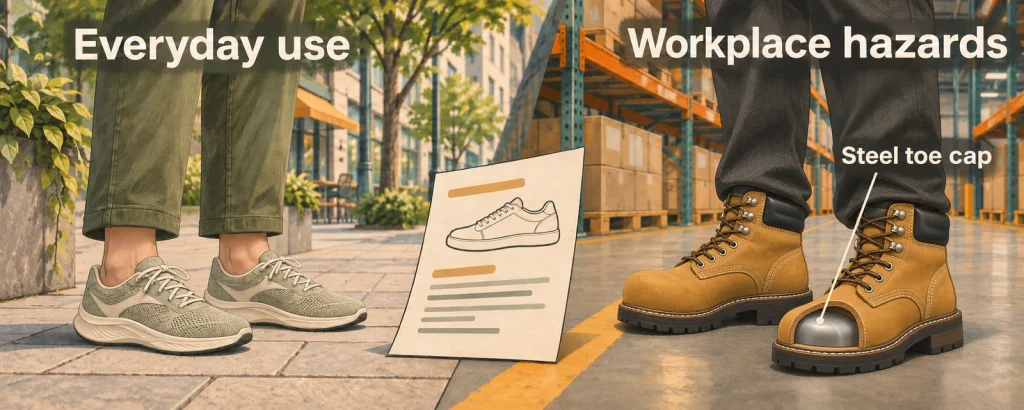
Before you send a sports shoe design for sampling, you need to know which U.S. requirements apply to it. That starts with its intended use, target age, materials, and the claims you plan to make.
Ordinary sports shoes do not automatically need to meet the protective-footwear requirements associated with workplace hazards. They still need a product-specific compliance review. A protective shoe can also look like a sneaker, so appearance alone tells you little. This guide explains how to separate product requirements, workplace protection, and the evidence you should request.
Start with the Shoe’s Intended Use
In this guide, the term “ordinary sports shoes” refers to footwear intended for general consumer use, without a claim to protect against a particular workplace hazard. Protective footwear is selected for specific risks. These categories describe use and protection, not a particular silhouette.
Start your product brief with the intended wearer, activity, sales locations, and proposed claims. If the shoe is intended for work, identify the hazards it must address. Then use that information to determine the relevant requirements.
| What to check | Ordinary sports shoes | Protective footwear |
|---|---|---|
| Intended use | General consumer use, such as everyday wear or exercise. | Protection against specified hazards in the intended setting. |
| Requirements to assess | Applicable marking, material, age-related, and claims requirements. | Applicable product requirements plus the protection needed for identified hazards. |
| Evidence to review | Records supporting relevant product rules and advertised claims. | Those records, plus evidence supporting the specific protection claimed. |
| What appearance cannot prove | A closed toe or rugged outsole does not establish workplace protection. | A sneaker shape does not rule out protection; a safety toe does not establish every protective feature. |
Age is an additional consideration. A children’s sports shoe can have requirements that an adult version does not, even when both share a similar design. Treat the age assessment as a separate part of the review.
Which Requirements Can Apply to Ordinary Sports Shoes?
Your review should cover both the physical product and the information supplied with it. The relevant rules depend on what the shoe contains, who it is intended for, and how it is presented.
Origin Marking and Accurate Material Claims
Imported footwear is generally subject to country-of-origin marking requirements, with exceptions governed by the applicable customs rules. Under 19 CFR Part 134, the marking generally identifies the origin in English and must be legible, conspicuous, and sufficiently permanent for the article. Do not assume there is one mandatory label position for every shoe.
Material descriptions also need to match the product. For example, the Federal Trade Commission’s Leather Guides address misleading leather and imitation-leather representations. Keep the agreed material specification, product description, and packaging consistent. An origin mark and a material claim answer different questions; neither establishes protective performance.
Why Apparel Rules Do Not Automatically Apply
A textile upper does not automatically make a shoe subject to the same labeling rules as a shirt. The FTC lists outer footwear among the Textile Act exclusions, while wool-containing products need a separate check under the Wool Act. The federal Care Labeling Rule also excludes footwear from its definition of textile wearing apparel.
The clothing flammability standard, 16 CFR Part 1610, has a footwear exception with conditions: the footwear must not consist wholly or partly of hosiery and must not be attached to, or form an integral part of, another garment.
Check those conditions before copying an apparel test plan. An exception from one rule does not remove other applicable product requirements.
When Children’s Product Requirements Apply
The Consumer Product Safety Commission (CPSC) generally defines a children’s product as one designed or intended primarily for children 12 years old or younger. Intended use, marketing, consumer recognition, and age-determination guidance matter. An age label alone does not settle the classification.
For children’s footwear, distinguish two lead requirements:
- Accessible component parts are subject to the applicable total lead limit of 100 parts per million (ppm).
- Paint and similar surface coatings on children’s products are subject to a separate lead limit of 90 ppm.
Where third-party testing is required for a children’s shoe, use a CPSC-accepted laboratory whose accepted scope covers the applicable children’s product safety rule.
Some materials qualify for exemptions from third-party total lead testing. That does not exempt them from meeting the lead limit or remove the applicable Children’s Product Certificate (CPC) responsibility.
Children’s products also need permanent tracking information on the product and packaging to the extent practicable. This identifies matters such as the responsible firm, production location and date, and batch or other source information.
Do not automatically add every toy requirement to a children’s shoe test plan. CPSC explains that ordinary shoes are not themselves children’s toys or child care articles for the federal phthalates restriction. Special features, other laws, and customer specifications may require a separate assessment.
Sales locations and special claims need attention, too. California Proposition 65, for example, concerns exposures and applicable warnings; it is not a universal chemical-content limit for every shoe.
When Does Protective Footwear Become Relevant?
Match Foot Protection to the Hazard
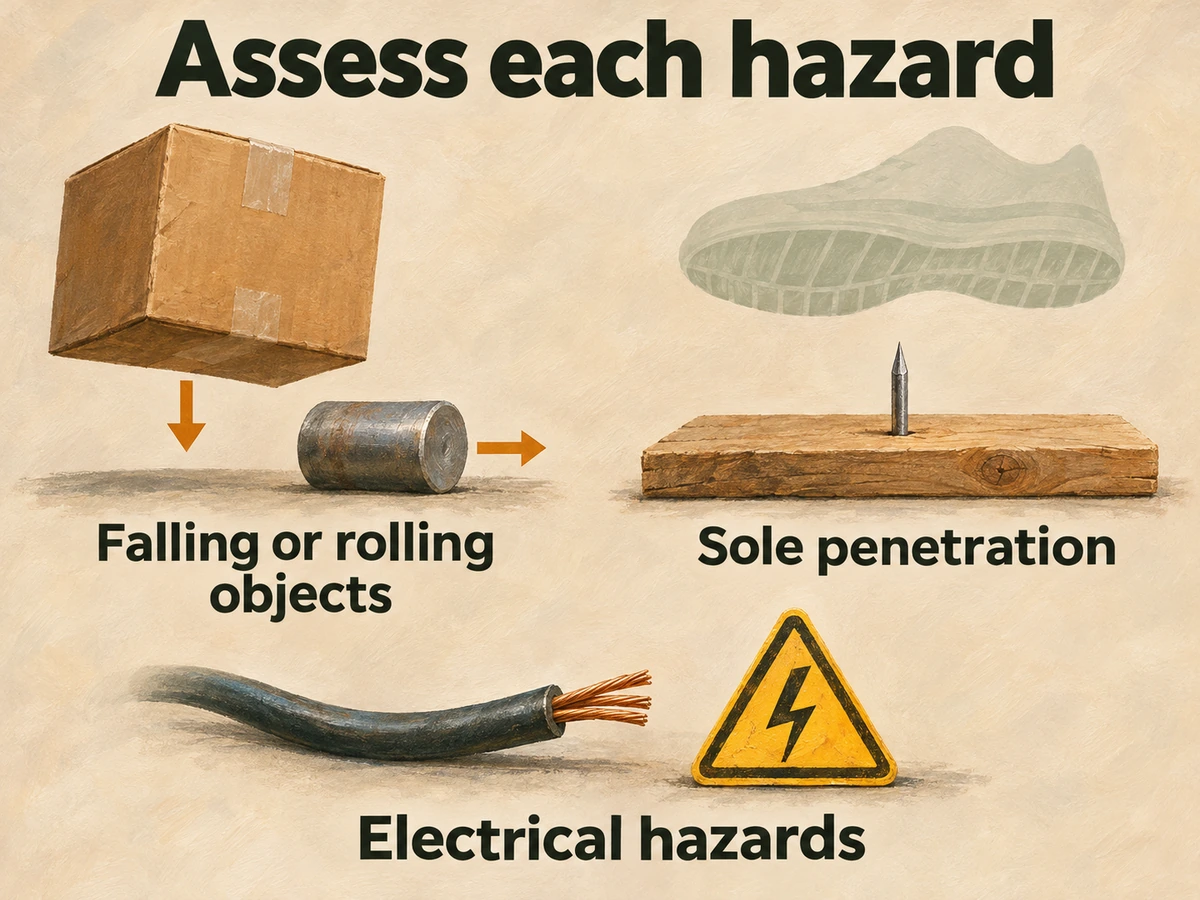
OSHA, the Occupational Safety and Health Administration, places workplace protective-equipment duties on employers. Its general-industry rules require a hazard assessment and suitable protection. Section 1910.136 addresses foot injuries from falling or rolling objects, sole penetration, and specified electrical hazards remaining after other necessary measures.
For a shoe-development project, translate the intended work conditions into specific protection requirements. A closed-toe design is not enough to establish protection against those hazards. Equally, a safety toe does not establish that the shoe provides every other protective feature.
These general-industry provisions are a useful starting point. They are not a complete guide to construction rules, state requirements, or individual workplace policies.
Safety-Toe and Soft-Toe Footwear Serve Different Needs
ASTM F2413 covers protective safety-toe footwear. ASTM F2892 covers soft-toe protective footwear; its scope excludes toe-area protection. That distinction matters when a project calls for protection without a safety toe.
Check the actual protection claimed and the evidence supporting it. Naming a standard does not mean every protective feature within its scope is present in a particular shoe.
Also avoid treating all ASTM references as merely test methods. The public scope of F2892-24 specifies independent third-party laboratory certification for footwear to bear its ASTM marking. That is different from saying OSHA has individually approved the shoe.
Check the Standard Edition and the Legal Reference
A standard’s current edition and the edition incorporated into a regulation can differ. OSHA 1910.136 lists ASTM F2412-2005 with F2413-2005 and specified ANSI Z41 editions. It also allows footwear an employer demonstrates provides at least equivalent protection.
F2413-24 does not automatically replace the edition incorporated into OSHA’s text. F2892 is not among the standards listed in §1910.136(b)(1). Record the legal basis, the technical standard and edition specified for the project, and the evidence supporting suitability. A newer marking alone does not resolve every workplace requirement.
What Does a Test Report Actually Demonstrate?
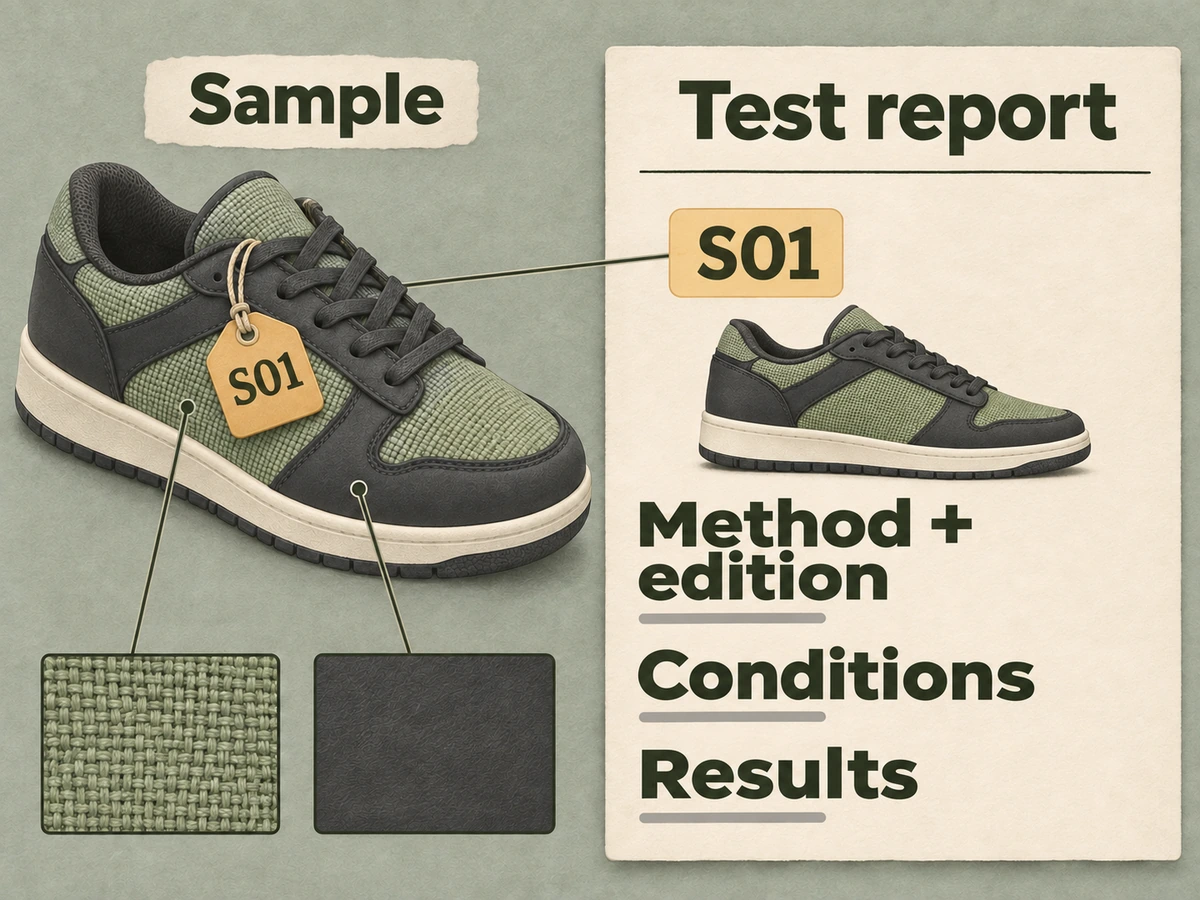
A report gives you results for identified samples, methods, and conditions. Its usefulness depends on how closely those details match the shoe and claim you are assessing.
Keep three types of evidence separate:
- Test reports document the testing performed and its results.
- Compliance certificates, such as a CPC or an applicable General Certificate of Conformity (GCC), are issued by the legally responsible party using the required supporting basis. A laboratory report does not automatically serve as that certificate.
- Product markings and tracking information communicate required details on the shoe or packaging. They are not substitutes for the underlying evidence.
Where a CPSC certificate is required for an imported product, the importer as defined by the applicable rule generally bears responsibility for issuing it. A GCC requirement depends on the applicable safety rules; it should not be assumed for every adult shoe.
When reviewing a report, compare the sample identification, relevant materials and construction, test method and edition, conditions, and results with your specification. Confirm what the report actually covers before applying it to another design.
Slip resistance illustrates the distinction. ASTM F2913 describes a slip-resistance test method, while ASTM F3445 sets performance requirements within its scope. Read the reported result alongside the test conditions and the requirements being assessed. A single result does not establish protection on every surface or under every use condition.
Objective performance claims need appropriate evidence before they are advertised. Material or construction changes may also require renewed evaluation. For children’s products, changes that could affect compliance trigger the applicable material-change testing and certification requirements; the scope depends on what changed.
What Should You Confirm Before Sampling?
Turn the scope review into a written development brief. This gives your team and supplier a shared basis for deciding what to sample, what evidence to obtain, and who will handle each obligation.
| Confirm | Record before sampling |
|---|---|
| Market and sales locations | The U.S. market, intended states, and sales channels. |
| Age and intended use | Target age, intended activities, and any workplace hazards the shoe must address. |
| Materials and claims | Component materials, coatings, construction, and planned product and packaging claims. |
| Applicable requirements | Relevant rules, technical standards and editions, plus separately identified customer requirements. |
| Evidence and responsibilities | Required testing, applicable certificates and markings, and the party responsible for each. |
| Changes after approval | How the approved sample connects to production, and who reviews material or construction changes. |
This is a project-planning tool, not a complete legal checklist. Use it to make unresolved points visible. If a supplier offers a report, ask which specification and sample it supports. If the intended claim is still changing, settle its meaning before treating the testing scope as final.
Retain the agreed brief with the sample records. It should help you compare the proposed product with the evidence supplied and identify decisions that still need a qualified assessment.
FAQ
Can a customer require footwear tests beyond the legal minimum?
Yes. A customer specification can call for additional tests or performance targets. Record those conditions separately from legal obligations, including the standard edition, acceptance criteria, and evidence expected. ASTM footwear specifications may be referenced in purchase contracts, but they are not complete purchasing specifications by themselves. Agree on the requested scope before sampling; meeting a customer’s extra requirement does not remove any applicable legal obligation.
Can replacement insoles or resoling affect protective-footwear compliance?
Yes, they can. The public scopes of ASTM F2413 and F2892 warn that changes such as replacement footbeds, inserts, or resoling may invalidate the compliance marking. Check with the manufacturer or relevant technical provider before assuming the modified shoe retains the original protection. This does not mean every replacement automatically invalidates compliance; the change and its effect need to be assessed.
Is an SDS enough to certify lead-in-paint compliance for children’s shoes?
No. CPSC states that a Safety Data Sheet (SDS) or similar document is insufficient to certify a children’s product’s compliance with the lead-in-paint requirement. Appropriate testing and certification evidence is needed. A supplier’s component-part certificate may be usable when it meets the applicable rules. Review that documentation and its coverage rather than assuming either that an SDS is enough or that every situation requires a new whole-shoe test.
Conclusion
U.S. footwear regulations become easier to assess when you define the product first. Establish its intended use, age group, materials, and claims; identify the applicable requirements; then match the evidence to the shoe you plan to produce.
Before sampling, put those decisions and responsibilities in writing. For your next sports shoe development discussion with HEVA, bring that brief and any existing specifications or reports so the product requirements can be discussed alongside the design.