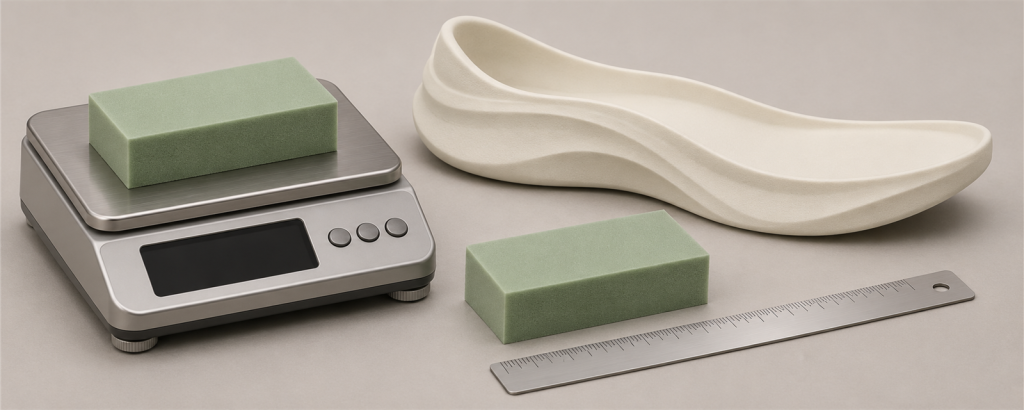
EVA foam density tells you how much mass a given volume of foam contains. That makes it useful when you compare material specifications or estimate the mass of a midsole. But a density value alone cannot tell you how the foam will feel, recover, or perform after repeated use. Before choosing between samples, you need to know what was measured, how it was measured, and which other properties matter for your shoe.
What Is EVA Foam Density?
EVA stands for ethylene-vinyl acetate. For the finished foam, density is the mass of a sample divided by its volume, including the space occupied by its cells. You may see this described as apparent density. EVA foam does not have one fixed density; the value belongs to a particular material and sample.
Check the object behind the number. Unfoamed EVA resin density, the bulk density of loose pellets, and cell density—the number of cells per unit volume—describe different things. None should be substituted for the mass density of the finished foam.
Understanding Density Units
Suppliers may report EVA foam density in grams per cubic centimeter, kilograms per cubic meter, or pounds per cubic foot. Convert the units before comparing values.
| Conversion | Equivalent value |
|---|---|
| 1 g/cm³ | 1,000 kg/m³ |
| 1 lb/ft³ | Approximately 16.0185 kg/m³ |
| 0.20 g/cm³ | 200 kg/m³ ≈ 12.49 lb/ft³ |
The last row shows the same density in three units. It is a conversion example, not a recommended density for athletic footwear.
Also check what the density value describes: the supplied EVA foam sheet or a sample cut from a molded component. Matching units will not resolve a difference in what was tested.
How Is EVA Foam Density Measured?
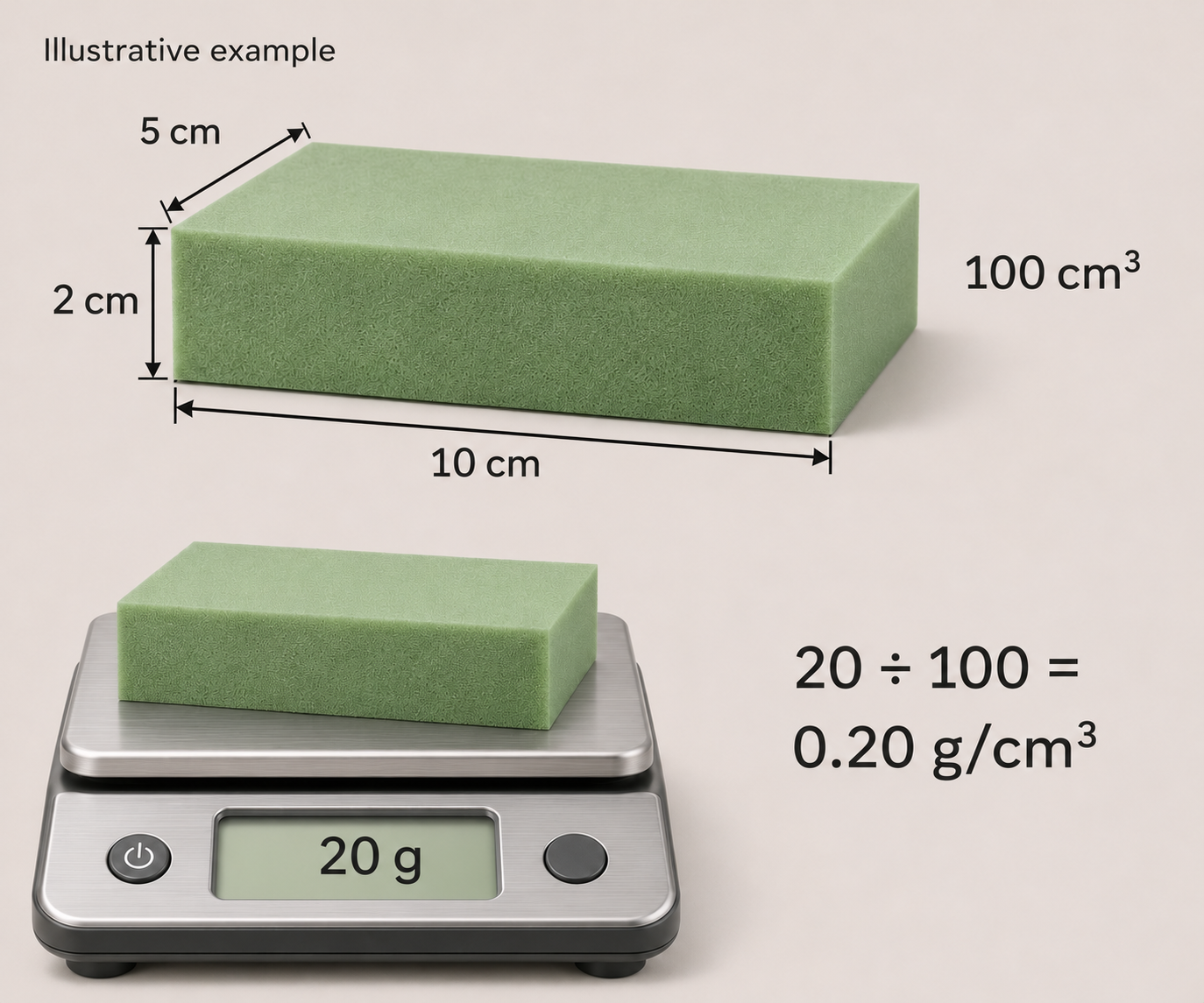
A Simple Density Calculation
The equation is straightforward:
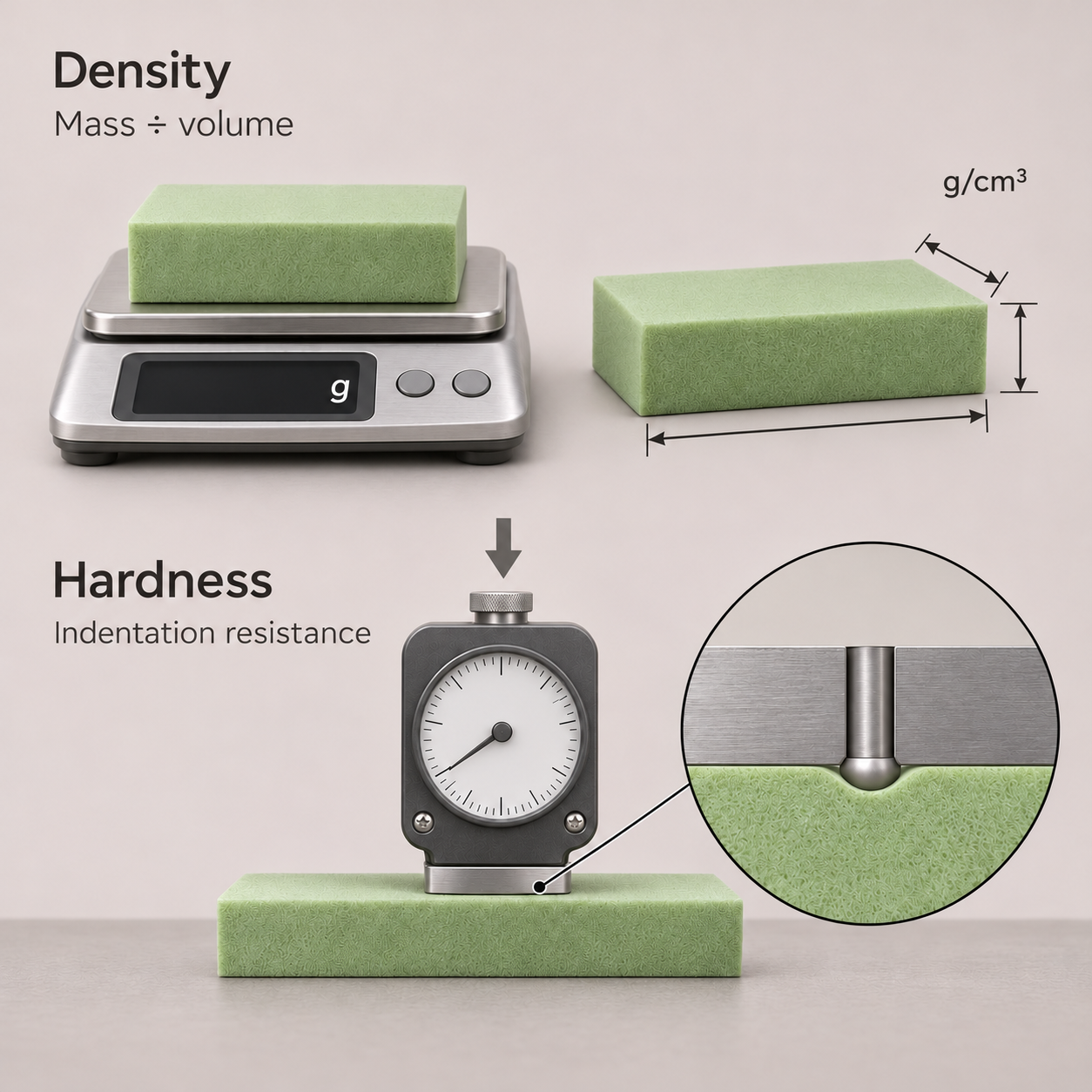
Density = mass ÷ volume
Imagine a rectangular foam sample measuring 10 cm × 5 cm × 2 cm with a mass of 20 g. Its volume is 100 cm³, so its density is 20 g ÷ 100 cm³ = 0.20 g/cm³, or 200 kg/m³.
These are hypothetical dimensions for explaining the calculation, not prescribed test dimensions. A density calculator performs the same arithmetic; the result still depends on accurate mass and volume measurements. When calculating volume from dimensions, confirm how thickness was measured, including any contact pressure specified by the applicable procedure.
Match the Method to the Sample
For a regular specimen, volume can be calculated from its dimensions. Irregular shapes may require another approach, such as measuring displacement in a liquid. The appropriate method depends on the material and whether it absorbs that liquid.
SATRA illustrates this distinction in its published method scopes. TM68 covers density measurement for absorbent materials, particularly low-density, open-cell sole materials, using dimensions to determine volume. TM134 uses water displacement for nonabsorbent materials. These are different applications of the same density equation.
Even when EVA foam is described as closed-cell, confirm that the chosen method suits the actual sample. A device sold as a densimeter does not automatically produce comparable results. Ask which procedure it uses and whether that procedure applies to your sample.
Check What Was Actually Tested
Check whether the sample includes the molded skin or consists only of the foam core. ISO 845 distinguishes apparent overall density from apparent core density, accounting for whether forming skins are included.
Your report should identify the sample, sampling location, skin condition, method, and method version. Confirm preparation and conditioning requirements with the laboratory under the agreed procedure. If one result includes the skin and another uses only the core, clarify that difference before treating the numbers as interchangeable.
EVA Foam Density vs. Hardness
Density measures mass per unit volume. Durometer hardness measures resistance to indentation by a specified instrument under defined conditions. They answer different questions, so your specification should list them separately.
For example, “35 Asker C” is a hardness reading. It cannot be converted into kg/m³ using a universal formula. The same applies to a stated hardness range of 60–65 Asker C. You need a separate density measurement for that material.
Specify the Hardness Scale
A number such as “45 degrees” or “45 C” leaves room for misunderstanding. Ask for the full scale name, instrument identification, sample thickness, and reading conditions. Preserve distinctions such as Shore A, Shore C, and Asker C; do not silently replace one label with another.
ASTM D2240 describes durometer hardness in terms of indentation and explains that readings from different durometer types do not have a simple relationship. Even when two reports use the same scale, differences in specimen preparation or reading conditions need to be resolved before comparison.
Density also cannot stand in for compression behavior. A 2023 study in Polymers reported different compressive strengths for two EVA-based formulations with close densities. That finding supports a limited but useful point: similar density does not guarantee similar mechanical performance. It does not establish a target density or formula for your shoe.
Within a controlled material series, density may help explain a performance trend. Across different formulations and structures, request the relevant test results instead of assuming that trend will hold.
What Do High- and Low-Density Labels Tell You?
“High-density EVA foam” and “low-density EVA foam” are descriptions you need to read in context. A supplier may use them to distinguish grades within a product range. Medium-density or ultra-high-density labels also need a numerical value, unit, and explanation of the grading system.
Start with the actual specification rather than transferring a label from a craft foam listing to a footwear material. A useful density chart states what its categories apply to. Without that context, it cannot tell you which grade belongs in a running shoe or training shoe.
Density does give you a direct mass comparison when volume is held constant. A 100 cm³ piece at 0.20 g/cm³ has a mass of 20 g; the same volume at 0.25 g/cm³ has a mass of 25 g. These hypothetical values illustrate the relationship; they are not recommended densities for footwear.
That comparison covers the foam volume only. A finished shoe also contains other materials and may use a different midsole geometry. Higher density by itself does not establish better durability, comfort, or rebound. Those judgments require evidence about the properties you actually need.
How to Compare EVA Foams for Athletic Footwear
Start with the Component and Its Geometry
Decide what the foam needs to do and where it will sit. For a midsole, record the intended use, shape, thickness, and relationship to the rest of the sole construction. Do not assume that a thin footbed and a thicker midsole need the same material specification simply because both contain EVA.
When possible, compare candidates in equivalent component geometries. If thickness or shape changes between samples, record it alongside the material change. Otherwise, you may attribute a difference in shoe feel to density when the construction has changed too.
Compare More Than Density
Choose tests that answer your development questions. Compression behavior shows how a specimen responds under a defined load or deformation. Compression set concerns the deformation that remains after compression and a specified recovery period. Rebound and energy-response tests describe aspects of recovery or energy behavior under their own methods.
Repeated-loading tests address another question: how do dimensions or cushioning behavior change after cycling? An initial hardness reading or one rebound result cannot answer that on its own.
Compare results only after checking the relevant conditions, such as specimen thickness, temperature, loading, recovery time, and cycle count. Two percentages with different definitions or test conditions are not automatically comparable. Laboratory cycles also should not be translated directly into a promised running distance or service life.
Use a comparison sheet to keep the evidence attached to each candidate:
| Record for Each Candidate | Why It Matters |
|---|---|
| Sample ID, grade, and intended component | Connects the report to the material you are evaluating. |
| Density, units, method/version, sampling location, and skin condition | Establishes whether the density values describe comparable samples. |
| Hardness value, full scale, and test conditions | Prevents confusion between instruments or reading procedures. |
| Relevant compression, rebound, and repeated-loading results | Separates initial response from recovery and changes after cycling. |
| Component dimensions and construction | Makes geometry differences visible during comparison. |
| Sample-shoe observations and evaluation conditions | Links material selection to the actual footwear design. |
These are suggested comparison fields, not universal acceptance criteria. Check whether each value is a measured sample result, a nominal or typical value, or an agreed acceptance limit. Set tolerances and pass/fail requirements for the project with the relevant technical team. If a data sheet provides density and hardness only, identify the remaining question before requesting more testing.
Confirm the Choice in the Shoe
Use material data to narrow your candidates, then assess the component and sample shoe. SATRA has separate methods for cushioning materials or assemblies and for whole-shoe bottom constructions, reflecting these different levels of evaluation.
Keep sample identification consistent through development so observations can be traced back to the material and construction tested. Agree which measurements and wear evaluations matter for the intended use, and record the conditions. This gives you a reasoned basis for choosing a candidate and checking later revisions.
FAQ
What Does Dual-Density EVA Mean in a Shoe Specification?
It generally describes EVA regions with different densities, but the phrase alone does not specify the construction. Ask which two materials or grades are used, their measured density values and units, and where each sits in the shoe. Request a drawing or sample identification that makes the regions clear. Record hardness separately for each region if it is part of the specification; “dual density” should not automatically be read as “dual hardness.”
What Should You Do If Two EVA Density Reports Disagree?
First, convert both results to the same units. Then check whether the reports cover the same material, sample location, and skin condition. Compare the methods, versions, and preparation conditions next. If the difference remains unexplained, ask the laboratories or suppliers to clarify it or arrange a retest under an agreed procedure. Avoid averaging the two values to create a specification before you understand why they differ.
Conclusion
EVA foam density becomes useful when you know the sample and measurement method behind it. Pair it with separate hardness and performance data, then evaluate the material in the geometry and construction of your shoe. For your next development discussion, bring the intended component, dimensions, candidate sample IDs, and available reports. If you are planning an OEM/ODM athletic footwear project with HEVA, those details provide a practical starting point for discussing material options and sampling.