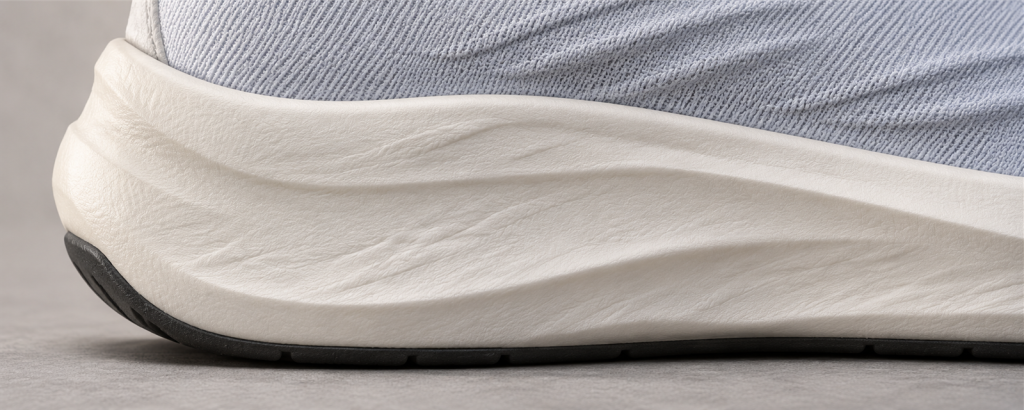
PEBA foam is a cellular material made from polyether block amide, a thermoplastic elastomer. In footwear, it is used in midsoles where low weight, flexibility, and rebound are useful. You may also see it described as Pebax foam or supercritical PEBA foam. Those names tell you different things about the material, its supplier, or its processing—and none gives you a complete picture of how a finished midsole will perform.
What Is PEBA Foam?
PEBA combines relatively hard polyamide segments with softer polyether segments. The hard segments help provide structure, while the soft segments contribute flexibility and elastic recovery. Changing their chemistry and proportions allows suppliers to produce grades with different properties.
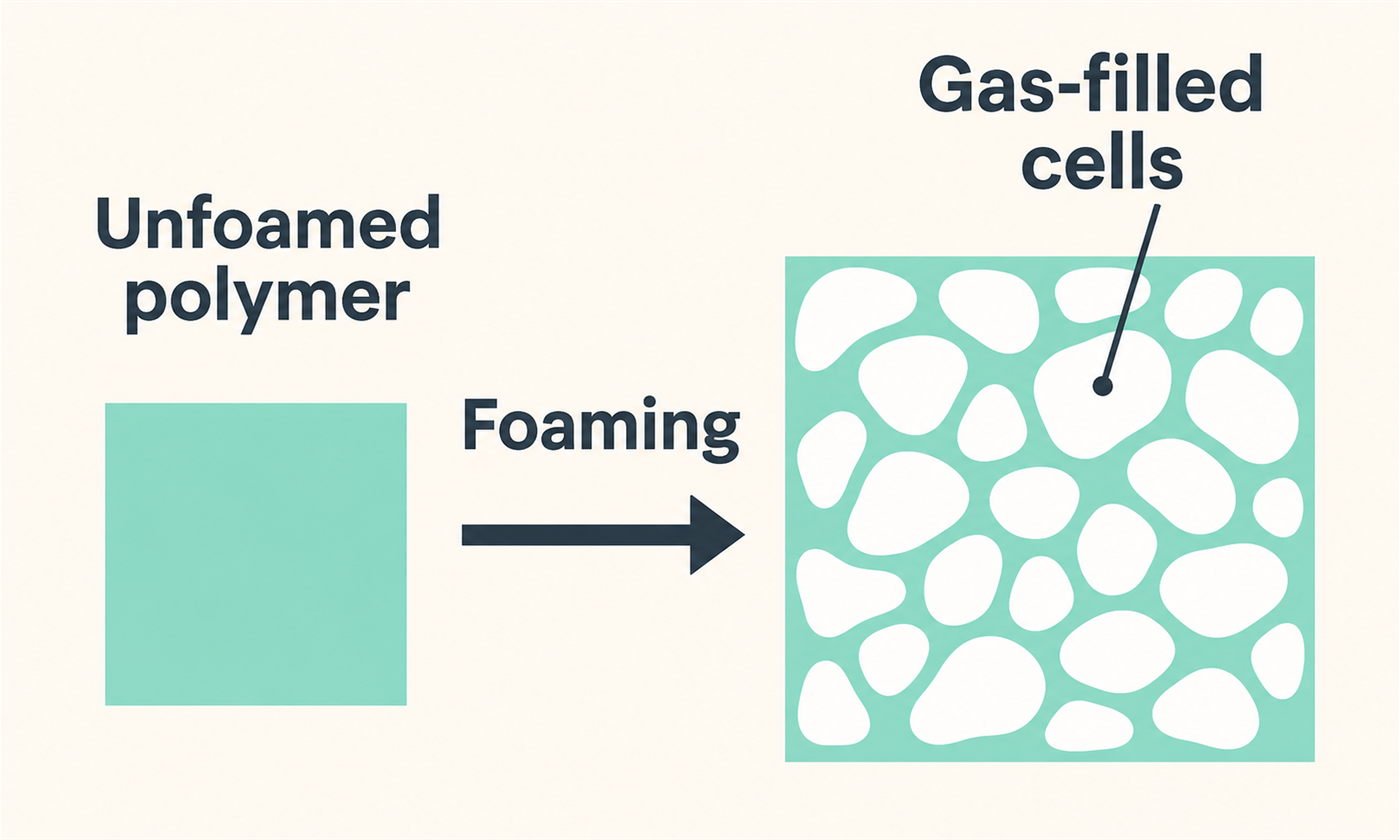
Foaming introduces gas-filled cells into that polymer structure. The result contains less solid material within a given volume, creating opportunities for a lighter midsole.
Three terms are worth separating:
| Term | What it refers to |
|---|---|
| PEBA | The polyether block amide material family. |
| PEBA foam | A cellular material made using PEBA, with properties shaped by its formulation and processing. |
| Pebax | Arkema’s brand of PEBA elastomers. The brand name alone does not identify a foam grade. |
Pebax is one source of PEBA materials; it is not the generic name for every PEBA foam. Evonik also supplies PEBA for foamed footwear applications. Likewise, a property listed for an unfoamed resin does not automatically describe the foam made from it. The finished material needs its own characterization.
How PEBA Becomes Foam
Physical foaming uses gas to create cells within the polymer. In one approach, gas enters the material under pressure. A controlled change in conditions allows cells to form and expand, producing a cellular structure that must stabilize.
Supercritical foaming is a processing route used with PEBA. Research has explored carbon dioxide, nitrogen, and mixtures of the two as blowing agents. Their behavior and the processing conditions influence the resulting cells.
This explains why “supercritical foam versus PEBA” can be a confusing comparison: PEBA identifies the polymer, while supercritical describes processing. A foam can be both. The specific formulation and manufacturing process vary among PEBA foams.
Key Properties of PEBA Foam
Density, flexibility, rebound, and recovery describe different aspects of how a PEBA foam behaves.
Low Density and Midsole Weight
Density is mass per unit volume. For midsoles of the same volume, a lower-density foam means less mass. A midsole’s total mass depends on both its density and its volume. A resin’s density is also different from the density of the foam produced from it; check which material state a specification describes.
Flexibility, Compression, and Rebound
Flexibility concerns bending, while compression describes deformation under a compressive load. Rebound describes how a foam springs back after deformation. A foam that feels soft is not necessarily the one that returns the most energy in a particular test.
Energy-return figures need a test method and conditions to be meaningful. They describe a measured material response, not a direct percentage improvement in running speed or efficiency. Supplier figures for particular foams should not become a universal PEBA specification.
Recovery Under Repeated Loading
A single rebound result does not tell you how a foam will behave after repeated loading. Over repeated loading, the questions are how well the foam recovers and whether its compression behavior changes. Compression set is a separate measure of the deformation remaining after a foam has been held under compression and then allowed to recover under specified conditions. Such measurements help characterize a foam, but they do not establish one service life or replacement mileage for every PEBA shoe.
Where PEBA Foam Is Used in Footwear
The midsole is the main application to understand here. Positioned beneath the foot and above the outsole, it provides a cushioning layer whose response depends partly on the foam. PEBA offers material options for running-shoe midsoles where designers want low weight and elastic recovery.
PEBA is also used in molded structural components, such as support pieces and plates. These serve different functions from foam midsoles and may use different grades, so their bending-test results do not describe a foam midsole’s cushioning durability.
Why PEBA Foams Can Perform Differently
Two midsoles can both contain PEBA without using the same material system. Differences begin with the polymer grade: suppliers can adjust the hard and soft segments to obtain different properties.
The formulation matters too. PEBA can be used in blended foam systems, including combinations with EVA. A “PEBA-based” label does not disclose every ingredient or its proportion. It also does not establish whether a blend is better or worse for a particular application.
Processing adds another source of variation. Research on PEBA foaming shows that changes in processing can alter cell structure, dimensional stability, and compression behavior.
To understand a particular PEBA foam, look at its grade, the formulation details the supplier provides, and the relevant test results. The finished shoe’s performance also depends on its design.
FAQ
Is PEBA Foam Bio-Based or Biodegradable?
Some PEBA grades contain renewable feedstocks, including grades in Arkema’s Pebax Rnew range. That does not make every PEBA foam bio-based. Bio-based content also does not establish biodegradability: the terms describe different characteristics. Check the specific material’s documentation before making claims about renewable content, compostability, or disposal.
Does a PEBA Foam Label Mean the Shoe Has a Carbon Plate?
No. A PEBA foam label describes the foam’s material family. It does not tell you whether a shoe contains a plate or what that plate is made from. Look at the shoe’s construction details separately; you cannot infer a carbon plate from the midsole material name.
Conclusion
PEBA foam combines a tunable elastomer with a cellular structure, making it useful for lightweight, resilient footwear midsoles. To understand a particular foam, read beyond the material name: its grade, formulation, and cell structure all contribute to its behavior. Keep resin data, foam tests, and finished-shoe performance distinct. That gives you a clearer basis for interpreting what a PEBA midsole description actually tells you.