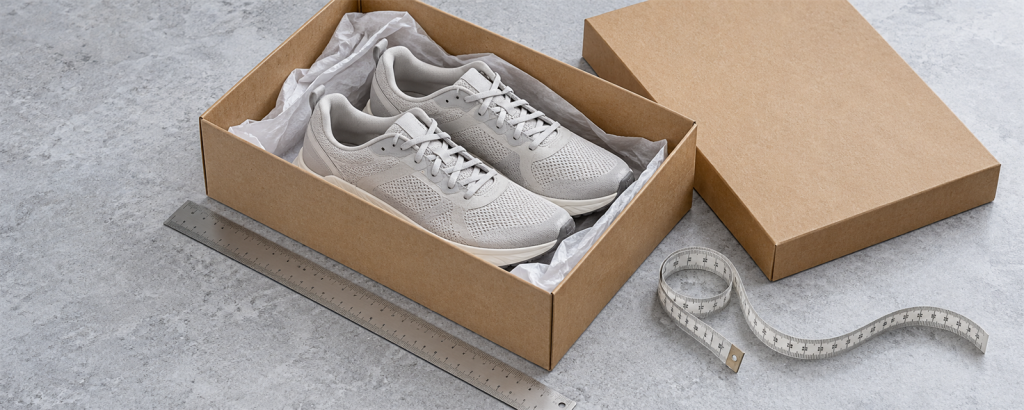
The right shoe box dimensions depend on the pair and how it’s packed. For reference, ULINE lists the S-17335 box’s interior at 13¼ × 8⅝ × 4⅞ inches (about 33.66 × 21.91 × 12.38 cm). Treat this as one product example.
Before choosing your box, check the space your shoes need with wrapping and inserts in place. If you’re adding a shipping box, compare its usable interior with the retail box’s outside dimensions and allow room for protection.
Common Shoe Box Size Examples in Inches and Centimeters
The two boxes below show why it helps to distinguish interior and exterior dimensions. ULINE publishes both for these models, giving you separate reference points for the space available inside and the size of the assembled box.
| Box and measurement | Inches: L × W × H | Centimeters: L × W × H (approx.) |
|---|---|---|
| ULINE S-17335 Interior | 13¼ × 8⅝ × 4⅞ | 33.66 × 21.91 × 12.38 |
| ULINE S-17335 Exterior | 14 × 9 × 5 | 35.56 × 22.86 × 12.70 |
| ULINE S-17336 Interior | 12⅝ × 7¾ × 4⅞ | 32.07 × 19.69 × 12.38 |
| ULINE S-17336 Exterior | 13 5/16 × 8 1/8 × 5 | 33.81 × 20.64 × 12.70 |
Dimensions are listed as length × width × height (L × W × H). The interior rows use ULINE’s “Inside (Actual)” figures; the exterior rows show the box’s outside measurements.
Check the specification beyond the product name. ULINE lists S-17335 as a 13 × 8 × 5-inch box and S-17336 as 12 × 7 × 4 inches. These catalog sizes differ from the published interior figures. Confirm which measurements your supplier is quoting before you order; don’t interpret the difference as a standard manufacturing tolerance.
To convert inches to centimeters, multiply by 2.54. The table rounds those results to two decimal places. For millimeters, multiply inches by 25.4. Conversion precision does not establish the tolerances of the manufactured box.
Use these examples as reference sizes when comparing options. They do not establish a single standard shoe box size or guarantee a fit for a particular shoe size. Check your actual pair, its intended arrangement and the inner packaging before choosing a box.
How to Measure a Shoe Box
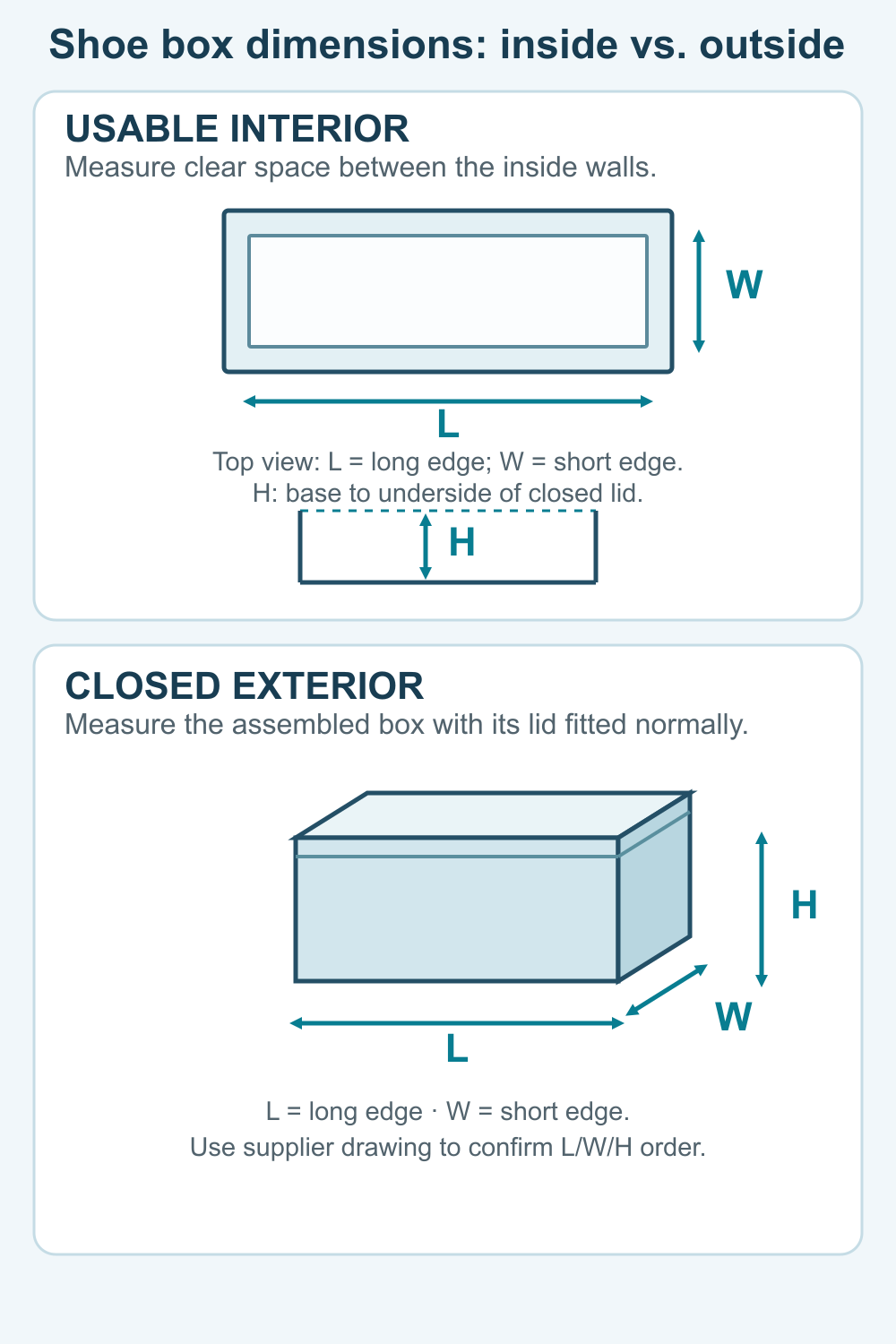
Use a ruler or tape measure, and record whether each measurement is internal or external. Start with the box assembled in its intended shape.
Set the Box Orientation and Units
Place the box on a flat surface. In this guide, length is the longer edge of the base, width is the shorter edge, and height is vertical. Choose inches, centimeters or millimeters, and keep the same units throughout. Check a supplier’s drawing or carrier’s instructions before transferring these labels to another system. For trade-item master data, GS1’s Package and Product Measurement Standard provides a repeatable framework for recording package measurements.
Measure the Usable Interior
Measure between the inside walls for length and width, noting any folded edges, dividers or other features that reduce usable space. For height, confirm the clearance from the inside base to the underside of the lid in its normal closed position.
If the closed interior height is difficult to measure directly, compare the supplier’s dimensioned drawing with the sample. The depth of an open tray alone may not describe the available height once the lid is in place.
Measure the Closed Exterior
Fit the lid normally, without forcing it down, and measure the box’s full outside length, width and height. For a separate lid that overlaps the base, don’t add the two sidewall heights together: the overlap means they do not stack end to end.
Record the exterior separately from the interior. Measure each directly where possible; subtracting a fixed allowance for board thickness can overlook folds and overlapping layers.
How to Choose the Right Shoe Box Size
Choose the box around the packed pair, including the materials that will stay inside it. A shoe size label alone won’t tell you the required length, width and height.
Arrange the Pair and Inner Packaging
Place both shoes in their intended arrangement, then add the tissue, bags, dividers and accessories you plan to include. A box that fits bare shoes may feel crowded once those items are added.
- Close the lid without pressing it down onto the shoes.
- Check for pressure on the uppers and unwanted contact between the shoes.
- Lift the shoes out and put them back to check that packing and unpacking are straightforward.
- Check how much the pair shifts when you handle the closed box.
A tighter fit is not automatically better. Leave space for the wrapping and protective arrangement without compressing the shoes. Agree the clearance for the specific design rather than adding one fixed allowance to every pair.
Check Fit Across Your Size Range
If several sizes will share one box, try representative pairs near both ends of the proposed range. The largest pair may reveal pressure or closure problems, while the smaller pair may leave more room to move. Use those observations to decide whether the range needs more than one box size.
Apply the same process to kids’ shoes, running shoes, high-tops and boots. Their shapes and intended packing arrangements matter more than the category name. A US 12 label, for example, is not a box specification. Record the shoe model, size and arrangement alongside the box dimensions so you can repeat the comparison when reviewing a sample.
Shoe Box Dimensions for Shipping
For shipping, work from the complete packed parcel. A retail shoe box that holds the pair comfortably still needs a separate assessment of protection for the journey.
Size the Outer Box Around the Packed Retail Box
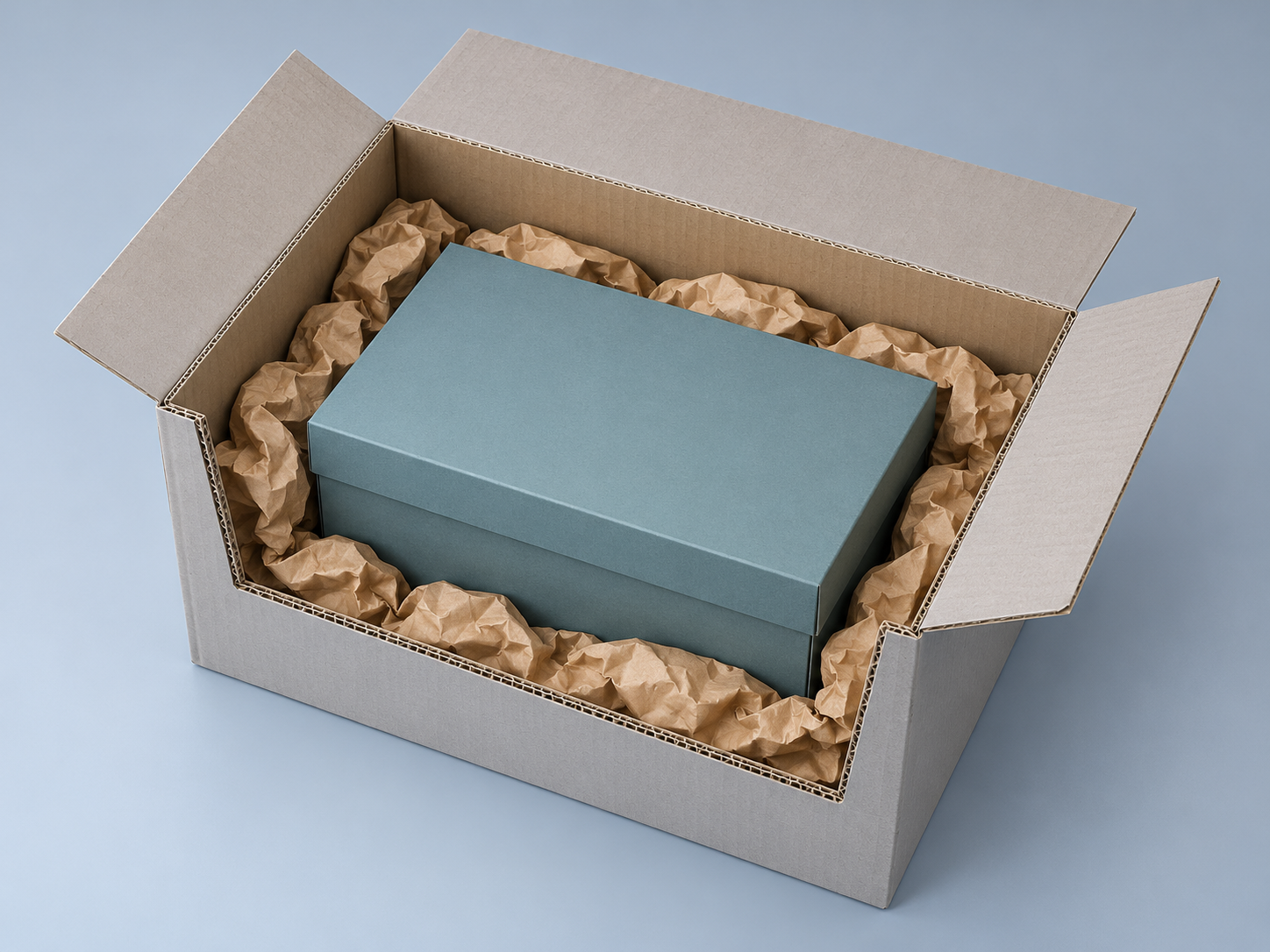
If you’re using an outer box, compare its usable interior with the retail box’s exterior. Include the space needed for your chosen protective materials. If you rotate the retail box, compare the corresponding dimensions in that orientation.
Whether the retail box can ship on its own depends on its design and the service requirements. Confirm the packaging arrangement for your shipment.
USPS Priority Mail Shoe Box Dimensions
USPS publishes the following specifications for its Priority Mail Shoe Box. The table keeps the official length × width × height order.
| Measurement | Inches: L × W × H | Centimeters: L × W × H (approx.) |
|---|---|---|
| Interior | 14⅜ × 5⅛ × 7¼ | 36.51 × 13.02 × 18.42 |
| Exterior | 14⅞ × 5¼ × 7⅜ | 37.78 × 13.34 × 18.73 |
These dimensions apply to one USPS product. Check your retail box and protective arrangement against its inside measurements before using it. Priority Mail packaging must be used with Priority Mail service.
For any shipping box, measure the parcel’s exterior and weigh it after packing and sealing. Multiplying length, width and height gives volume, not weight. Dimensional weight is a billing calculation based on package size and the applicable service rules. USPS treats the longest dimension as the parcel’s length. Follow your chosen carrier’s current measurement and rounding instructions.
What to Record Before Approving a Box Sample
Before approving a box sample, keep its measurements and packing arrangement in one record. Use this as a shared reference when comparing the sample with the drawing or reviewing a revision.
- Shoe model and the sizes intended to share the box.
- Pair orientation, tissue, bags, dividers and any included accessories.
- Usable internal length × width × height.
- Full external length × width × height with the lid normally closed.
- Units, clearly labeled directions and the tolerances agreed with your supplier.
- Sample identifier, drawing revision and date.
Add fit observations from the larger and smaller representative pairs, including closure, pressure and movement. If the box or packing arrangement changes, update the record and recheck the affected fit. Keep the dimensions alongside your wider packaging design requirements.
FAQ
Where Can You Find Nike or Adidas Shoe Box Dimensions?
Start with the exact box supplied with your pair. If you use a published listing, check that it applies to that box and identifies internal or external dimensions. Otherwise, measure the box you have or ask the brand or supplier to confirm its specifications. Avoid choosing a replacement or shipping carton from the brand name alone.
How Much Does an Empty Shoe Box Weigh?
Put the empty box on a scale and note what is included, such as the lid, tissue or inserts. A figure for another box may refer to a different material, structure or set of contents. Keep that reading separate from the weight of a complete packed parcel when preparing shipping information.
Is the USPS Priority Mail Shoe Box Flat Rate?
No. The USPS Priority Mail Shoe Box is a specific Priority Mail product, not a Flat Rate box. USPS states that its shipping cost depends on weight, dimensions and destination. Flat Rate pricing requires USPS-produced Flat Rate packaging. Select the correct packaging and service in the postage calculator rather than treating all Priority Mail boxes as the same category.
Conclusion
Choose shoe box dimensions around your packed pair, then record the usable interior and closed exterior separately. Use published sizes as references and check the fit across your intended size range. For shipping, assess the complete parcel. If you’re planning a footwear project with HEVA, bring the shoe model, size range and packaging requirements so the project requirements are clear from the start.