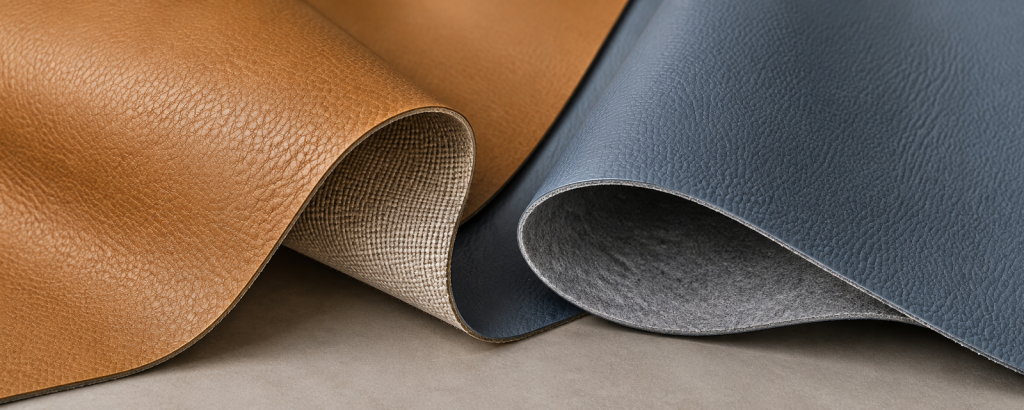
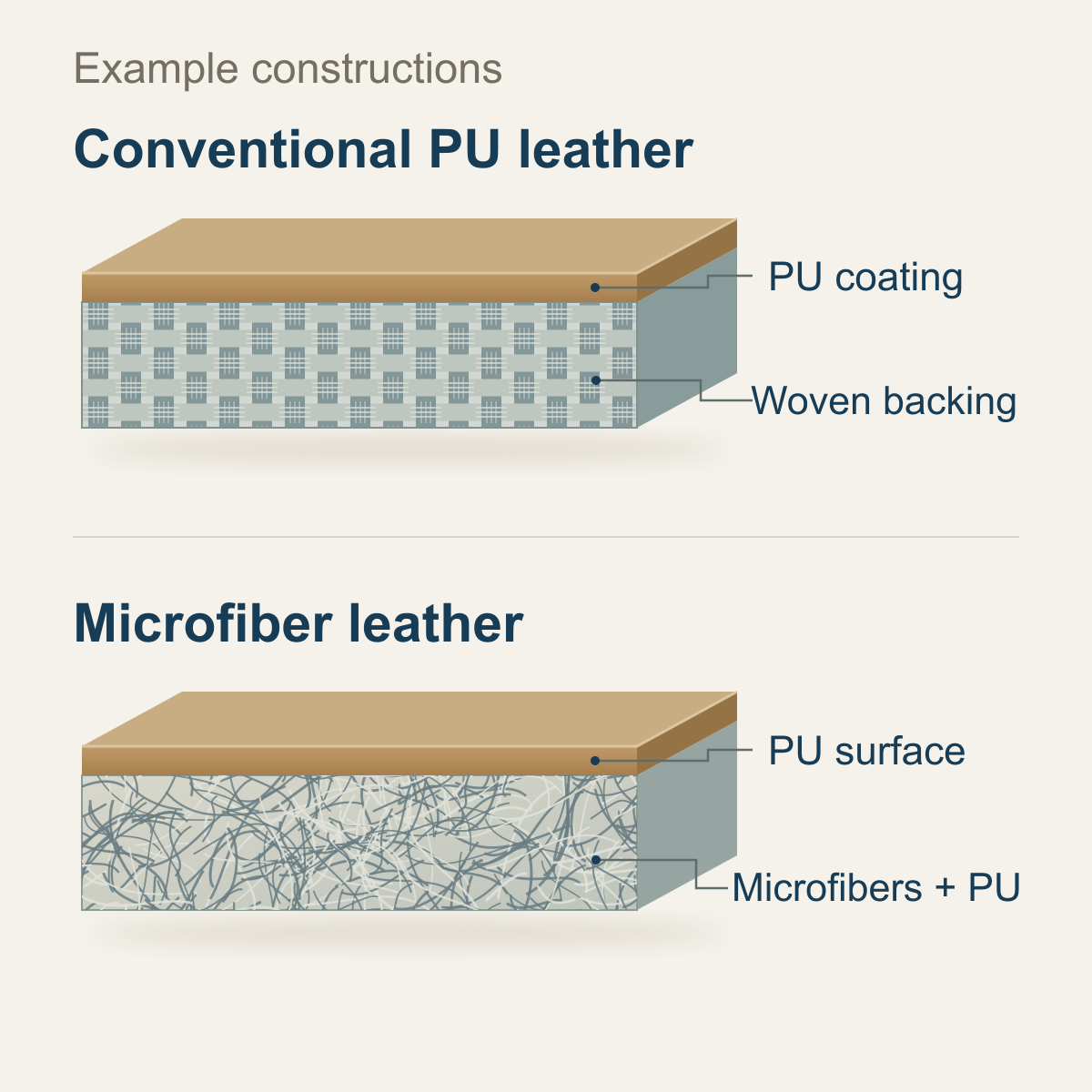
The main difference between microfiber leather and conventional PU leather is usually the backing structure. Conventional PU leather commonly has a polyurethane coating on a textile backing. Microfiber leather uses a dense nonwoven network of fine fibers and can also contain polyurethane. The two names do not describe mutually exclusive materials.
For a shoe upper, that distinction matters when you cut, stitch, shape, and flex the material. It helps explain how a sample is built, but you still need to compare its finish, performance, and suitability for the part of the shoe you are developing.
How Microfiber Leather and Conventional PU Leather Are Built
In this comparison, conventional PU leather means a synthetic material with a PU coating on a backing such as woven or knitted fabric. PU stands for polyurethane, a synthetic polymer. The backing supports the material, while the surface coating provides the visible finish. Backing constructions and coating formulations vary.
Microfiber leather is also synthetic. Its fine fibers form a nonwoven structure rather than a conventional woven or knitted base. Polyurethane can be incorporated into that structure and used in the surface layer. This is why a specification may describe a material as “microfiber PU leather.” It is not genuine leather, and “microfiber” does not mean polyurethane-free.
| Comparison point | Conventional PU leather | Microfiber leather | What to verify |
|---|---|---|---|
| Backing | Textile, often woven or knitted | Fine-fiber nonwoven | Actual construction |
| PU’s role | Surface coating | May be within the base and at the surface | Layer composition |
| Appearance and feel | Vary with backing and finish | Vary with fiber structure and finish | Finished sample |
| Cutting and skiving | Check the chosen construction | CLARINO example: clean cutting and suitability for skiving | Trial cuts and skiving on the proposed grade |
| Performance | Grade-specific | Grade-specific | Comparable test results |
Kuraray, for example, describes its CLARINO material as having an intertwined microfiber base containing PU. It identifies clean cutting and suitability for skiving—thinning an edge—as benefits of that construction. These are useful reasons to examine a microfiber sample, not guarantees for every grade. Grain and suede-like finishes also need to be assessed on the material you intend to use.
What the Differences Mean for Upper Performance
Flexing, Surface Wear, and Peeling
“Durable” can mean several different things. A material may resist surface rubbing yet develop cracks along a repeated flex crease. Its backing may remain intact while the coating loses adhesion. Compare flex resistance, abrasion resistance, and coating adhesion separately so that one favorable result does not hide another weakness.
Peeling is not exclusive to conventional PU leather. A microfiber construction that includes a PU surface still needs suitable coating adhesion and resistance to aging. A strong fiber base alone does not establish how well the finish will stay attached.
Heat and moisture can contribute to hydrolysis—the chemical breakdown of susceptible PU formulations. Chemistry and manufacturing affect resistance, so ask what happens to the relevant properties after aging, as well as when the sample is new. SATRA’s published guidance for PU footwear materials includes comparing performance before and after humid aging.
A test period is not a promised service life. Avoid treating a number of laboratory weeks as an equivalent number of years of wear. Neither “microfiber” nor “PU” gives you a reliable fixed lifespan, and visible peeling alone does not establish its cause.
Stretch and Stitching Performance
For a stitched upper, consider how the material extends, resists tearing, and holds around needle perforations. These properties answer different questions. A high tensile strength result, for example, does not by itself show how well a stitched edge will hold up.
Check sample orientation and compare the construction you will actually use. Review a sewn piece where possible, including its edge treatment and any added layers. Stretch should suit the component and fit requirements; neither maximum stretch nor maximum stiffness is automatically the goal.
Breathability and Water Resistance
Air permeability describes air passing through a material. Water vapor permeability concerns moisture moving through it as vapor. They are related to comfort but are not interchangeable measurements. The microfiber base, PU coating, and additional layers all belong in the assessment.
A PU coating can be made porous through coagulation, which SATRA describes as improving water vapor permeability. This is another reason the PU label alone cannot establish how a finished material handles moisture.
Compare finished materials under equivalent test conditions. A result for an uncoated base cannot stand in for the coated upper you plan to use. Where a lining or laminate forms part of the construction, evaluating that combination gives you more relevant information than considering its layers in isolation.
Resistance to liquid water is a separate property. Some microfiber leathers are water-resistant; Kuraray lists water resistance among CLARINO’s characteristics. Neither “microfiber leather” nor “PU leather” alone establishes the water resistance of a particular grade. A water-resistant surface does not establish that a finished shoe is waterproof. Whole-shoe construction needs its own evaluation if you intend to make a water-resistance claim.
Compare the Materials by Upper Component
Start with the part of the upper you are developing. The same material can serve different purposes in a forefoot panel, a small overlay, or a shaped component. Use those purposes to decide which differences deserve the most attention.
At the forefoot flex area, compare how the finished construction bends and how its surface responds to repeated creasing. Look at the sample with the intended supporting layers, rather than judging only a loose swatch by hand. A material that feels soft initially still needs to meet the component’s flexing requirements.
For overlays and areas near stitching, examine cut edges, surface wear, and the material around the stitch line. If an overlay provides local reinforcement, review that function in the assembly. Its appearance or microfiber label does not establish reinforcement performance.
For components that must take and retain a shape, review a processed sample. After forming, check whether the piece holds the intended shape. Check whether the selected grade works with the intended cutting, thinning, and forming steps. A flat material sample and a shaped upper component answer different questions, so include both in the comparison when forming is important.
Microfiber leather may be worth evaluating for its nonwoven construction and processing characteristics. Conventional PU leather should remain a candidate when the selected grade meets the appearance, manufacturing, and performance requirements. Make the choice at the level of the actual component, rather than assigning one material category to every part of the shoe.
What to Confirm Before Approving a Material Sample
Give each candidate the same job before comparing its quality or price. A useful sample review covers five points:
- Use: Identify the shoe type, upper component, and the performance you need from it.
- Construction: Record thickness, backing, surface finish, and any lining or laminated layers included in the sample.
- Processing: Review trial cuts, sewn pieces, or formed components for the operations relevant to your design.
- Evidence: Match test reports to the proposed material. Check the method, conditions, date, and specimen description, including aged results where relevant.
- Cost: Compare quotations using the same unit and a clearly defined specification. A price per linear meter and a price per square meter cannot be compared directly without knowing the width.
Not every project needs every available test. Select the checks that address the intended use and agree on the requirements before approval. A lower material price is useful only if the selected grade works for the component; a higher price does not replace evidence. Keep the approved specification with the sample so later discussions refer to the same material.
FAQ
Does a microfiber leather upper make a shoe vegan?
No. The upper is only one part of the shoe. Other components and adhesives also need to be checked for animal-derived ingredients. The Vegan Society specifically cautions that leather-free footwear may still contain animal-derived glue. Confirm the relevant material and component declarations before making a claim about the complete shoe; the upper’s name alone is insufficient.
Is microfiber leather more sustainable than conventional PU leather?
You cannot establish that from the category names alone. A meaningful comparison needs evidence for the specific materials and the same scope of assessment. Without comparable environmental data, avoid claiming that one is inherently greener, biodegradable, or easy to recycle. A synthetic leather description also does not establish the environmental performance of the finished shoe.
Can the same microfiber leather be used for uppers and linings?
Do not assume an approved upper grade is suitable for a lining. Confirm that the supplier’s specification covers the intended use, then review the properties relevant to that position and the actual layer combination. Evaluate the proposed lining as part of the shoe construction rather than carrying over approval simply because both materials are called microfiber leather.
Conclusion
When comparing microfiber leather with conventional PU leather, start with the backing and coating, then consider the upper component you need to make. Review the finished sample, relevant test evidence, processing needs, and cost on a comparable basis. That gives you a clearer decision than a general claim that one category is better.
For a HEVA shoe development project, share the upper component, target appearance, and performance requirements so we can discuss material options and the next sampling step.