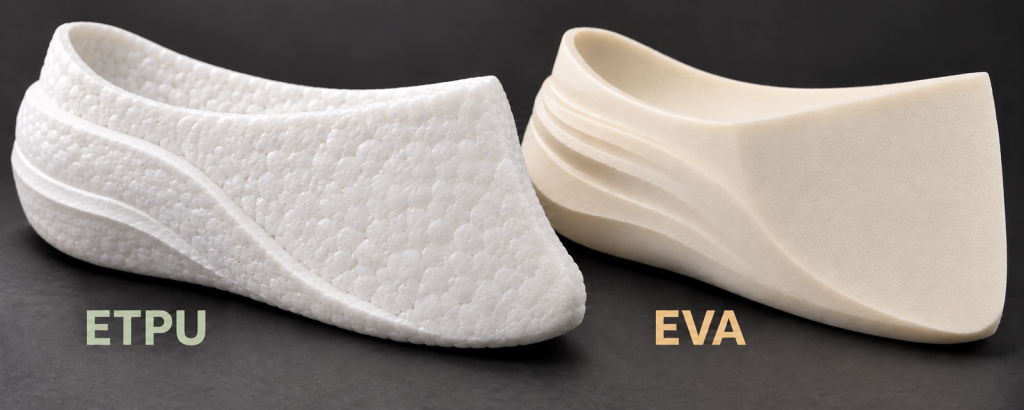
Choosing between ETPU and EVA starts with what you need the midsole to do. If responsive cushioning and performance retention are priorities, evaluate specific ETPU grades alongside EVA formulations with relevant performance data. If weight and budget lead your decision, compare finished parts that meet your requirements before choosing either material.
A useful ETPU vs EVA comparison connects foam properties to your shoe design: how much the midsole weighs, how it responds under load, what changes with use, and what the complete part costs.
What Are ETPU and EVA Foams?
ETPU, also written E-TPU, stands for expanded thermoplastic polyurethane. In bead foam midsoles, expanded TPU particles are joined to form a cushioning component. The polymer, cellular structure, and molding process all contribute to its behavior. This foam is different from the solid TPU used in structural footwear parts.
EVA stands for ethylene-vinyl acetate, a copolymer used in many footwear foam formulations. Resin selection, formulation, and foaming conditions affect the finished material. An EVA resin data sheet therefore cannot tell you everything about the weight or feel of an EVA midsole.
This comparison focuses on the midsole, the cushioning layer between the footbed and the outsole. An ETPU insole or a solid TPU outsole serves a different role. Likewise, a foam brand name alone may not identify its precise composition or processing route. Ask which material and finished component a specification describes.
ETPU vs EVA: Six Factors to Evaluate
Use these six factors to assess the proposed midsoles. The table outlines what to establish for each material; the sections below explain how to interpret the results.
| Factor | ETPU: points to check | EVA: points to check | Basis for comparison |
|---|---|---|---|
| Weight | Density varies by grade and processing. | Density varies by formulation and foaming. | Finished part weight in the same size; note geometry differences. |
| Cushioning and rebound | A candidate for responsive cushioning; verify the specific foam. | Footwear formulations offer different cushioning and rebound properties. | Hardness scale, loading conditions, and rebound method. |
| Compression and fatigue | Evaluate recovery and properties after repeated loading. | Evaluate initial properties and how they change with cycling. | Compression set and fatigue results separately. |
| Temperature | Specific grades have temperature performance claims. | Check the candidate foam under the intended conditions. | Results after equivalent temperature conditioning. |
| Processing | Bead molding includes steam processes and specific heat press systems. | The formulation must suit the selected molding process. | Material, equipment, tooling, and bonding requirements. |
| Cost | Obtain a quote for the proposed component and process. | Quote against the same design and order requirements. | Included tooling, molding, assembly, and validation costs. |
Weight, Cushioning, and Rebound
Compare finished foam density and part volume together. A lighter piece may simply be thinner. The bulk density of loose ETPU beads is also different from molded foam density; neither should be compared directly with the density of unfoamed EVA resin.
Softness describes how readily a material deforms under a given load. Cushioning involves its response during loading, while rebound concerns energy returned as it recovers. A thumb press cannot establish all three. Hardness readings need a stated scale, and rebound percentages need a test method: ball rebound, pendulum tests, and cyclic compression measurements are not interchangeable. Do not treat one reported energy return percentage as a value for every ETPU or EVA foam.
Higher laboratory rebound alone does not establish better comfort or running economy in the finished shoe. The full construction and the person wearing it still matter.
Compression, Fatigue, and Temperature
Compression set measures residual deformation after specified compression and recovery conditions. Fatigue testing examines changes under repeated loading. A favorable result in one does not replace the other.
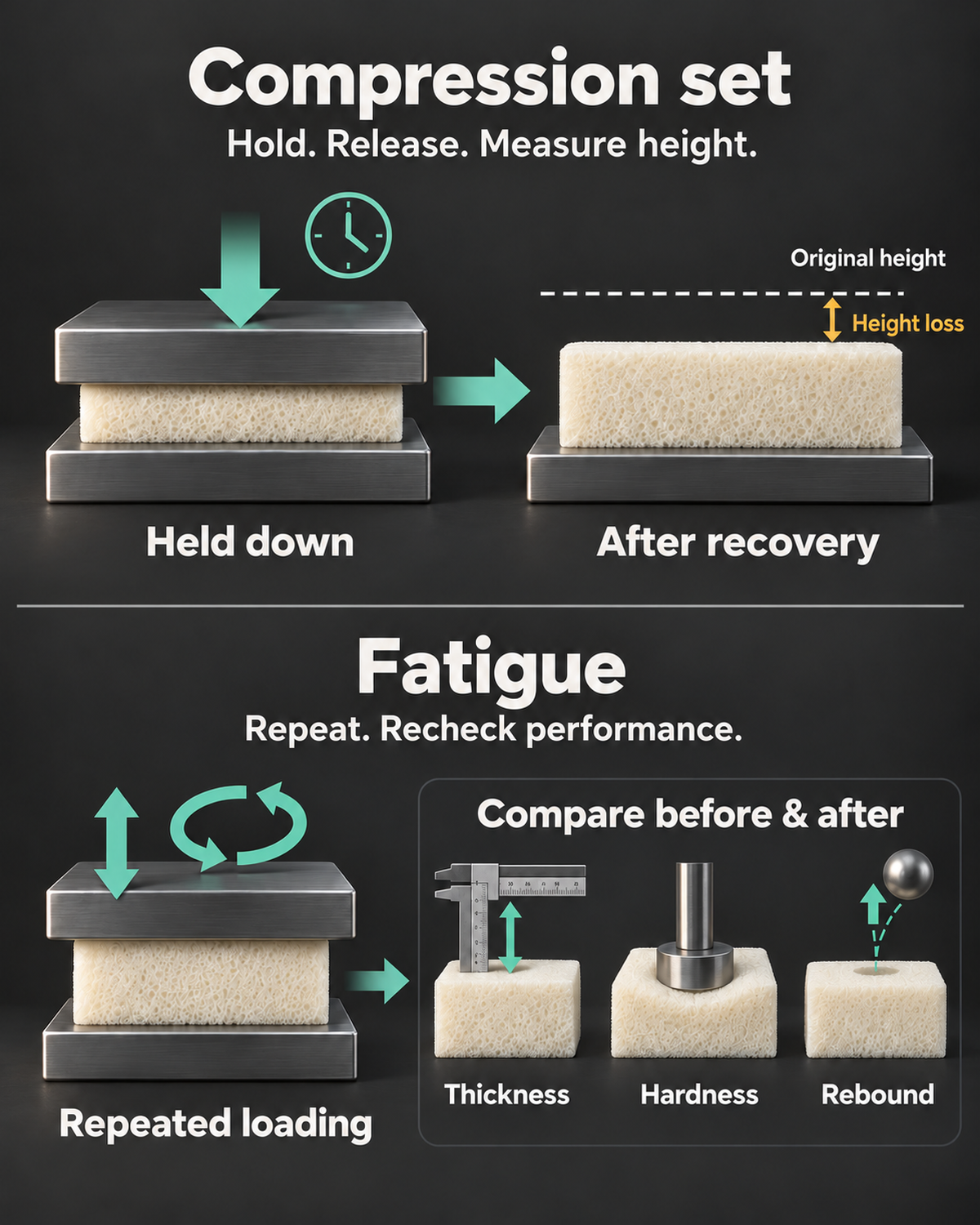
In a 2024 laboratory study, the expanded-bead TPU sample showed slower damage development during repeated compression, while some EVA samples had higher energy absorption relative to density. The samples also differed in structure, so this does not establish a universal durability ranking or shoe lifespan.
For cold or hot conditions, compare candidate foams after agreed temperature conditioning. A supplier’s claim for one grade should not become a temperature guarantee for every foam in that family.
Processing and Cost
ETPU is not limited to steam molding. BASF’s Infinergy Revolution system also uses heat and pressure to join expanded beads. That does not establish compatibility with every existing mold or production setup.
Compare quotes for the same order quantity and finished-component requirements, with tooling, molding, bonding, production losses, and validation clearly accounted for. A raw material price per kilogram leaves too much out to determine the cheaper midsole.
How to Choose for Your Shoe Design
Before reviewing samples, define the intended use, target weight, underfoot feel, durability expectations, and budget.
When Weight and Budget Come First
Shortlist foams that meet your cushioning and structural requirements, then compare actual midsole weights and quotes. Do not select the lightest sample if its geometry differs substantially from the part you need. Ask for the missing dimensions or a more representative sample before treating the weight difference as a material advantage.
When Response and Performance Retention Matter Most
Include ETPU in the evaluation, alongside EVA candidates with relevant performance data. Look beyond how springy each new sample feels. Compare recovery and changes after repeated loading, using agreed conditions. This helps you judge whether any extra weight or cost delivers a benefit that matters to your shoe.
When You Need a Balance
Separate essential requirements from preferences. If two samples meet the essentials, decide which compromise is easier to accommodate: a weight difference, a different underfoot feel, or a higher component cost. Record that decision before approving the next development step.
For example, a sample with appealing rebound but excessive weight may warrant a design revision or a different grade. It does not automatically justify approving the heavier shoe.
What to Compare in Midsole Samples
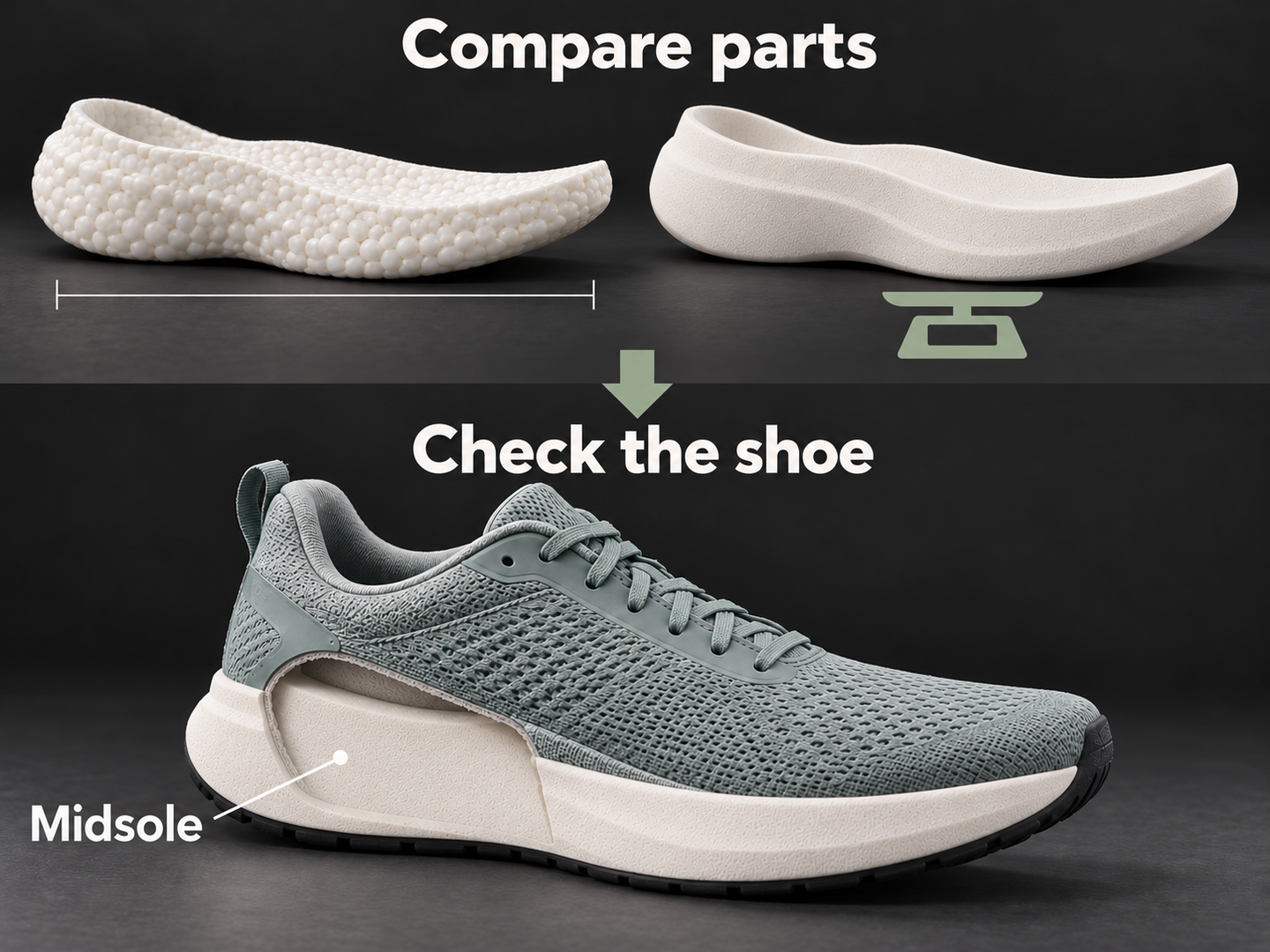
Evaluate samples in two stages. First, document the foam or molded midsole so you can explain differences between samples. Then assess the assembled shoe. Record:
- Material identity: supplier, grade or formulation description, processing route, and whether the sample is a test piece or a molded midsole.
- Weight and geometry: shoe size, part weight, thickness, dimensions, and finished foam density. Record differences you cannot control.
- Hardness and rebound: hardness scale, test method, sample dimensions, conditioning temperature, and the conditions used to obtain each result.
- Recovery and repeated loading: compression and recovery times, temperature, and the agreed cyclic loading conditions, with results before and after testing.
- Finished construction: bonding, underfoot feel, and wear evaluation appropriate to the shoe’s intended use.
Match the variables you can control and record the remaining differences. Agree on the relevant tests and acceptance criteria for the project, then review each sample against them.
Once a candidate moves into the final shoe, reassess the overall result. A useful foam comparison cannot substitute for checking the assembled design.
FAQ
Can ETPU and EVA Be Used in the Same Midsole?
Yes. Documented designs pair an ETPU cushioning section with an EVA frame in the same midsole. First define what each section should contribute, then assess the proposed materials, how they will be joined, and how the combined structure behaves under load. Separate foam specifications do not establish that the interface will perform as intended. Confirm feasibility for the actual grades and design before treating the combination as an available production option.
Does Recyclable ETPU Make the Whole Shoe Recyclable?
No. A statement about the foam alone does not establish that a finished shoe can be collected and processed through a suitable recycling route. The outsole, upper, adhesives, and other components also need to be considered. Ask what the claim covers: the material itself, manufacturing scrap, or the assembled shoe after use. Before making a shoe-level claim, confirm the proposed separation or processing approach and the recycling route available for that construction.
Conclusion
Choose between ETPU and EVA by matching the specific foam to your shoe’s requirements. Compare finished part weight, cushioning response, recovery, and cost, then confirm the choice in the assembled shoe. Clear priorities make those tradeoffs easier to judge.
For your next footwear project, share the intended use, target weight, preferred feel, budget, and sample requirements with HEVA to discuss development feasibility.