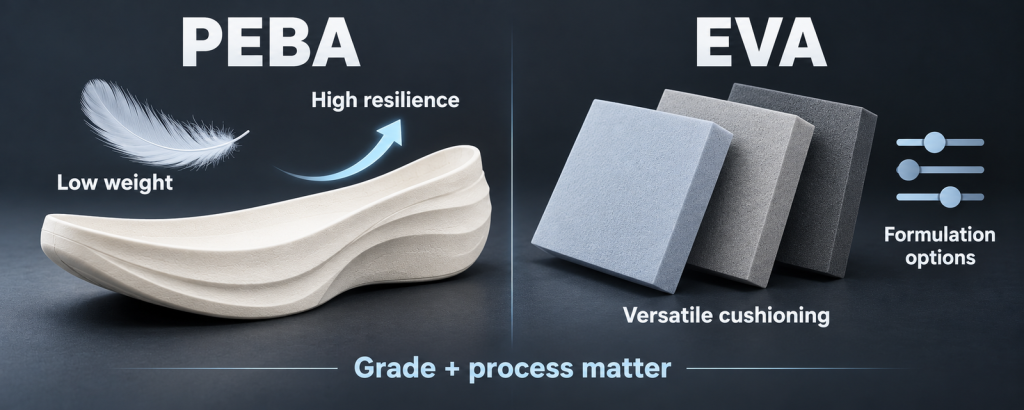
PEBA foam is worth considering when low weight and strong energy return are priorities for a running shoe. EVA offers a versatile cushioning platform whose performance can change substantially with its formulation and foaming process. Choosing between them means comparing the actual foams available for your design.
A useful PEBA vs EVA foam comparison goes beyond the material name. You need to consider how the foam feels, how it performs inside the shoe, how that performance holds up, and what the complete project costs. Start with the differences below, then use comparable samples to narrow your choice.
PEBA, EVA, and Pebax: What the Names Mean
PEBA stands for polyether block amide. It combines flexible polyether segments with harder polyamide segments. Their balance helps manufacturers adjust properties such as flexibility and hardness. When processed into foam, PEBA can provide lightweight cushioning with high resilience, but the polymer grade and foam structure still matter.
EVA stands for ethylene-vinyl acetate. It is widely used in footwear cushioning, including midsoles. EVA foams can differ in their formulation, density, hardness, and processing. An EVA label alone tells you little about how a particular midsole will feel or perform.
Pebax is Arkema’s brand of PEBA elastomers. That makes “Pebax vs EVA” a comparison involving a branded PEBA material, rather than a separate third polymer family. Pebax comes in different grades for different applications. For a meaningful comparison, ask which grade and finished foam specification you are evaluating, and whether the material contains other polymers.
PEBA vs EVA Foam at a Glance
Use this table to identify what deserves a closer look. The entries describe selection considerations; they are not specifications shared by every PEBA or EVA foam.
| Factor | PEBA foam | EVA foam | What to check |
|---|---|---|---|
| Energy return | A strong candidate when resilience is a priority | Varies with formulation and processing | Comparable tests on finished foam |
| Softness and cushioning | Available in different grades and foam structures | Can be formulated for different cushioning needs | Hardness scale and underfoot behavior |
| Weight | Offers potential for lightweight midsoles | Density can be adjusted through formulation and foaming | Density, midsole volume, and finished shoe weight |
| Temperature | Supplier claims must be checked at foam level | Evaluate the selected foam in its intended environment | Performance at relevant temperatures |
| Performance retention | Initial performance needs follow-up evaluation | Retention also depends on the specific foam | Changes after comparable use or testing |
| Cost | Price the specified material and construction | Price the equivalent project requirements | Matching quantities and quotation scope |
| Application | Consider for demanding weight and rebound targets | Keep in the comparison for varied cushioning and cost targets | The complete shoe’s priorities |
Compare samples against the same design targets to see which differences matter for your shoe. A laboratory result from one formulation cannot stand in for an entire material family.
What Affects Midsole Performance?
Softness, Energy Return, and Running Economy
A soft feel, high rebound, and efficient running describe different things. Separating them makes performance claims easier to evaluate.
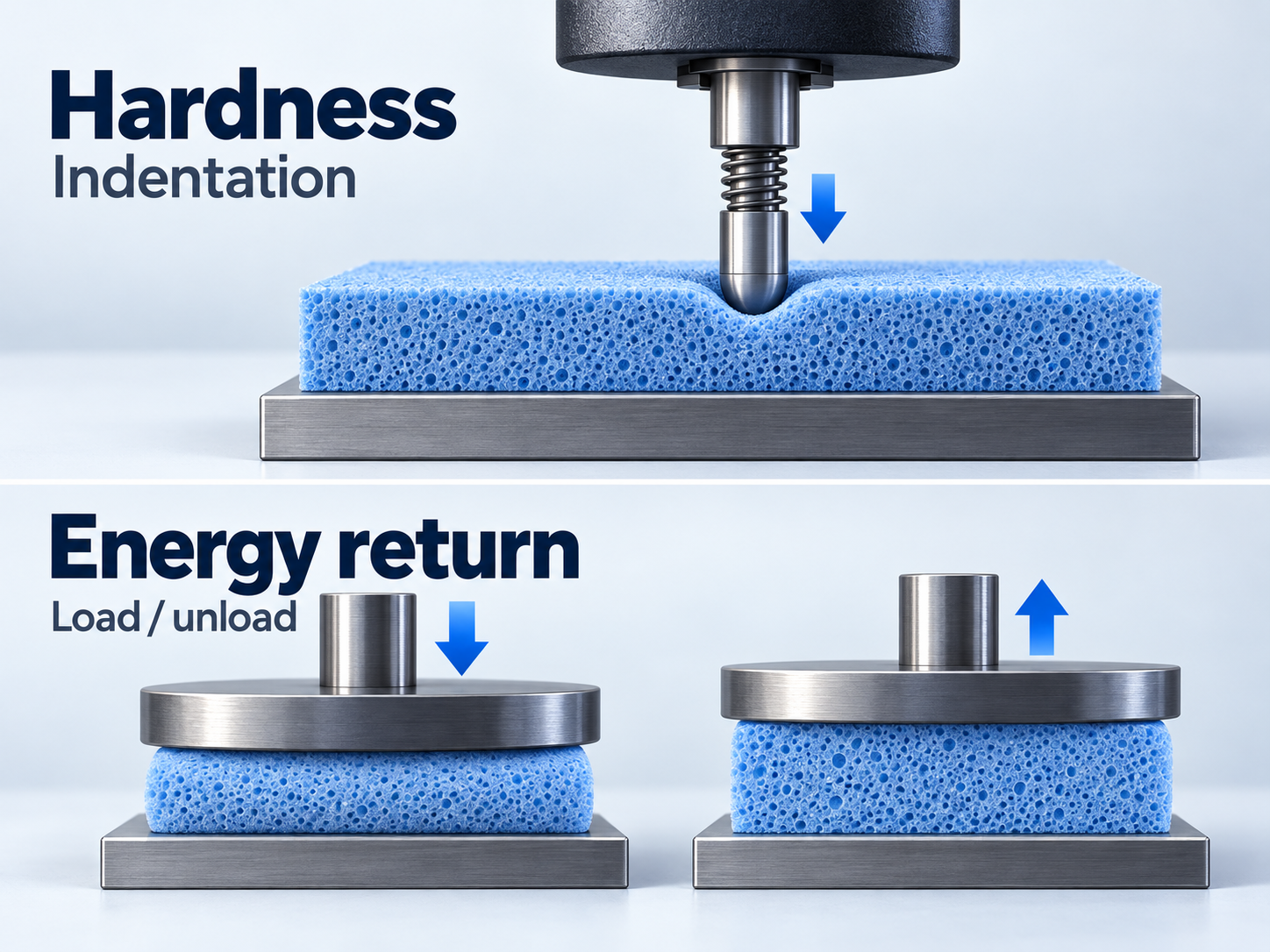
Hardness testing measures resistance to a specified form of indentation. Underfoot softness also reflects how much foam is present and how the shoe supports it. Two samples with similar hardness readings may respond differently during a stride.
Mechanical energy return describes how much energy a sample gives back under a particular loading and unloading test. There is no single energy-return percentage that represents every PEBA or EVA foam. A rebound percentage may come from a different procedure, such as a ball rebound test. Before comparing two percentages, check the method, sample dimensions, temperature, and loading conditions. Otherwise, the numbers may not answer the same question.
Running economy concerns the energy a person uses to run at a given speed. It is measured with the runner wearing the complete shoe. A higher foam energy-return percentage does not translate directly into an equal percentage improvement in running economy. Treat material measurements as useful screening information, then assess the shoe as a system.
Density and Shoe Design
For the foam portion of a midsole, mass depends on density and volume. A lower-density foam can create an opportunity to reduce weight, but adding more volume may offset that saving. The outsole, upper, and other components also contribute to the finished shoe’s mass.
Geometry matters to the experience as well. Midsole thickness, platform width, and supporting structures need to work with the foam. Assess cushioning and stability in the intended construction; a loose foam sample cannot show you how the completed shoe will behave.
Temperature deserves a brief check, too. Arkema describes temperature-related advantages for its PEBA materials, but those claims do not establish identical behavior in every finished foam. Compare your candidates at temperatures relevant to the shoe’s intended use.
Where Supercritical EVA and Blends Fit
Supercritical Foaming Is a Process
PEBA and EVA identify polymer families. Supercritical foaming uses a fluid, such as nitrogen or carbon dioxide, above its critical temperature and pressure to help create cells in the polymer. The term does not tell you which polymer was used.
This distinction matters when comparing supercritical EVA vs PEBA. Research comparing chemical and physical foaming of EVA shows that processing conditions and crosslinking influence foam structure and properties. Physical foaming can still involve crosslinking agents and other formulation ingredients.
Ask how the candidate was made and what its measured properties are. The word “supercritical” alone does not establish a performance ranking, and it does not make every EVA foam equivalent to every PEBA foam.
What EVA/PEBA Blends Add to the Comparison
Blends give you another reason to look beyond a simple two-material ranking. A 2026 study from Qingdao University of Science and Technology examined a specific series of supercritically foamed EVA/PEBA formulations. Rebound differed as PEBA content changed, even though the samples had similar density and hardness.
That finding shows why hardness alone is an incomplete comparison. It does not establish a universal blend ratio or prove how a finished running shoe will perform. If a supplier proposes a blend, request information about the actual formulation and sample results, including how the samples were conditioned before testing.
Comparing Durability and Cost
Performance Retention Is More Than Visible Wear
Durability can mean several things: an outsole resisting wear, a midsole retaining cushioning, or a shoe maintaining its initial running performance. A shoe that still looks intact has not necessarily retained all three. Decide which outcome you need to evaluate.
A study by Rodrigo-Carranza and colleagues tested 22 trained male runners in two carbon-plated prototype shoe models, one using PEBA foam and the other EVA. The researchers compared new shoes with shoes worn for 450 kilometers (about 280 miles), at a fixed running speed.
Runners used less energy in the new PEBA model than in the new EVA model. After wear, the difference between the models was no longer statistically significant. Energy cost increased with wear in the PEBA model, while the EVA model showed no significant change in that comparison.
These results apply to those shoes and test conditions. They do not establish a 450-kilometer expiration point for PEBA or prove that every EVA foam lasts longer. They support evaluating performance retention alongside the first impression of a new sample.
Compare Costs for the Same Project
Compare quotations against the same requirements: material specification, size range, construction, process, order quantity, and included development work. Clarify whether a price covers the foam component, an assembled sole, or the complete shoe.
A cheaper component may require changes elsewhere in the design, so review the resulting shoe cost as well. Retail prices cannot tell you the manufacturing cost difference between PEBA and EVA. Use current project quotations to judge whether a candidate’s measured benefits justify the additional expense, if any.
How to Choose a Midsole Foam for Your Shoe
Set the Priorities for Your Shoe
Write down the intended use and rank the requirements before requesting samples. Identify which targets are essential and where you can make tradeoffs. Weight, cushioning feel, rebound, stability, performance retention, and cost may compete for attention.
For example, imagine a shoe project where weight and rebound take priority. You could include PEBA candidates in the first sample round and compare them with an appropriate supercritical EVA option. For a daily-use design with a tighter cost target, start with EVA formulations suited to the required cushioning, then assess whether another material offers enough benefit to justify changing the project.
These hypothetical examples suggest starting points for sample selection. Both racing and everyday shoe projects still need their own material comparison.
Compare Samples Under Matching Conditions
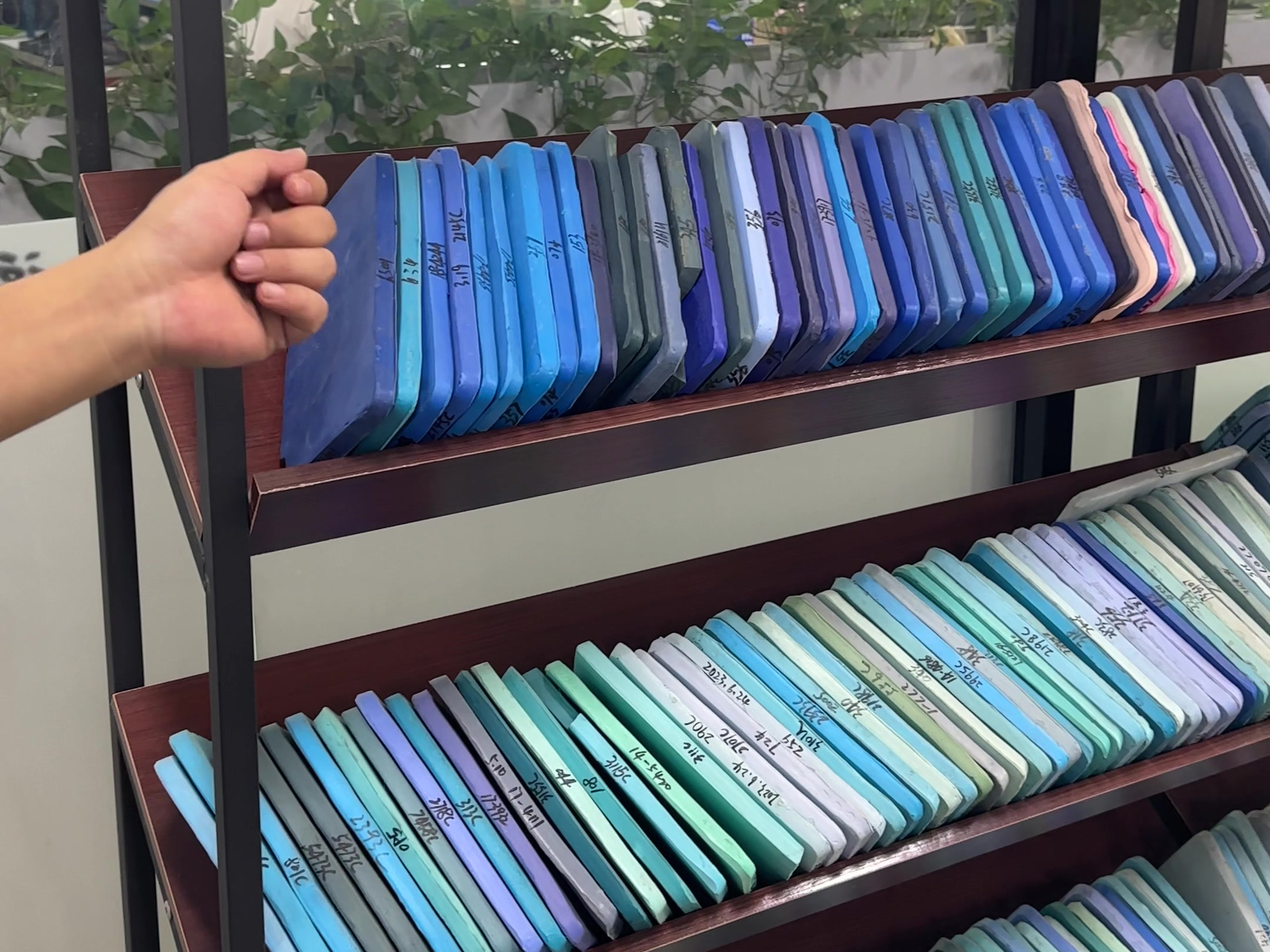
For the checks that matter to your project, agree on acceptance criteria before you compare samples. Ask the supplier to document enough detail for a useful comparison:
- The polymer grade or blend and the foaming process.
- Foam density, sample thickness, and hardness, including the hardness scale.
- The rebound or energy-return method, with its loading and temperature conditions.
- The time and conditions used to prepare or condition samples before testing.
- Results before and after a defined wear or cycling procedure, showing how the same cushioning or rebound measure changes.
Keep the comparison conditions consistent where possible, and record differences that cannot be matched. A data sheet with an unexplained “rebound” value gives you less to work with than a result tied to a named procedure. If information is missing, agree on what needs clarification before selecting the foam.
Check the Complete Shoe Before Finalizing the Foam
Build the shortlisted foam into the intended construction and review the actual shoe weight, cushioning, stability, and fit. Agree on how to evaluate changes after representative use. Record any design adjustments alongside the updated quotation so you can see their performance and cost implications together.
You should be able to explain why the selected foam meets your project requirements and support that choice with sample results. Keep the approved sample and agreed specifications as the reference for subsequent discussions.
FAQ
Does PEBA Foam Require a Carbon Plate?
No. PEBA identifies the foam material, while a carbon plate is a separate structural component. You can consider PEBA foam in a design without a carbon plate. Decide whether a plate belongs in the shoe by evaluating the intended geometry, stiffness, and running experience. Results from a plated prototype should not be assumed to carry over unchanged to an unplated design.
Can You Identify PEBA or EVA Foam by Appearance or Touch?
Appearance and a quick squeeze are not reliable ways to confirm the polymer. Color, texture, and softness can vary within a material family. Ask for the material identification, grade or blend information, and the relevant specification from the supplier. When composition needs independent verification, agree on an appropriate identification method rather than treating a visual comparison as proof.
Can You Replace EVA with PEBA in an Existing Midsole Design?
Treat the change as a development decision that needs review and sampling. Ask whether the proposed material and process are compatible with the existing geometry, tooling, and assembly requirements. Then check the revised shoe against its performance and cost targets. Do not assume that keeping the same external shape means the existing manufacturing setup can remain unchanged.
Conclusion
PEBA offers an important option when lightweight cushioning and energy return are priorities. EVA and EVA-based blends remain worth evaluating through their specific formulations and processes. Base your choice on the performance you need, the conditions used in testing, and how the complete shoe performs after use.
For your next development discussion, bring the target shoe type, ranked performance requirements, and cost range. Those details give you a practical basis for selecting candidates and agreeing on meaningful sample evaluations.