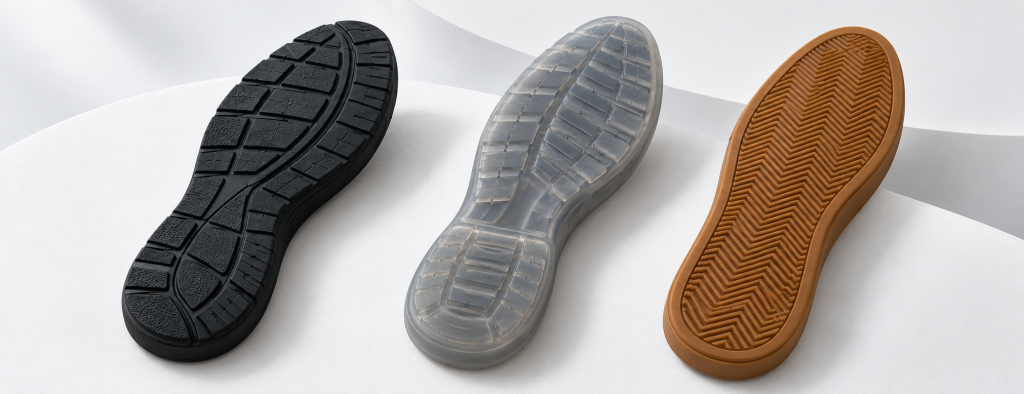
Shoe soles are commonly made from rubber, EVA, polyurethane (PU), and other polymers, including thermoplastic polyurethane (TPU). Leather is also used in some footwear. A single shoe can combine several of these materials: a foam midsole may sit above a rubber outsole, with a separate cushioned insert under your foot.
To understand what a sole is made of, start with the part you’re looking at. The material touching the ground has a different job from the material cushioning your step.
Outsole, Midsole, and Insole: What Each Layer Does
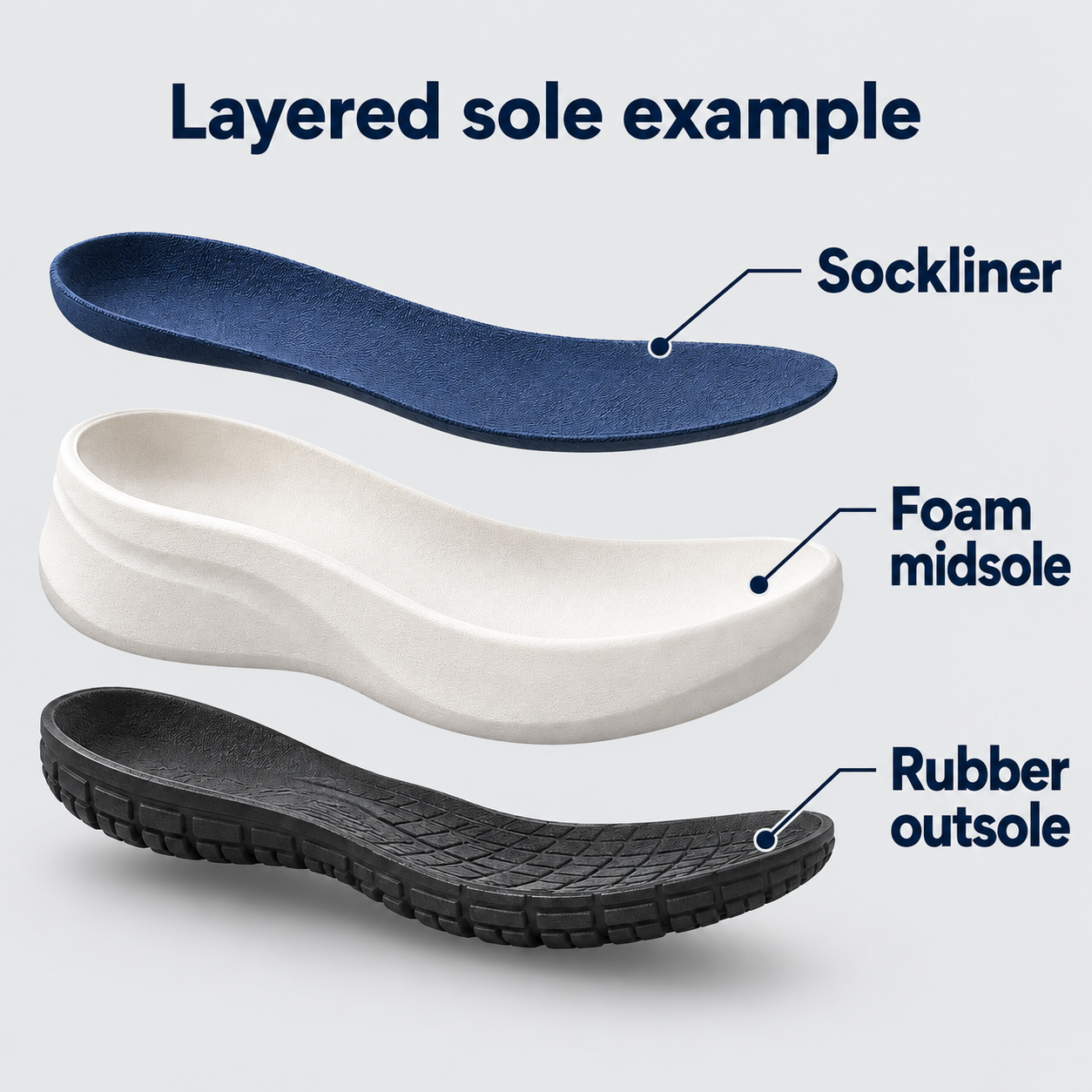
The sole is the bottom part of a shoe. In a layered sneaker, it includes several components rather than just the outsole.
The outsole is the ground-contacting part of the shoe. Its material and tread pattern—the arrangement of grooves and raised areas on the bottom—both matter when you’re considering grip, wear, and the surfaces the shoe will encounter. A label that says “rubber outsole” describes this part of the construction, rather than everything beneath your foot.
The midsole sits above the outsole in many sneakers and provides much of the underfoot cushioning. Foam is common here, but its feel depends on more than the polymer name. Thickness, formulation, and the surrounding construction help determine how the shoe responds when loaded.
The insole or sockliner, in everyday product descriptions, usually means the insert directly beneath your foot. It may be fixed or removable and can provide another layer of cushioning, using materials such as EVA or PU foam.
There’s one terminology detail to watch in manufacturing specifications: “insole” can also mean the structural base used in making the shoe. That component is different from the comfort insert placed over it. If a specification simply says “PU insole,” confirm which part it describes.
Not every shoe has three distinct layers. Treat these names as a way to identify functions, then check the actual construction.
Common Shoe Sole Materials and Where They’re Used
The table below gives you a starting point for reading sole specifications. These labels are common industry terms, rather than separate, mutually exclusive chemical categories. TPU, for example, belongs to the broader thermoplastic elastomer family.
| Material | Typical location or form | What to check |
|---|---|---|
| Rubber | Outsole or ground-contact pieces | Compound, tread, and intended surface |
| EVA | Foam midsole, underfoot insert, or selected outsole applications | Foam formulation and thickness |
| PU | Midsole, insert, or outsole | Density, hardness, component role, and aging requirements |
| TPU / E-TPU | Solid components / expanded foam midsole | Solid or foamed form; specific grade |
| TPR / TR | Molded soling compound | Actual formulation behind the label |
| PEBA | Foam or molded footwear component | Material grade and finished form |
| PVC | Molded sole | Formulation and required properties |
| Leather | Leather sole construction | Construction and intended conditions |
Rubber
Rubber soles can contain natural rubber, synthetic rubber, or combinations of polymers and other ingredients. The finished compound is formulated for its intended purpose. That helps explain why two outsoles labeled “rubber” can feel and perform differently.
For a rubber outsole, wear, flexibility, and grip are useful ways to describe performance. Grip depends on the tread and the conditions underfoot as well as the rubber compound, so a rubber label alone cannot guarantee slip resistance on wet or oily floors.
EVA
EVA stands for ethylene-vinyl acetate, a copolymer used in many applications, including footwear. In sneakers, you’ll often encounter it as a lightweight foam midsole. The foam structure allows the material to compress under load, contributing to the shoe’s cushioning.
An EVA designation doesn’t specify one density, firmness, or service life. When comparing two EVA midsoles, look at the actual foam and construction rather than assuming the shared name means an identical ride. An EVA midsole can also work with a separate rubber outsole, so choosing EVA for cushioning doesn’t require using it for every ground-contact area. EVA is also used in some outsoles, with grades intended for ground contact.
PU
PU means polyurethane. Footwear formulations are used in midsoles, comfort inserts, outsoles, and complete sole units. PU foam systems can be formulated with different densities, hardness levels, and elasticity.
These systems also differ in chemistry and resistance to aging. When comparing PU components, consider where each is used and what it needs to do; neither the feel nor the lifespan is fixed by the material name alone.
TPU and Expanded TPU
TPU is thermoplastic polyurethane, a member of the thermoplastic elastomer, or TPE, family. It can be processed into molded footwear components, including outsoles. Expanded TPU, commonly written as E-TPU, is a foamed form used in cushioning applications such as midsoles.
This distinction matters: a solid TPU outsole and an E-TPU foam midsole share a material family but serve different functions. You wouldn’t assess them using the same expectations for thickness, feel, or ground contact.
When a description says only “TPU sole,” ask whether it refers to an outsole, a foam midsole, or another component. The material’s form is part of the answer.
TPR and the Broader TPE Family
TPR means thermoplastic rubber; you may also see TR on sole specifications. TPE is the broader term for thermoplastic elastomers: materials that combine rubber-like elasticity with the ability to soften for shaping when heated.
These names can overlap in product descriptions. TPR refers to a range of compounds rather than one universal recipe, so grip and other properties vary with the formulation. If you’re comparing TPR with TPU, compare the specific compounds for the same application.
Other Materials: PEBA, PVC, and Leather
PEBA, short for polyether block amide, is another thermoplastic elastomer used in footwear. It can be made into foams or molded components. Pebax is a brand name associated with PEBA materials, rather than the generic name for every performance foam. A PEBA label by itself does not tell you that the material is foamed, bio-based, or suitable for every shoe.
PVC, or polyvinyl chloride, is also used in molded soles. Leather is another established soling material.
Many synthetic sole materials are polymers, and some fall within everyday usage of the word “plastic.” That doesn’t mean they all behave like hard plastic. A cushioning foam, an elastic molded component, and a rigid part can have very different properties.
How Different Sole Materials Work Together
An EVA foam midsole paired with a rubber outsole is a straightforward example of materials sharing the work. The foam provides cushioning above the ground-contact layer; the rubber compound and tread address demands at the surface. In this construction, EVA and rubber complement each other by doing different jobs.
You can also have a foam layer working alongside a separate support component. This gives the design another way to address structure instead of asking the cushioning material to do everything. The component’s shape, position, and material need their own specification; you can’t identify its composition simply because the shoe has an EVA midsole.
Different footwear categories use other combinations. In work footwear, for example, a PU foam midsole and comfort insert can be paired with a TPU outsole. This illustrates another way to divide the work between components, with the construction chosen for that shoe’s intended use.
When discussing a new sneaker, describe the proposed construction by component: what sits under the foot, what provides cushioning, and what contacts the ground. Then compare the resulting samples. This makes the conversation more precise than requesting a “soft sole” or choosing one material name for the entire shoe. It also makes clear which part needs to change if the sample doesn’t meet the intended feel or use.
What to Compare Beyond the Material Name
Once the materials and their positions are clear, use four questions to guide the comparison.
Where Will the Shoe Be Used?
Identify the surfaces and conditions that matter: dry indoor floors, wet pavement, or other expected environments. Slip resistance concerns the interaction between footwear and the surface, including contaminants such as water or oil. A result from one set of conditions does not automatically describe another.
What Should the Shoe Feel and Move Like?
Consider cushioning, rebound, flexibility, and support separately. Rebound describes the energy returned after deformation; it is not another name for shock absorption. Pressing a sole with your thumb can give a first impression, but it cannot replace assessing the complete shoe for its intended use.
How Should Performance Hold Up Over Time?
Look beyond the first try-on. Wear at the outsole, changes after repeated loading, and material aging are different concerns. Abrasion testing measures material worn away at the surface. Compression set describes how much thickness a material fails to recover after a defined period under pressure and a defined recovery time. For PU components, resistance to hydrolysis may be one consideration; there is no single lifespan that applies to every formulation.
What Exactly Is Being Compared?
Check the component, compound or grade, sample construction, and test conditions. Two figures labeled “rebound” or “abrasion” are not necessarily comparable if the methods differ. For a development discussion, agree on the shoe’s intended use and the requirements the sample should meet. A clear brief gives you a useful basis for choosing between constructions and deciding what needs adjustment.
FAQ
Why Do Some Shoe Soles Crumble Even When Rarely Worn?
Some PU components can deteriorate through hydrolysis, a chemical breakdown involving moisture. Time in storage matters as well as time on your feet, so limited wear doesn’t rule out aging. The outcome depends on the formulation and conditions, and not every crack or detached sole has the same cause. Follow the product’s storage guidance and check for deterioration before use; wearing a shoe more often is not a guaranteed way to prevent hydrolysis.
Is a Soft Sole Always More Comfortable?
No. There is no single sole material that is most comfortable for every wearer or activity. Softness is only one part of how the complete shoe feels underfoot. Thickness, flexibility, and the rest of its construction also affect that experience. Assess comfort in the complete shoe for the activity you have in mind.
Can Recycled Materials Be Used in Shoe Soles?
Yes. Some sole compounds incorporate recycled materials, including recycled rubber. Check which component contains them, the stated proportion, and whether the finished material meets the required performance. Recycled content is different from recyclability: a sole containing recycled material does not establish that the completed shoe can be collected and recycled where you live. It also does not, by itself, prove a lower overall environmental impact.
Conclusion
Understanding sole materials starts with identifying the part: outsole, midsole, or underfoot insert. From there, compare the formulation, construction, and intended use. The most useful choice is a combination that meets the shoe’s requirements, rather than a material with the most impressive label. If you’re developing a sneaker, bring those requirements and your proposed sole construction to HEVA to discuss the next development steps.