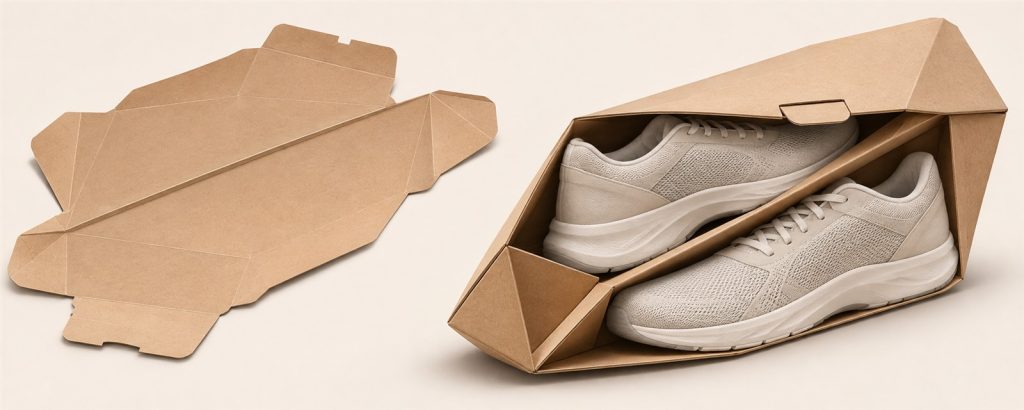
Choosing sustainable shoe packaging starts with a practical question: what does each part of your packaging need to do? A recycled paper box, a molded pulp insert, and a reusable bag serve different purposes. Their material names alone tell you little about whether the complete package will protect your shoes or fit the disposal options available to your customers.
Start with the shoe, its sales channel, and the full delivery configuration. Then compare materials, remove unnecessary components where protection allows, and check the evidence behind environmental claims. This gives you a useful basis for discussing packaging with suppliers—and helps you avoid replacing one material while overlooking the rest of the package.
Define What Your Shoe Packaging Needs to Do
A shoe box displayed in a store has a different job from a package sent individually to a customer. For bulk shipments, retail boxes may be packed inside a larger shipping carton. An e-commerce order may need a separate outer package, or a box specifically evaluated for direct shipping.
Before choosing materials, list the components in your current or proposed configuration: the shoe box, wrapping, shaping or cushioning pieces, labels, and any outer packaging. Give each a clear purpose. Does the wrapping separate the shoes and limit rubbing? Does an insert hold a shoe in position? Is the outer carton needed for the delivery route?
Include the condition you expect on arrival. An intact box does not necessarily mean the shoe surface is unaffected, and acceptable shipping protection may still leave a retail box looking unsuitable for presentation. Consider contact marks, ink transfer, movement inside the box, and the appearance of both the shoes and packaging.
Keep the shoe style and distribution conditions consistent when comparing options. Otherwise, a lighter configuration for store delivery can appear better than a parcel package simply because it has fewer responsibilities.
Compare Materials and Packaging Components
Separate Structure, Fiber Content, and Certification
Terms used to describe sustainable shoe boxes often answer different questions. Corrugated describes a structure: flat liner sheets bonded to a fluted medium. Recycled fiber describes a material source. FSC labeling provides information about the forest-based materials and the applicable certification category. These attributes can overlap in one box.
A brown surface does not establish recycled content. Likewise, an FSC Mix label does not mean that all the material is recycled. Ask for the actual board specification, the stated recycled content and its scope, and documentation supporting any label you plan to use.
Keep those details separate from performance and disposal. A sourcing label does not establish that the complete package is suitable for your shipping route, accepted in every local recycling program, or compostable.
Match Each Component to a Function
Use the following comparison to narrow your options. It is a guide to the questions each component raises, rather than a ranking of environmental performance.
| Component option | Potential role | Main trade-off | What to verify |
|---|---|---|---|
| Paperboard or corrugated box | Containment, presentation, and protection within the chosen configuration | Less material must still meet the package’s protection requirements | Board construction, fiber information, dimensions, and sample performance |
| Paper wrapping or tissue | Separation and contact protection | Removing a layer may also remove a useful function | Contact behavior, treatments, and relevant local disposal instructions |
| Molded pulp insert | Shape matching, positioning, or cushioning where needed | Shaped support comes with processing and material requirements to assess | Fiber composition, treatments, fit, and performance under relevant conditions |
| Reusable bag or container | Storage or a defined reuse system | Added material needs a credible use beyond the first delivery | Expected use, durability requirements, and any return or collection arrangements |
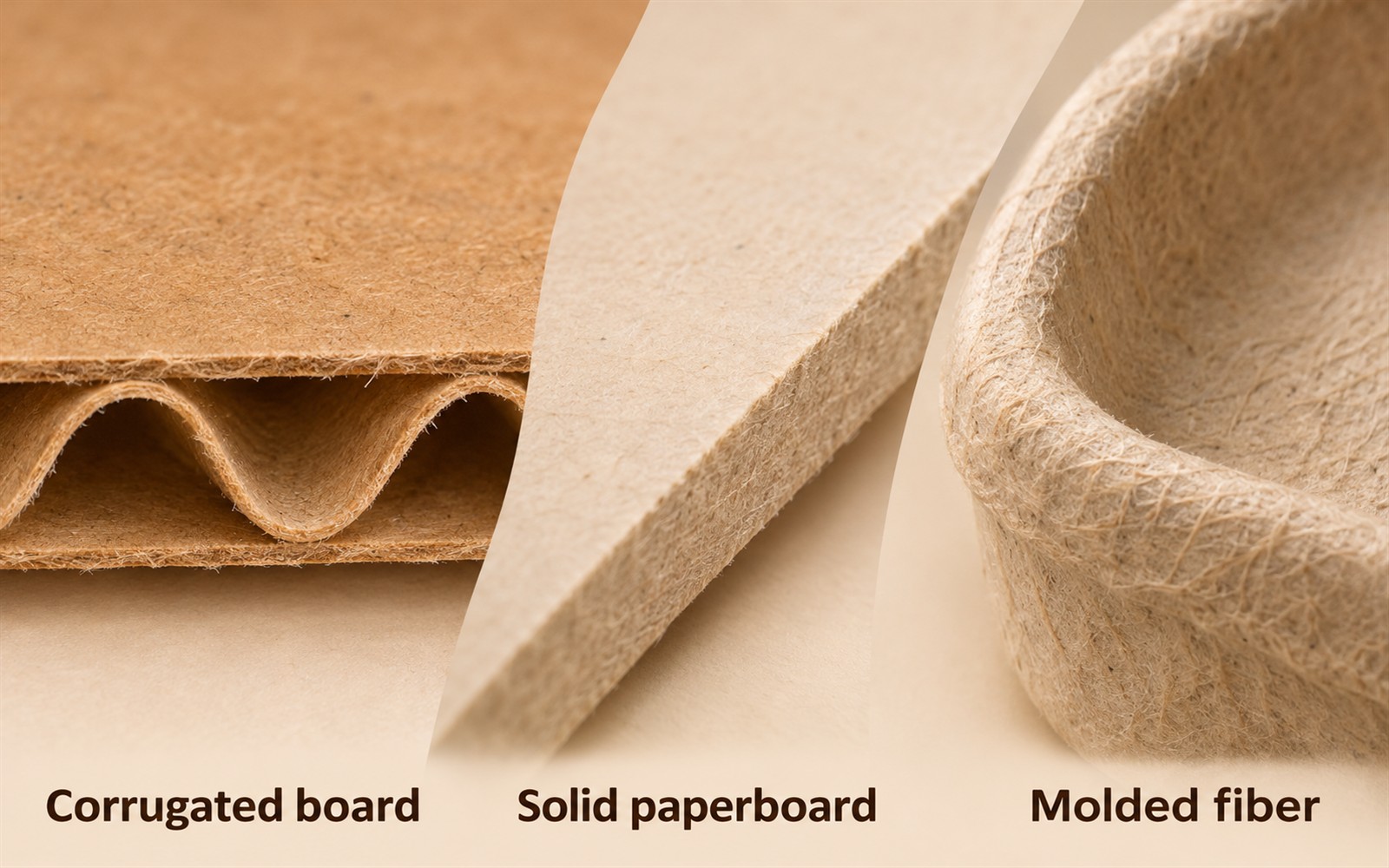
For paperboard and corrugated options, ask what construction is being offered rather than relying on a generic material name. A change in board structure deserves evaluation in the actual package; it does not become acceptable simply because the fiber source sounds preferable.
Molded pulp can provide shaped support and cushioning. Its manufacture also involves removing water and drying the formed material, and treatments may be used to achieve particular properties. Moisture conditions can affect mechanical behavior. Those considerations make it worth asking how a proposed insert is made and what it needs to withstand.
If wrapping already performs the required separation function, adding a molded insert needs a clear reason. Conversely, removing an insert solely to reduce the component count may leave a protection problem unresolved. First compare how each option protects the shoes, then review its material information and environmental claims.
Reduce Material and Space Without Losing Protection
Review Layers and Unused Space
Source reduction is a useful starting point: look for material you can avoid using in the first place. Review decorative additions, duplicate layers, and unused space alongside the function list you prepared.
A component with no clear role is a candidate for removal. A layer that prevents contact between shoe surfaces needs a different discussion: can another part of the design perform that job, or should the layer remain?
Review packaging dimensions in the same way. Unused space may offer an opportunity to reduce volume, but a tighter fit must still accommodate the shoes and the protection they require. Check the complete configuration, including how retail boxes fit inside shipping cartons. A change to one box can affect the way the shipment is packed.
Evaluate Shipping Without an Extra Box
Direct shipping in a shoe box is an option to evaluate, not a feature to assume. Compare it with the configuration that uses an outer package. Consider protection, shipping-label placement, the condition of the box at delivery, and whether the customer can use it for a return.
Choose a verification approach appropriate to the distribution route. ISTA distinguishes basic integrity screening from procedures that simulate aspects of transportation. A design check does not provide the same evidence as an evaluation intended to address shipping hazards.
When you remove an outer carton or change internal support, evaluate the revised package as a whole. Record what changed and which configuration was assessed. Avoid carrying an approval from the previous design over to a materially different package without reviewing its basis.
Check Recycling, Composting, and Reuse Conditions
Check the Local Recycling Route
Recycled content describes the recovered material used to make a product. Recyclability concerns whether it can be collected and processed for recycling after use. A package can contain recycled fiber without having a suitable collection and processing route wherever it is sold.
For recyclable shoe packaging, check the actual components and the local service conditions relevant to your customers. Paper and cardboard are commonly collected, but acceptance rules vary. Cleanliness, dryness, attachments, and material treatments may affect the instructions you need to provide.
Ask about coatings, liners, labels, and other additions instead of judging only the main box material. That does not mean every coating or adhesive makes paper packaging unrecyclable. It means the finished configuration needs an informed assessment.
Where components require different disposal routes, explain how to separate them. Keep instructions specific enough to be useful, and avoid implying that a recycling symbol guarantees local acceptance.
Treat Composting and Reuse as Conditional Options
Paper-based, bio-based, and degradable are not interchangeable with compostable. A compostability claim needs support for the finished item and the stated conditions. Industrial composting and home composting are different settings, and the required collection or treatment route must be considered.
Before choosing compostable packaging, establish which components the evidence covers and where customers could actually send them. A claim about a raw material does not automatically cover the assembled package, its printing, or its attachments.
Reuse also needs a plausible next use. A bag may become shoe storage; a durable container may belong to a managed return system. Describe that use and consider whether the design supports it. Adding a bag that customers have little reason to keep does not establish an environmental advantage.
Without a relevant lifecycle comparison, you cannot reliably conclude that a cloth bag or durable box has a lower overall impact than a simpler alternative. State the supported attribute—such as documented recycled content or a defined reuse function—and keep broader claims within the evidence available.
Compare the Complete Options Before Approval
Once you have narrowed the options, ask suppliers to quote and document them on the same basis. Sustainable packaging for shoes becomes easier to evaluate when the discussion refers to a defined shoe, order, and delivery configuration.
Use a short approval checklist:
- Components and specifications: Identify every part, its function, construction, and relevant material information.
- Quantity and dimensions: Record component and total packaging weights, along with packed dimensions, for the same number of shoe pairs and delivery configuration.
- Assembly and delivery: Clarify what arrives flat or assembled, what packing work is required, and which outer packaging is included.
- Protection evidence: Identify the sample configuration, assessment conditions, results, and unresolved concerns.
- Environmental information: Check the scope of sourcing labels, recycled-content statements, and disposal or reuse instructions.
- Commercial scope: Compare quotations with the same order assumptions and clarify included components, tooling, assembly, and delivery terms.
A lower box price does not answer what the complete packaging option costs. Equally, reducing weight or volume alone does not establish a quantified carbon reduction. Keep cost comparisons tied to actual quotations and environmental comparisons tied to the evidence and boundaries they require.
Use the same version reference on the approved sample, specification, and supporting documents. If information is missing, record the gap and who will resolve it. This makes the approval usable when production begins, rather than leaving important choices in an email exchange or sample photograph.
FAQ
Can One Packaging Specification Cover Every Shoe Size in a Collection?
Do not assume that it can. A box and internal arrangement that fit one size may leave excess movement for another or create a tight fit at the larger end of the range. Review fit and protection across the sizes you intend to group together. You may be able to use a limited set of packaging sizes, but the grouping should follow sample assessment. There is no universal box-size rule that replaces checking the actual shoes and their packing arrangement.
What Should You Recheck When a Packaging Material or Supplier Changes?
Compare the proposed change with the approved specification before treating it as an equivalent replacement. Review construction, composition, surface contact, and any information supporting labels or disposal instructions. Decide which checks need to be repeated based on what changed and the function affected. Keep the replacement sample and updated documents identifiable, so an older approval is not mistaken for evidence about a new material or configuration. A familiar material name alone is not enough to establish equivalence.
Conclusion
A useful sustainable footwear packaging decision connects material choices with protection, delivery, and what happens after use. Start by defining each component’s role. Compare complete configurations, investigate avoidable material and space, and verify the conditions behind recycling, composting, or reuse claims.
Before approval, bring the sample, packaging specification, supporting information, and quotation into agreement. For a HEVA OEM or ODM project, include your packaging goals alongside the shoe specifications and intended sales channels. That gives the project discussion a concrete starting point and makes the remaining questions easier to resolve before production.