Switching midsole foam makes sense when it solves a problem your current shoe cannot solve well enough. That might be excess weight, an unsatisfactory underfoot feel, or cushioning that changes too much with use. A new process name alone is a weak reason to change a working specification.
Before comparing the options, clarify the terms: supercritical describes a foaming process, while EVA is a polymer. Supercritical foam can itself be EVA. Other supercritical foams may use polymers such as PEBA or TPU, so their results should not be treated as evidence for supercritical EVA. Here, the comparison is between conventional chemically foamed EVA and supercritical EVA.
The upgrade is worth considering when a specific supercritical EVA option delivers a useful improvement in your shoe, and that improvement justifies its development requirements and quoted cost. Start with the project target, then compare the actual options.
Supercritical EVA vs Conventional EVA at a Glance
Conventional chemical foaming uses a blowing agent that generates gas through a chemical reaction. Supercritical foaming uses a fluid above its critical temperature and pressure, commonly nitrogen or carbon dioxide, which dissolves in the polymer before controlled changes in processing conditions cause cells to form.
In a comparison of chemical and physical EVA foaming, researchers found differences in processing temperatures and cell structure under their experimental conditions. The study did not establish finished-shoe cushioning or service life.
That difference affects how the foam is made. It does not fix the finished foam’s density, hardness, rebound, or durability. Resin selection, blends, additives, crosslinking, and processing conditions still matter.
| Dimension | What the process name establishes | What to compare |
|---|---|---|
| Foaming route | Conventional EVA uses a chemical blowing agent; supercritical EVA uses a supercritical fluid. | Resin or blend and the proposed process |
| Weight and density | Neither label establishes finished weight. | Density, geometry, component and shoe weight |
| Feel and rebound | Neither label specifies a measured response. | Results from comparable test methods |
| Performance retention | Neither label establishes service life. | Initial and post-conditioning measurements |
| Production fit | Neither label confirms compatibility with the existing setup. | Dimensions, finishing, bonding, tooling and assembly |
| Project cost | Neither label determines the project quote. | Quantity, included operations, development and tooling charges |
Ask each supplier to identify the resin or blend, target density, and test data for the foam being offered. Two products labeled “supercritical EVA midsole” may have different specifications.
What Changes Matter in the Finished Shoe?
Weight Depends on More Than Foam Density
For the same volume, a lower-density foam has less mass. The complication is that a proposed midsole may also change in thickness, shape, or supporting structure. A density reduction therefore does not tell you the final weight saving by itself.
Compare midsoles in the same size and record their geometry alongside their weight. If the new design changes outsole coverage or adds a supporting component, weigh the assembled shoes as well.
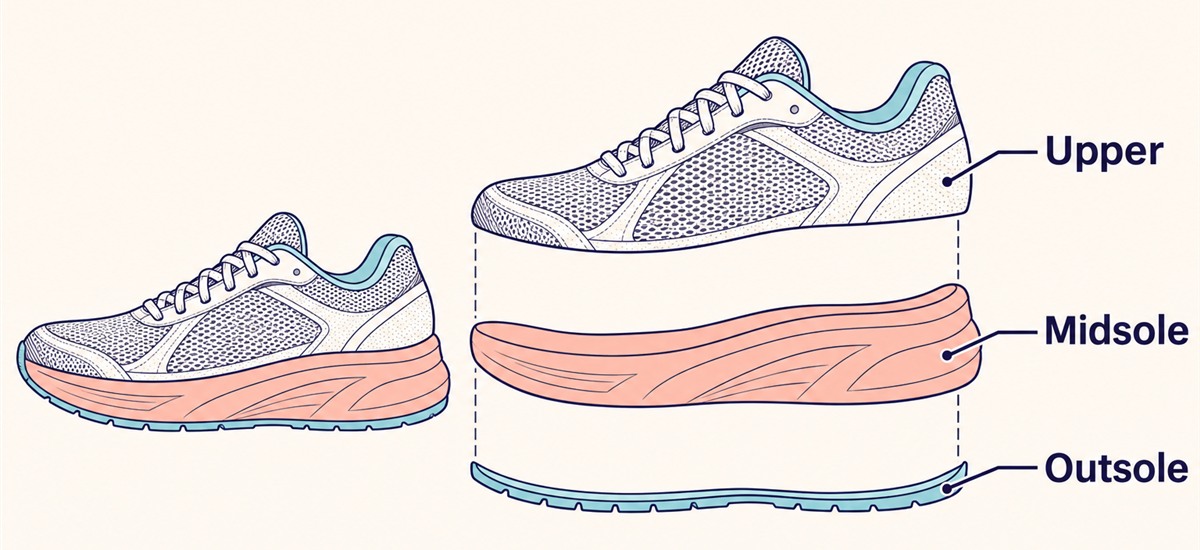
A lighter result is useful only if the shoe still meets its other requirements. For example, a running shoe project may prioritize weight, while also needing a particular fit, platform feel, and cushioning response. Agree on those requirements before treating the lightest sample as the preferred option.
Softness, Rebound, and Performance Retention
Softness and rebound answer different questions. A foam that feels easy to compress is not automatically the one that returns more energy under a given test. Neither a hand squeeze nor a single rebound percentage describes the full experience of wearing the shoe.
Ask how each result was measured: which test method was used, what the sample dimensions were, and how the samples were conditioned and loaded. Compare results from the same method before drawing a conclusion. Then evaluate the complete shoe for its intended activity.
A study of supercritical nitrogen–foamed EVA/PCL blends measured changes in compression recovery as the blend composition changed. Those findings apply to the tested formulations and conditions, rather than every commercial supercritical EVA midsole.
Also look beyond the initial result. Record baseline thickness and relevant mechanical measurements, use an agreed conditioning procedure or compression fatigue test, and measure again under consistent conditions. Compression set concerns the deformation remaining after specified compression and recovery conditions; it is not a substitute for evaluating all forms of repeated-use change.
The appropriate loading, temperature, recovery period, and acceptance limits depend on the project and test method. Set them with your supplier or laboratory. A universal mileage claim cannot replace that work.
When Conventional EVA Is Still the Right Choice
Keep conventional EVA under consideration when the current specification already delivers the required weight, feel, and performance at an acceptable project cost. A familiar material can remain a sound choice even when another route produces an interesting sample.
The useful question is what the new option improves enough to matter. If the improvement is difficult to demonstrate, or it addresses a feature your customer does not need, changing the specification may add work without improving the product in a meaningful way.
Consider the timing too. A switch that requires further fitting, assembly trials, or supplier validation must fit the development schedule. Confirm those requirements for the actual proposal rather than assuming either route will be simpler.
Use your current conventional EVA midsole as the baseline. Compare the alternative with its measured performance, manufacturing requirements, and current quote. If the alternative does not deliver an improvement that matters to the project, keeping the current specification is a reasonable decision.
When Supercritical EVA Is Worth Sampling
Sampling becomes useful when you can describe the gap you want to close. “Improve the foam” is too broad. A better brief identifies the target shoe, the current midsole, the desired change, and the requirements that must still be met.
For a weight-focused project, that could mean investigating a lighter midsole while preserving the required cushioning response and dimensions. For another shoe, the priority may be a particular underfoot feel or how that feel changes after use. These are development objectives, not promised outcomes from supercritical processing.
Decide what kind of comparison you are making:
- To investigate the process effect: define the effect you want to isolate and control the relevant formulation, geometry, conditioning, and testing variables. Record density as well, and state whether it is held constant or evaluated as an outcome. If important variables differ, treat the results as a comparison of those specific foam systems rather than proof of the process effect alone.
- To select a commercial solution: compare each supplier’s proposed specification against the same product goals. The formulations may differ, but those differences should be recorded and the acceptance methods should be consistent.
Both comparisons can be useful. Problems arise when a commercially optimized sample wins a test and the result is presented as proof that its process always wins.
Keep the sample record practical: identify the material specification, size, geometry, batch, conditioning, and test method. Retain the current midsole as a reference. Where a change in construction is necessary, document it so the comparison reflects the product you could actually manufacture.
Advance the option when the results answer the original brief. If they reveal a tradeoff, decide whether it is acceptable before ordering another round of samples.
Is the Improvement Worth the Added Cost?
Compare Quotes on the Same Basis
There is no useful universal percentage for how much more a supercritical EVA option should cost. A quote is tied to a specification, quantity, manufacturing arrangement, and included work. Compare those details before comparing the final numbers.
Request the same purchasing scope for each option. Clarify whether the price covers a foam blank, a finished midsole, or a larger assembled sole unit. Record the order quantity, size range, color requirements, finishing, and assembly operations included.
Separate one-time development and tooling charges from recurring unit prices. Ask which sample rounds, trials, or tests are included and what could create an additional charge. If a supplier has already allowed for production waste in the unit price, avoid adding that cost again in your own comparison.
Compare the additional cost with the improvement the shoe needs. Even a measurable gain may offer little value if it does not address that priority.
Confirm Production Fit Before Approval
A promising foam sample still needs to work in the intended construction. Confirm dimensional requirements, the condition in which parts are supplied, surface preparation, bonding, and any finishing operations. Discuss whether the proposed process is compatible with the intended tooling and assembly route.
Where needed, use a production trial to check whether the proposed specification can be delivered consistently. Agree on the relevant inspection points and how deviations will be handled. The process name does not establish those arrangements.
You can then make one of three decisions:
- Keep conventional EVA: it meets the project requirements, and the alternative has not demonstrated enough additional value.
- Continue sampling: the improvement is promising, but performance retention, manufacturing fit, consistency, or cost still needs confirmation.
- Adopt supercritical EVA: the improvement has been verified and the production and commercial conditions meet the project requirements.
This gives the development team a clear next step without forcing every comparison to end in a material change.
FAQ
Can supercritical EVA replace an existing EVA midsole without changing the tooling?
Confirm tooling compatibility before committing to reuse. Give the supplier the existing design and tooling details, then ask which parts of the setup can be retained and what changes would be needed. Verify the proposal through the agreed samples or trials.
Does “nitrogen-infused” tell you what the foam is made of?
The label alone does not identify the complete resin formulation or establish every processing detail. Ask for the polymer or blend description and an explanation of the foaming route. It also does not prove better cushioning, longer life, recyclability, or a lower environmental impact. Those claims need evidence for the particular material or product and the scope of the claim.
Conclusion
Choose supercritical EVA when the specific option improves something your shoe needs, and the verified benefit supports the development effort and quoted cost. Keep conventional EVA when it already meets the requirements or the alternative still lacks convincing evidence.
Begin with the current midsole and a clear target. Compare samples using consistent methods, check the finished shoe, and confirm production and purchasing conditions before approval. If you are exploring an EVA midsole change with HEVA, share your target shoe type, current specification, and priority improvement so the sample discussion can focus on the decision your project needs to make.