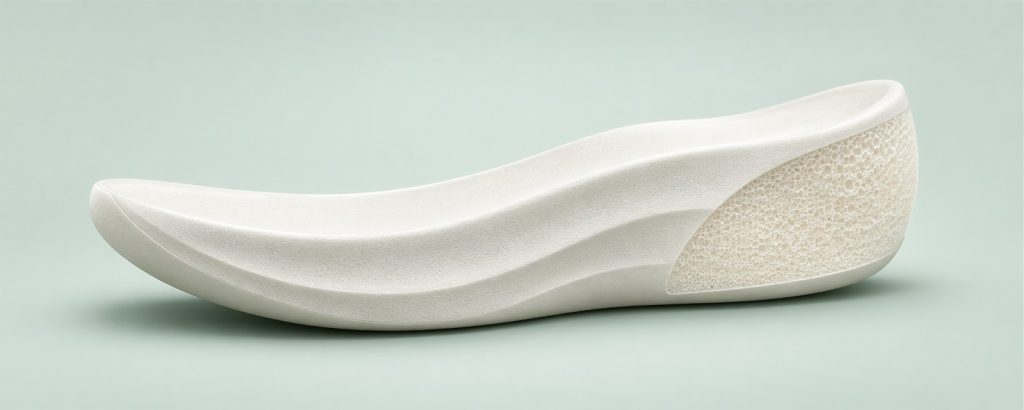
Supercritical foam is a polymer foam made using a physical blowing agent, commonly nitrogen or carbon dioxide, introduced under supercritical conditions. In footwear, it is used in cushioning components such as midsoles and insoles. The term describes how the foam is produced; the base polymer still needs to be specified.
What Does “Supercritical” Mean in Foam?
A substance becomes a supercritical fluid when its temperature exceeds its critical temperature and its pressure exceeds its critical pressure. It forms a single fluid phase rather than separate liquid and gas phases. It can have properties associated with both, but it is not a mixture of liquid and gas.
For foaming, the useful part is that the fluid can enter the polymer under controlled conditions. Changes in those conditions then allow a cellular structure to form.
This makes “supercritical” a process-related description. EVA, TPU, and PEBA identify material families. A foam can be EVA and supercritically foamed at the same time.
How Supercritical Foaming Works
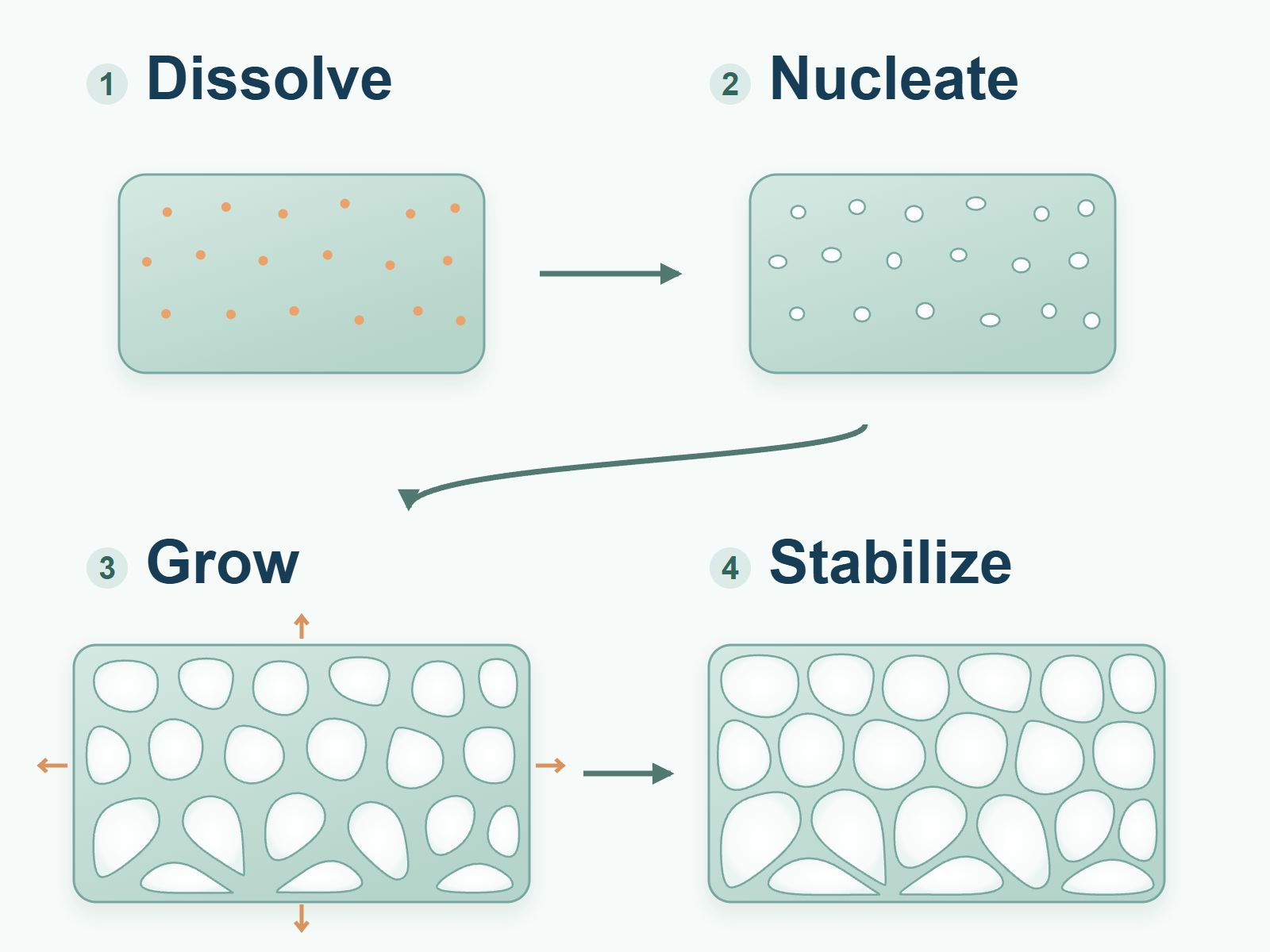
The equipment and sequence vary, but you can understand the process through four stages:
Introduce the blowing agent. Nitrogen or CO₂ enters and dissolves in the polymer under controlled pressure and temperature.
Initiate cells. A change in conditions, commonly a pressure drop, makes the dissolved gas form small bubble nuclei within the material.
Grow the cells. Gas moves into these nuclei, expanding the bubbles and the polymer around them.
Stabilize the structure. The material must retain the growing cells without excessive collapse. Cooling and the polymer’s structure help establish the finished foam.
The same basic stages can be achieved through different production routes:
Route | How it works |
|---|---|
Batch foaming of a preform | A prepared polymer shape takes up gas in a pressure vessel before foaming is triggered. Published EVA research uses pre-crosslinked preforms in this way. |
Foam injection molding | Supercritical fluid is mixed into molten thermoplastic material. As the mixture enters a lower-pressure mold cavity, cells form and grow within the molded part. |
Extrusion is another route used in polymer foaming. The appropriate route depends on the material and component; “supercritical” alone does not specify the machine or the full forming sequence.
Physical foaming also does not mean the entire manufacturing process is free of chemical reactions. Some EVA formulations are crosslinked before gas foaming. Crosslinking helps establish a polymer network, while the physical blowing agent supplies the gas that forms the cells.
How EVA, TPU, and PEBA Fit Into the Process
When you compare foam specifications, keep the material family alongside the process description:
EVA: Supercritical foaming can be used with EVA formulations, including crosslinked systems. The formulation and crosslinking conditions still matter.
TPU: Thermoplastic polyurethane can be physically foamed for midsoles, including through routes that mix supercritical fluid into the melt before molding.
PEBA: Polyether block amide is another polymer family used in supercritical foam research and footwear applications. It has its own formulation and processing considerations.
That is why “supercritical foam vs. EVA” needs clarification. You might be comparing chemically foamed EVA with supercritically foamed EVA, or comparing two different polymers. Ask which materials and formulations the comparison actually involves before drawing conclusions about cushioning, durability, or cost.
Where Supercritical Foam Is Used in Footwear
Running-shoe midsoles are one application, including designs made with supercritically foamed EVA. The foam forms part of the cushioning system between your foot and the ground. Cushioning depends on both the foam’s properties and the midsole’s thickness, shape, and surrounding structure.
Insoles and sockliners are another application, with commercial examples using supercritical foam in the layer beneath the foot. Their role and thickness differ from those of a full midsole.
Keep these uses separate from outsole performance. A cushioning foam’s label does not establish how the shoe grips a surface. The outsole material, tread, and finished construction require their own evaluation.
What the Process Can Change—and What to Check
Supercritical foaming offers a way to adjust cell structure and foam density, creating opportunities for lighter cushioning components. Research on specific EVA formulations has also shown differences in cell size and uniformity compared with chemically foamed samples. The study compared different formulations as well as different foaming routes.
Those results do not establish a universal performance upgrade. Formulations, processing conditions, and component geometry all affect the outcome. Lower density is not the same measurement as softness or energy return, and an initial rebound result does not establish long-term durability.
Before approving a midsole sample, ask for information you can compare:
Material and process: Confirm the polymer family, relevant formulation or grade information, and how the component was foamed and formed.
Comparable measurements: Check the test method, specimen dimensions, and conditioning behind density, hardness, or rebound values.
Behavior over use: Consider compression recovery, performance after repeated loading, and dimensional stability where relevant to the project.
Performance in the shoe: Evaluate the material in the intended construction, including fit and how it works with adjacent components.
You do not need the same test package for every project. Agree on the properties that matter for the intended use, then compare samples under consistent conditions. This is more informative than choosing a foam solely because its specification includes “supercritical.”
FAQ
Does “Nitrogen-Infused” Always Mean Supercritical Foam?
“Nitrogen-infused” identifies the gas, but the term alone does not confirm that it was used under supercritical conditions. Ask the supplier to confirm the foaming route and base polymer before using the terms interchangeably in your specifications.
Is Supercritical Foam Recyclable?
Some material systems can be recycled, but the foaming label does not determine that on its own. The polymer, crosslinking or blends, and the way the component is combined with other materials all matter. You also need an available collection and reprocessing route. A material that can technically be recycled does not automatically make a glued, multi-material shoe recyclable in practice.
Conclusion
For your footwear project, assess supercritical foam alongside the base polymer, component design, and sample results. Start by defining the shoe’s intended use and cushioning requirements. Then bring the material details, foaming route, and comparable sample data into the development discussion. Together, these give you a practical basis for assessing whether a proposed foam and construction suit the shoe you plan to make.